

Faceless YouTube Channel Ideas 2026: 20 Profitable Niches That Work
A faceless YouTube channel creates content without showing the creator on camera, using voiceovers, screen recordings, stock footage, or animations to deliver value while maintaining anonymity and enabling scalable content production.
The opportunity has never been bigger. YouTube Shorts now generates 200 billion daily views as of June 2025, according to CEO Neal Mohan's announcement at Cannes Lions. Faceless channels like Kurzgesagt (23M subscribers), Daily Dose of Internet (20M subscribers), and Mr. Nightmare (6M subscribers) prove you don't need to show your face to build a media empire.
Here's the reality: YouTube's July 2025 "inauthentic content" policy update changed the game. Mass-produced, templated videos are out. Original, value-driven faceless content is in.
This comprehensive guide, part of our complete faceless YouTube channel blueprint, breaks down exactly which niches work, what they pay, and how to build a compliant channel that actually makes money in 2026.
Table of Contents
- Why faceless channels still dominate in 2026
- Understanding YouTube monetization and RPM tiers
- High RPM niches that pay the most
- Medium RPM niches with growth potential
- Entertainment and volume-based niches
- How to launch your faceless channel in 8 steps
- 2026-specific opportunities you can't ignore
- Conclusion: Your path forward
Why faceless channels still dominate in 2026 {#why-faceless-channels-dominate}
The creator economy keeps evolving, but faceless channels have carved out a permanent place. There's a reason 70% of all YouTube channels now upload Shorts according to YouTube's July 2025 data, and many of those are faceless operations.
The scalability advantage nobody talks about
Traditional creator-led channels hit a ceiling: you can only film so many hours per day. Faceless channels don't have this problem.
5-Minute Crafts, the 23rd most-subscribed channel on YouTube with 81 million subscribers, uploads multiple videos daily using their hands-only, top-down format. They've generated over 28 billion views and an estimated $38 million annually.
The economics are simple. When your face isn't the product, you can systematize production. You can hire editors, scriptwriters, and voiceover artists without disrupting your brand.
The policy shift that changed everything
YouTube renamed its "repetitious content" policy to "inauthentic content" on July 15, 2025, according to YouTube's official monetization policies. This wasn't a minor tweak, it was a shift targeting what the industry calls "AI slop."
Content that's now at risk includes:
- Image slideshows with minimal commentary
- Readings of materials you didn't create
- Videos produced using templates repeated at scale
- Mass-produced content without human creative input
What's still allowed? AI as a tool in the creative process (not the entire process), reaction videos with genuine commentary, and compilations with original analysis.
The key distinction: human creative input must be evident.
YouTube's Creator Liaison Rene Ritchie clarified in the July 2025 update announcement: "It's just clarifying what we mean by inauthentic and repetitive content."
Understanding YouTube monetization and RPM tiers {#youtube-monetization-rpm}
Before diving into niches, you need to understand how the money actually works.
RPM (Revenue Per Mille) represents what you earn per 1,000 views after YouTube takes its 45% cut. CPM (Cost Per Mille) is what advertisers pay before that split.
2025 RPM benchmarks by content category
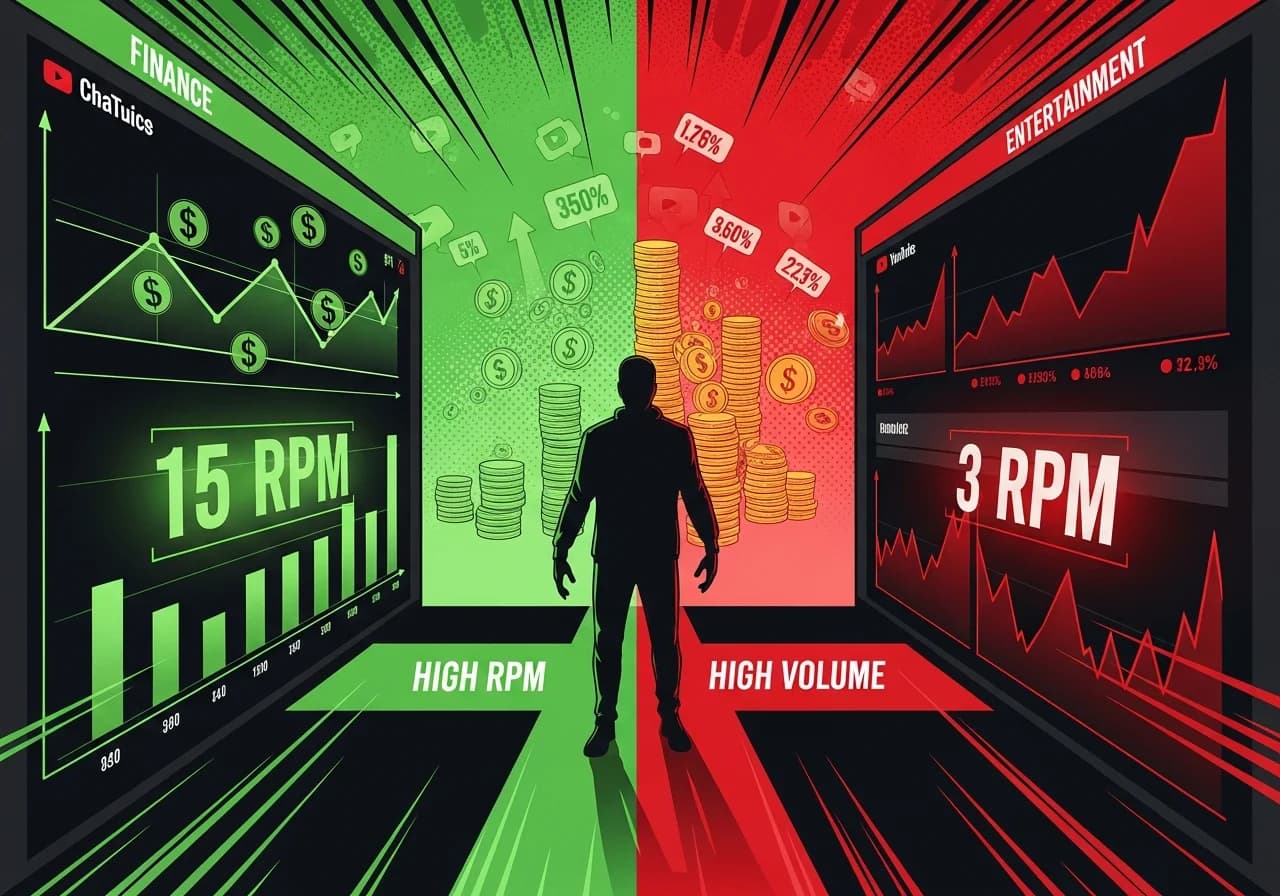
The difference between niches is staggering. Finance channels can earn $12-22 CPM while gaming entertainment might see $2-8 CPM.
This data comes from Telepromptero's 2025 analysis of 2.8 million views across multiple channels, corroborated by OutlierKit and LenosTube.
| Content Category | Typical RPM | CPM Range | Advertiser Demand |
|---|---|---|---|
| Personal Finance/Investing | $10-15 | $15-22 | Extremely High |
| Legal Explainers | $9-12 | $12-18 | High |
| B2B SaaS/Tech | $9-14 | $12-18 | High |
| Real Estate | $8-12 | $10-16 | High |
| Career/Education | $8-14 | $10-25 | High |
| True Crime | $7-8 | $9-15 | Medium-High |
| Health/Fitness | $7-11 | $7-20 | Medium-High |
| Animated Horror | $8-13 | $13-20 | Medium |
| History Docs | $6-9 | $9-13 | Medium |
| Home Improvement | $5-7 | $6-11 | Medium |
Why these numbers matter for your strategy
Senior marketing manager Cliff Sizemore from LocaliQ explains the trend in Google Ads 2025 benchmarks: "Costs are rising, but so is performance. 65% of industries saw better conversion rates in 2025. The main takeaway here is that a smart strategy beats cheap clicks."
The highest-paying advertisers (financial services, software companies, legal firms) need to reach decision-makers. They'll pay premium rates to appear on content those audiences watch.
This is why a finance channel earning 100,000 monthly views can outpace an entertainment channel with 1 million views.
High RPM niches that pay the most {#high-rpm-niches}
These categories command $8+ RPM because advertisers in these industries have high customer lifetime values and will pay accordingly.
1. Personal finance and investing education
RPM Range: $10-15 | Competition: High | Format: Voiceover + charts/animations
This remains YouTube's most lucrative faceless niche. Economics Explained has built 2.66 million subscribers with animated content explaining complex financial concepts, one video on MIT's society collapse prediction hit 14 million views.
The Swedish Investor proves quality beats quantity here. With roughly 1 million subscribers, they post fewer videos but focus on deeply researched investment concepts with polished visual aids.
Content volume requirement: 1-2 videos weekly minimum, with emphasis on production value.
Policy compliance: Financial content faces extra scrutiny. Avoid "get rich quick" framing and include appropriate disclaimers.
For creators wanting to scale production efficiently, platforms like Virvid now offer AI-powered workflows that maintain the polish financial audiences expect while reducing production time.
2. Tech tutorials and software walkthroughs
RPM Range: $7.60-12 | Competition: Medium-High | Format: Screen recording + voiceover
Fireship dominates this space with 3.44 million subscribers and a distinctive fast-paced style. Creator Jeff Delaney never shows his face, just code, animations, and his voice. His "100 Seconds of Code" series proves you can explain complex programming concepts quickly and entertainingly.
freeCodeCamp takes the opposite approach: 4.5 million subscribers watching tutorials that sometimes run 3-12 hours. Both work because they deliver genuine value.
The screen recording format keeps production costs minimal. You need:
- A quality microphone
- Screen capture software like OBS (free)
- Expertise in your subject
3. B2B SaaS and business tools
RPM Range: $9-14 | Competition: Low-Medium | Format: Screen recording + case studies
This niche is underserved. Decision-makers actively search YouTube before purchasing enterprise software, and they prefer content under 2 minutes that's actionable and direct.
MagnatesMedia has carved out a documentary-style approach covering business and technology stories, earning millions of views per video through deep research and engaging storytelling.
The opportunity here: nobody's doing comprehensive, honest software comparisons for specific use cases.
Growth timeline: Expect 6-12 months to build authority, but sponsorship rates here can hit $5,000+ per video once you have 50K subscribers.
4. Home improvement and energy efficiency
RPM Range: $5-7 | Competition: Medium | Format: Voiceover + demonstration footage
This niche has a unique 2026 opportunity we'll cover later, but the fundamentals are strong.
DIY Garden Ideas has grown to 2.97 million subscribers with gardening tips and hacks. The hands-only format pioneered by 5-Minute Crafts works well here.
Advertiser demand comes from:
- Home services companies
- Tool manufacturers
- Energy efficiency product brands
Content volume: 2-3 videos weekly for consistent growth.
5. Make money online and side hustles
RPM Range: $12-18 | Competition: Very High | Format: Voiceover + screen demonstrations
Everyday Money hit 200K+ subscribers and 9 million views in under 3 years covering work-from-home strategies. The CPM here rivals finance because advertisers include course creators, software companies, and affiliate programs.
Warning: This niche attracts the most scrutiny for "inauthentic content." YouTube specifically targets templated videos promising easy money.
Succeed by sharing genuine case studies, transparent income breakdowns, and actionable tutorials. If you're building an audience in this space, the Virvid affiliate program offers 30% recurring commissions, making it easier to diversify revenue beyond just ad income.
6. Legal procedure explainers
RPM Range: $9-12 | Competition: Low | Format: Animation or presentation style
Family court content shows $9.03 RPM with 8.1x growth potential according to OutlierKit's 2025 analysis.
Audit the Audit has built 2.75 million subscribers analyzing police interactions from a legal perspective, assigning letter grades to encounters.
The opportunity: most legal content on YouTube is dry and inaccessible. Channels that make law understandable, without providing legal advice, fill a genuine gap.
7. Real estate market analysis
RPM Range: $8-12 | Competition: Medium | Format: Data visualization + voiceover
BiggerPockets operates as a media company generating $7 million annually across their platform, with their YouTube channel reaching 1.3 million subscribers. Content focuses on wealth building through real estate without get-rich-quick tactics.
The hyperlocal angle works particularly well here. Neighborhood-specific guides, local market updates, and city investment analyses have:
- Lower competition
- Attract local advertiser spend
- Build authority in specific markets
Medium RPM niches with growth potential {#medium-rpm-niches}
These categories earn $4-8 RPM but often have lower competition and clearer paths to scale.
8. Health and wellness education
RPM Range: $7-11 | Competition: Medium | Format: Animation or presentation
Improvement Pill reached 3.72 million subscribers covering communication skills, habit formation, and wellness topics through animation.
The senior health micro-niche shows $6.17 RPM with 19x growth, it's one of the most underserved audiences on the platform.
Content gaps worth exploring:
- Mental health coping strategies
- Sleep optimization techniques
- Aging-related health topics
- Preventive wellness for specific age groups
9. Career skills by profession
RPM Range: $8-14 | Competition: Low-Medium | Format: Screen recording + presentation
Educational content earns $10-25 CPM because employers and training platforms advertise heavily. English learning podcasts show $11.88 RPM per LenosTube data.
The angle that works: specific career paths rather than generic advice.
"How to become a UX designer in 2026" outperforms "Career tips for success."
10. Crime psychology documentaries
RPM Range: $7-8 | Competition: Medium | Format: Documentary with archival footage
JCS – Criminal Psychology built 5.5 million subscribers with a unique angle: analyzing the psychology behind criminal interrogations.
Inspector Ray earned 64 million views with just 30 videos by focusing on intriguing scripts and curious titles.
Production note: This format requires careful research and access to publicly available footage. Avoid sensationalism, analytical angles perform better long-term.
11. History and documentary content
RPM Range: $6-9 | Competition: Medium | Format: Animation or archival footage compilation
OverSimplified has 8 million+ subscribers making complex historical events accessible through humor and animation.
Epic History TV reached 2 million subscribers with fact-filled videos blending storytelling and accuracy, their Alexander the Great series hit 22 million views.
Timeline – World History Documentaries represents the aggregation model: 5.23 million subscribers posting 3-4 videos weekly using licensed content from BBC, Channel 4, and PBS.
12. AI productivity and tools
RPM Range: $8-15 | Competition: Growing | Format: Screen recording
This niche barely existed two years ago. Now it's one of the fastest-growing categories. AI tools tutorials earn $7-30 RPM depending on specificity.
The key: focus on practical applications, not just tool reviews.
Example content: "How I automated my invoicing with Claude" beats "Claude AI review."
13. Meditation and sleep content
RPM Range: $4-7 | Competition: Medium | Format: Audio-focused with minimal visuals
Lofi Girl earns $20,000-$45,000 monthly with 14 million subscribers through 24/7 livestreams.
Soothing Pod – Sleep Meditation generates approximately $4,000 monthly with just 50,000 subscribers, proof that smaller channels can monetize well in this space.
Revenue diversification matters here: merchandise, music licensing, and brand partnerships often exceed ad revenue.
Entertainment and volume-based niches {#entertainment-volume-niches}
These categories have lower RPMs but can scale with consistent output.
14. Scary stories and horror narration
RPM Range: $8-13 | Competition: High | Format: Voiceover with atmospheric visuals
Mr. Nightmare has accumulated 1.6 billion+ total views across 6+ million subscribers with a simple formula: calm narration, atmospheric music, and allegedly true scary stories.
Corpse Husband built 7.5 million subscribers narrating horror stories before pivoting to other content. Lazy Masquerade proves accents help: his English narration of true stories and urban legends has earned 1.7 million subscribers.
Success factor: Voice quality matters enormously. A distinctive, engaging vocal style becomes your brand.
For creators who want professional narration without recording themselves, tools like Virvid offer high-quality AI voices optimized specifically for horror and storytelling formats. You can also try their free scary story video script generator to get started with compelling narratives.
15. True crime documentary style
RPM Range: $7-8 | Competition: High | Format: Documentary with bodycam/archival footage
Law&Crime Network has built a mini-empire with 5.78 million subscribers and over 3 billion views. Their bodycam videos average 1.25 million views each, with one hitting 49.7 million.
EWU Crime Storytime and Coffeehouse Crime (2.2 million subscribers) prove the format scales: long-form documentary style with voiceover narration over real photos and footage.
If you're exploring this niche, check out the free true crime video script generator to streamline your scriptwriting process.
16. Curated compilation content
RPM Range: $3-6 | Competition: Very High | Format: Edited clips with light commentary
Daily Dose of Internet earns an estimated $140,000-$400,000 monthly with 20 million subscribers. The model: curate interesting clips, add light commentary, maintain consistent quality.
Policy warning: This format faces the highest risk from "inauthentic content" policies. Success requires genuine curation skill and original commentary, not just re-uploading viral clips.
17. Animated educational facts
RPM Range: $5-10 | Competition: Medium | Format: Custom animation
The Infographics Show generates $100,000-$300,000 monthly with 14 million subscribers covering everything from conspiracy theories to historical events. Their distinctive animation style has become instantly recognizable.
Kurzgesagt sets the gold standard: 23.3 million subscribers with animations so polished each video takes months to produce.
18. Gaming analysis and highlights
RPM Range: $2-5 | Competition: Very High | Format: Screen capture + commentary
Lower CPMs but massive audience. Success requires differentiation, analytical content about game design, strategy guides, or unique editing styles outperform generic gameplay.
19. Motivational and self-improvement
RPM Range: $4-8 | Competition: High | Format: Presentation or animation
"Escaping Ordinary" gained 14 million views with animated book summaries. The key: transform complex self-improvement concepts into actionable, visual content.
20. Study and focus content
RPM Range: $3-5 | Competition: Medium | Format: Background visuals + audio
Simple format, loyal audience. Study music compilations and focus environments serve students and remote workers who play content for hours, excellent for total watch time even with lower RPM.
How to launch your faceless channel in 8 steps {#launch-faceless-channel}
Step 1: Validate your niche using YouTube Studio's research tools
YouTube Studio's "Content Gaps" feature identifies topics where viewers search but can't find quality results. Access it through Analytics → Research → "Content Gaps Only" filter.
This feature expanded to desktop in January 2024 and remains underutilized.
The "Breakout Videos" feature, announced September 2024, highlights videos from similar channels that performed well, giving you proven content ideas before you invest production time.
Step 2: Choose your format based on niche and skills
Match your format to your content type:
- Screen recording: Tech tutorials, software reviews, AI tools
- Voiceover + stock footage: Finance, true crime, documentaries
- Animation: Educational content, complex explanations
- Hands-only POV: DIY, crafts, cooking
- Presentation style: Business, career, educational lists
Each has different cost structures. Screen recording can cost nothing beyond a microphone. Animation might run $500-$5,000 per video if outsourced, or $20-50/month for DIY tools like Vyond or Doodly.
For a more comprehensive comparison of production approaches, see our guide on faceless vs face camera YouTube channels.
Step 3: Set up your production pipeline
Voice options:
- Record yourself: Best for personality-driven content
- AI voiceover: ElevenLabs ($11/month Creator plan) has become the industry standard. One creator reported reaching 6,000 subscribers and 8 million views in 3 months spending only $11 total on voice generation
Stock footage sources:
- Storyblocks: $15-30/month unlimited
- Envato Elements: $16.50/month (includes music and graphics)
- Pexels/Pixabay: Free but limited
Editing software:
- Free: DaVinci Resolve, CapCut
- Budget: Filmora ($80/year)
- Professional: Adobe Premiere Pro ($22/month)
Total minimum viable budget: Under $100/month. Fully outsourced: $400-800/month at 2 videos weekly.
Step 4: Establish your content calendar and publishing rhythm
VidIQ's analysis of 5 million+ channels found that posting 12+ times per month leads to 53% more views and 66% more subscribers.
But consistency matters more than frequency, YouTube's own analysis found no correlation between short breaks and viewership drops.
Start with 1 quality video weekly. Scale to 2-3 weekly once you've refined your process.
For Shorts, 1-3 per day is optimal; average creators post 220-300 Shorts before reaching 1 million subscribers.
Learn more about scaling in our article on YouTube automation for faceless channels.
Step 5: Create policy-compliant content from day one
Avoid these red flags under the July 2025 policy update:
- Templated videos repeated at scale
- Image slideshows with minimal commentary
- Readings of materials you didn't create
- Robotic text-to-speech with no personality
Include these elements to demonstrate authenticity:
- Original analysis or commentary
- Thoughtful editing beyond basic automation
- Unique insights viewers can't find elsewhere
- Evidence of human creative input
For detailed guidance, see our faceless YouTube channel copyright and fair use guide.
Step 6: Optimize for discovery with proper SEO
Use TubeBuddy or VidIQ for keyword research. Target keywords with 5,000+ monthly searches and low competition.
Include your primary keyword in:
- Title
- Description (first 200 characters)
- Tags
Thumbnail click-through rate matters enormously, aim for 6%+ CTR. Strong hooks in the first 10 seconds determine whether viewers stay.
Channels with 60%+ average view duration typically grow 2-3x faster.
Step 7: Build your Shorts-to-long-form funnel
YouTube Shorts now have higher engagement rates (5.91%) than TikTok (5.75%) or Instagram Reels (5.53%) according to Social Insider's Q1 2024 data.
But Shorts monetization remains low: $0.01-$0.07 per 1,000 views compared to $1-30 for long-form.
The strategy: use Shorts for discovery, convert viewers to long-form for revenue.
Channels combining Shorts with long-form grow 41% faster. MacDannyGun gained 670,000 subscribers through this funnel approach.
Step 8: Diversify revenue beyond ads
Top faceless creators stack multiple income streams:
- Affiliate marketing: Finance and tech niches earn 30-50% of total revenue from affiliates
- Sponsorships: 100K-subscriber channels can charge $1,000-$5,000 per sponsored video
- Digital products: Guides, templates, courses
- Memberships: YouTube memberships or Patreon
As the 1of10 Creator Guide notes: "The creators who win don't rely only on ad revenue. They stack memberships, sponsorships, affiliates, and their own products to build multiple income streams."
Explore more revenue strategies in our guide on how to monetize faceless YouTube channels.
2026-specific opportunities you can't ignore {#2026-opportunities}
The energy rebate content goldmine
Here's a time-sensitive opportunity most creators haven't discovered: IRS Form 5695 and state energy rebate explainers.
The Inflation Reduction Act funded $8.8 billion in home energy rebates through two programs:
Home Electrification and Appliance Rebates (HEAR):
- Up to $8,000 for heat pumps
- Up to $4,000 for electrical panels
- $14,000 maximum per household
Home Efficiency Rebates (HER):
- Up to $16,000 per dwelling for whole-home upgrades
Many state programs just launched in late 2025 (Arizona, California, New York, Michigan, Georgia) with more rolling out in early 2026 (Tennessee Q2, Colorado multifamily February 2026).
Critical deadline: Many IRA energy tax credits expire December 31, 2025 due to the "One Big Beautiful Bill Act" signed July 4, 2025. This creates urgent demand for explainer content right now.
Hyperlocal content with national reach
Hyperlocal YouTube content outperforms in 2026 because Google now surfaces YouTube videos in local search results.
Real estate agent Kyle Talbot generated 35 transactions and built a $20 million business from hyperlocal social content alone.
High-performing hyperlocal formats:
- Neighborhood real estate guides by city
- State-specific tax filing tutorials
- Local market economic updates
- Regional legal requirement explainers
You can create 50+ hyperlocal videos using the same template but customizing data for different cities or states, building a content library with compounding search value.
The senior content gap
Senior-focused content represents the fastest-growing underserved audience on YouTube. The data shows $6.17 RPM with 19x growth potential, and almost nobody is creating for this demographic at scale.
Topics that work:
- Technology tutorials for seniors
- Health content for aging audiences
- Financial planning for retirement
- Medicare and benefits navigation
The audience is loyal, engaged, and advertisers pay premium rates to reach them.
AI-powered production at scale
Tools like Virvid and similar AI shorts platforms have made faceless content production dramatically more efficient.
According to industry reports, over 70% of educational and tutorial faceless channels now use AI voices as their primary narration. The quality gap between AI and human voiceover has nearly closed for many content types.
The winning approach isn't replacing creativity with AI, it's using AI to handle production mechanics while you focus on research, scripting, and strategy.
For creators choosing between platforms, see our comparison of Virvid vs InVideo AI or explore alternatives to VidAI.
What realistic growth looks like
Let's set honest expectations. Industry data shows the average channel takes 15.5 months to reach monetization. That includes 1,000 subscribers and 4,000 watch hours (or 10 million Shorts views in 90 days).
| Milestone | Typical Timeline | What It Takes |
|---|---|---|
| First 1,000 subscribers | 6-24 months | Consistent weekly uploads, niche focus |
| Monetization eligible | 6-18 months | 15-30+ videos, audience retention focus |
| 10,000 subscribers | 1-3 years | 2-3 videos weekly, community building |
| 100,000 subscribers | 2-5 years | Production scaling, diversified content |
Some channels beat these timelines dramatically. One faceless finance channel reached 261K subscribers in 5 months with just 20 videos. Another using only ElevenLabs voiceover hit 6K subscribers and 8 million views in 3 months.
The difference? Niche selection, content quality, and timing. Nobody can guarantee virality, but you can stack the odds through systematic optimization.
Conclusion: Your path forward {#conclusion}
The faceless YouTube opportunity in 2026 isn't about gaming algorithms or producing content at scale without regard for quality. It's about finding the intersection of your expertise, audience demand, and advertiser value.
The niches paying $10+ RPM (finance, legal, B2B tech, real estate) require genuine expertise and careful compliance with YouTube's authenticity standards. They also reward quality over quantity.
The volume-based entertainment niches can still work, but they demand either distinctive creative voice (Mr. Nightmare's narration style) or exceptional curation skills (Daily Dose of Internet's edit quality). The middle ground of templated, AI-generated content faces an increasingly hostile policy environment.
The 2026-specific opportunities (energy rebate explainers, hyperlocal content, senior-focused channels) represent genuine gaps where first movers have advantages.
Pick your niche based on realistic self-assessment:
- What do you actually know well enough to explain?
- What audience can you serve better than existing channels?
- Where does advertiser demand align with your interests?
Then execute consistently for 12-18 months before expecting meaningful results. The channels earning six figures monthly didn't get there overnight, they built systematically, adapted to platform changes, and kept creating when early results disappointed.
The faceless model works. The question is whether you'll do the work to make it work for you.
Ready to start creating? Try the free AI video script generator to brainstorm your first video ideas, or explore our guide to starting a faceless YouTube channel in 2026 for the complete roadmap.