
AI Video Ads That Convert in 2026: Complete Guide (12 Templates + ROI Playbook for Meta/TikTok/YouTube)
AI-generated video ads have crossed from experimental curiosity to mainstream marketing strategy, and the numbers prove it works.
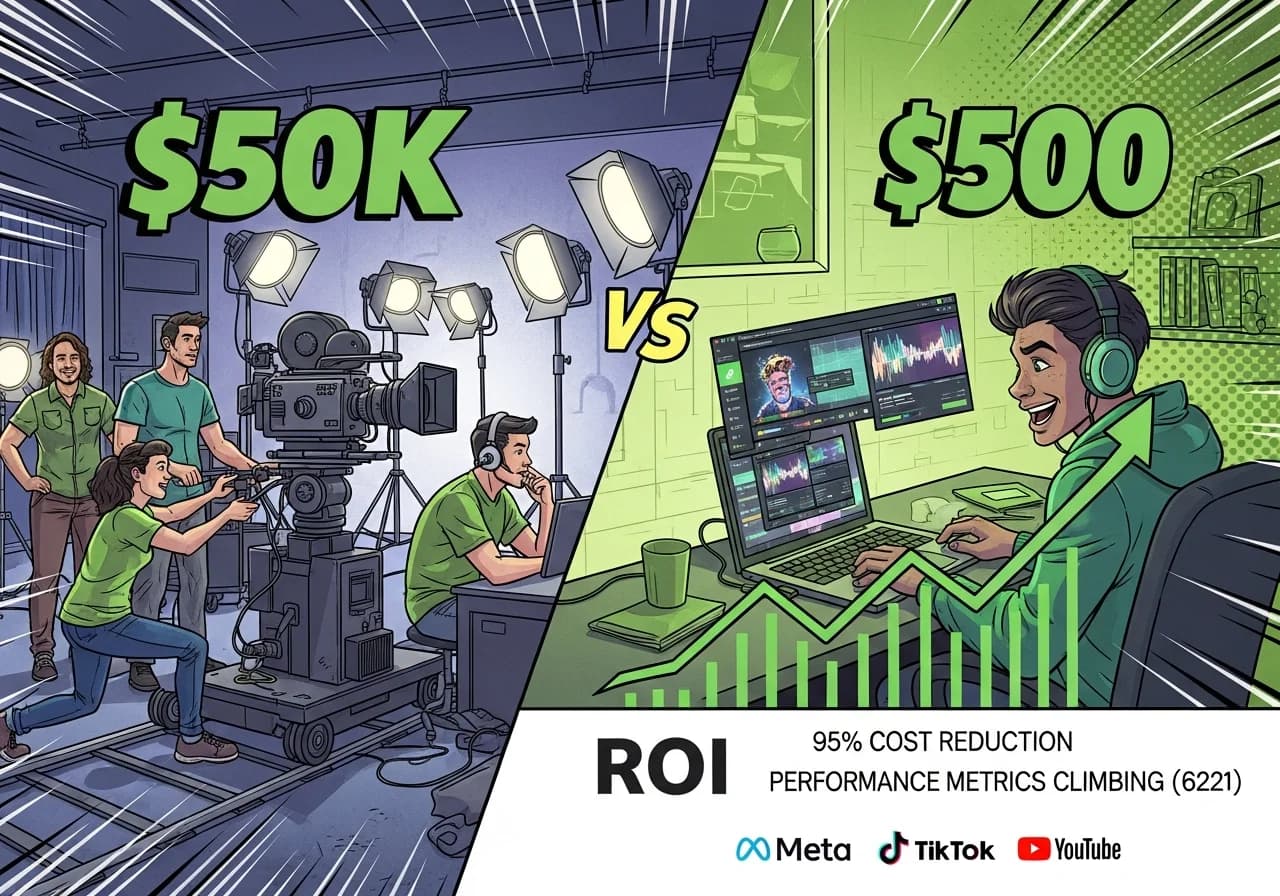
Traditional 30-second commercials cost $10,000–$50,000 in production alone, while AI tools like Virvid now create comparable content for $100–$1,000, a 95%+ cost reduction.
The brands winning with AI video aren't just cutting costs. They're deploying it strategically within a framework that prioritizes authenticity and platform-native creative.
This guide delivers that complete framework with verified 2025–2026 data on what's actually working, platform-specific specifications and strategies, tool comparisons with current pricing, twelve battle-tested script templates, and the compliance requirements that became law in December 2025.
Table of Contents
- Part 1: The AI Video Ads ROI Revolution
- Part 2: Platform-by-Platform Strategy & Specs
- Part 3: AI Tool Selection & Comparison
- Part 4: UGC vs Studio Performance Data
- Part 5: The 12 Copy-Paste Script Templates
- Part 6: Creative Best Practices by Platform
- Part 7: Disclosure Requirements & Compliance
- Part 8: Advanced Testing & Optimization
- Part 9: Production Workflow & Speed-to-Market
- Part 10: Scaling to Six Figures in Ad Spend
Part 1: The AI Video Ads ROI Revolution
The cost equation has fundamentally shifted in 2026.
AI production operates on software economics, and the difference is staggering.
The Kalshi Case Study: $2,000 vs $200,000
Kalshi, the prediction market platform, needed an NBA Finals ad in June 2025. Rather than accept agency quotes in the hundreds of thousands, they hired solo AI filmmaker PJ Accetturo.
Using Google Veo 3, Gemini, and ChatGPT, Accetturo produced a broadcast-quality commercial in two days for $2,000. The result:
- 3+ million X views
- 20+ million total impressions
- Earned media coverage that amplified the message further
The traditional route would have cost $200,000+ and taken 6–8 weeks. The AI approach delivered comparable (arguably better) results at 1% of the cost in 2 days.
For more detailed cost comparisons and ROI calculations, see our full breakdown in AI Video Ads vs Traditional Video Ads: Cost, Performance & ROI 2026.
Verified Case Studies with Specific Numbers
Klarna's $10 Million Annual Savings
- $6 million saved on AI-generated imagery (Midjourney, DALL-E, Firefly)
- $4 million from reducing external agency costs by 25%
- Image development cycles: 6 weeks → 7 days
- By Q1 2024: 87% of Klarna employees used generative AI daily
Mondelēz's 30–50% Cost Reduction
Mondelēz committed $40 million to an AI creative platform built with Publicis Groupe and Accenture, targeting 30–50% reduction in marketing content production costs.
Their executive team noted: "The cost to do animations is in the hundreds of thousands—this type of setup is orders of magnitude smaller."
AI-generated content for Chips Ahoy (US) and Milka (Germany) is already running on social media, with TV campaigns planned for 2025–2026.
Headway's 40% ROI Improvement
Headway, the Ukrainian edtech startupwith 50 million users, achieved a 40% improvement in video ad ROI during H1 2024 using HeyGen, Midjourney, and D-ID for AI avatar production.
Their AI+UGC hybrid campaigns demonstrated 60% higher engagement than traditional ads.
Platform Performance Data from Nielsen and Meta
[Nielsen's 2025 Marketing Mix Modeling study analyzing 50,000+ brand campaigns across food, beverage, retail, apparel, telecom, and automotive—produced definitive benchmarks:
| AI Solution | Performance vs Manual |
|---|---|
| YouTube AI video campaigns | +17% ROAS |
| Video Reach + Video View combined | +23% sales effectiveness |
| Demand Gen + Search + Performance Max | +10% ROAS, +12% sales effectiveness |
Meta's internal studies show Advantage+ Shopping campaigns deliver 32% lower CPA and 17% higher ROAS compared to manual campaign setups.
ROI Calculator: Traditional vs AI Production
For an e-commerce brand spending $50,000 monthly on paid media:
| Cost Category | Traditional Approach | AI-First Approach |
|---|---|---|
| Initial creative production | $15,000 (4 videos) | $1,500 (15 videos) |
| Monthly refresh costs | $5,000 (1-2 new creatives) | $500 (5-10 variants) |
| Production timeline | 3-4 weeks | 2-3 days |
| Creative tests per month | 2-4 | 20-40 |
| Annual production costs | $75,000 | $7,500 |
| Savings | — | $67,500/year |
The AI approach enables 10x more creative testing at 10% of the cost. This means brands find winning messages faster while reallocating production savings to media spend.
Tools like Virvid make this accessible even for smaller brands, offering trending video formats and one-click generation that previously required expensive freelancers or agencies.
Part 2: Platform-by-Platform Strategy & Specs
Each platform has evolved distinct creative environments with specific technical requirements and algorithmic preferences.
Success requires platform-native execution, not repurposed content. Let's break down exactly what works on each major platform in 2026.
Meta (Facebook and Instagram) Specifications
Reels Ads Technical Requirements:
- Aspect ratio: 9:16 (vertical full-screen); 4:5 also supported for Feed
- Resolution: 1080×1920 pixels minimum; 1440×2560 recommended
- Video length: 1 second to 2 minutes (full display up to 90 seconds)
- File format: MP4, MOV, or GIF
- File size: Maximum 4GB
- Safe zones: Keep top 14%, bottom 35%, and 6% on each side clear of text and logos
Advantage+ Creative Features
Meta's AI-powered creative optimization now includes:
- Automatic asset customization across Stories, Reels, and Feed
- Dynamic product catalog integration with Shopify, WooCommerce, BigCommerce
- AI-powered text variations
- Image-to-video generation (rolling out late 2025)
Creative Best Practices for Meta
Key tactics:
- Hook in first 3 seconds: Don't build to the hook—start with it
- Sound-off captions required: ~80% of Reels plays occur with sound off
- Mobile-first design: 4:5 ratio maximizes mobile screen real estate
- Safe zone compliance: Text/CTAs outside safe zones get cut off
For platform-specific deep dives, see Meta AI Video Ads Guide 2026: Facebook & Instagram Formats.
YouTube Specifications and ABCD Framework
Shorts vs In-Stream Comparison:
| Specification | YouTube Shorts | In-Stream (Skippable) | Bumper Ads |
|---|---|---|---|
| Aspect ratio | 9:16 (vertical) | 16:9 (horizontal) | Any |
| Video length | Under 60 seconds | Under 3 minutes recommended | 6 seconds max |
| Skippability | Immediate (swipe) | Skip after 5 seconds | Non-skippable |
| CTA appearance | 3 sec (action) / 10 sec (awareness) | Immediate | Immediate |
The ABCD Framework Google's official creative guidelines
- Attract: Jump in fast with engaging pacing, tight framing, bright high-contrast visuals
- Brand: Show up early and throughout; reinforce with audio brand mentions
- Connect: Humanize with people; leverage humor, surprise, or intrigue
- Direct: Include clear CTA with voiceover reinforcement
Google/Kantar research confirms ABCD-compliant ads achieve 30% lift in short-term sales likelihood and 17% lift in long-term brand contribution.
Vertical Video Performance
Official Google data shows adding vertical creative assets to Video Action campaigns delivers 10–20% more conversions per dollar on YouTube Shorts compared to landscape-only campaigns.
For complete YouTube strategies, check out YouTube AI Video Ads Guide 2026: Shorts & In-Stream Formats.
TikTok Specifications and Creative Codes
Technical Requirements:
- Aspect ratio: 9:16 (vertical only for optimal performance)
- Resolution: 720p minimum; 1080×1920 recommended
- Optimal length: 21–34 seconds for highest completion rates (62% average)
- File size: Maximum 500MB
The 6 Creative Codes:
- Think TikTok-first: Go lo-fi, use vertical format, feature real people
- Connect with trends: Leverage trending hashtags, sounds, formats
- Be production-principled: 720p+ resolution, mind safe zones for UI
- Stick to a structure: Hook → Body → Close with strong CTA
- Hold attention with stimulation: Music, dynamic transitions, text overlays
- Build with sound: 88% of TikTok users say sound is vital
Creator-Led Ad Performance
TikTok internal data (February 2024–January 2025) shows creator-led ads dramatically outperform brand content:
- 70% higher CTR than non-creator ads
- 159% higher engagement at same CPM
- 134% higher completion rate for Spark Ads vs standard In-Feed
Disclosure Requirements
TikTok mandates labeling for AI-generated content containing realistic images, audio, or video. Political AI advertising is completely banned.
As of January 2025, TikTok auto-detects and labels AI content via C2PA Content Credentials and invisible watermarking. Unlabeled AI content receives immediate strikes with no warnings.
Platforms like Virvid help creators stay compliant by offering platform-native formats that follow each platform's creative best practices and disclosure requirements automatically.
Part 3: AI Tool Selection & Comparison
The AI video tool landscape in 2026 spans from platform-native free solutions to enterprise avatar platforms.
Selection depends on content type, production volume, and platform distribution strategy. Here's what actually works.
Third-Party Tools Comparison (December 2025 Pricing)
| Tool | Starting Price | Avatars | Languages | Best Use Case |
|---|---|---|---|---|
| Virvid | $19/mo | Trending styles | Multiple | TikTok/Reels/Shorts viral content at scale |
| HeyGen | $24/mo (annual) | 500+ | 30+ | Short-form explainers, product videos |
| Synthesia | $18/mo (annual) | 70–230+ | 120+ | Corporate training, enterprise comms |
| Runway ML | $12/mo | N/A (generative) | N/A | Cinematic content, creative videos |
| Pika | $8/mo | N/A (generative) | N/A | Social content, animations |
| Creatify | $33/mo (annual) | 1,250+ | 29 | UGC-style e-commerce ads |
| InVideo AI | $25/mo | Express avatars | 30+ | YouTube marketing, educational |
| Arcads | $99/mo | 300+ | Multiple | Performance UGC at scale |
| CapCut | Free–$9.99/mo | N/A | N/A | TikTok editing, quick production |
Virvid offers the fastest path from concept to viral-ready content with built-in trending formats for TikTok, Reels, and YouTube Shorts. At $19/month for 30 videos, it's specifically designed for creators and brands prioritizing speed and platform optimization over custom avatar development.
HeyGen offers the strongest balance of avatar quality and pricing for traditional advertising use cases, with 500+ stock avatars and one custom avatar included at the Creator tier ($29/month). Video length extends to 5 minutes on paid plans with 1080p export.
Arcads specializes in UGC-style AI actors with emotion control and voice cloning—ideal for A/B testing at scale. However, the $99/month starting price and no free trial creates a higher barrier to entry.
For detailed tool comparisons, see Virvid vs Arcads AI: Best AI Video Ad Generator for Ecommerce 2026 and Best Alternatives to Higgsfield AI Video Ads 2026.
Runway ML's Gen-4.5 represents the cutting edge of generative video, producing approximately 25 seconds of content per 625 credits ($28/month Pro tier). Best for creative experimentation rather than high-volume ad production.
Platform-Native Free Tools
Four major platforms now offer free AI video generation for advertisers:
Amazon Ads Video Generator
Transforms product images or ASINs into 6 different 15-second videos with multi-scene animation, background music, and high-motion realistic shots.
Available in US, UK, Canada, France, Germany, India, Italy, Mexico, and Spain for Sponsored Brands campaigns. Free for all Amazon sellers.
TikTok Symphony Creative Studio
TikTok's native AI video generator provides:
- AI video generation from text or product URLs
- Stock digital avatars in 30+ languages
- Script generation
- Image-to-video conversion
- Video translation
All Symphony-generated content is automatically labeled as "AI-generated." Free for TikTok For Business users.
Google Ads Asset Studio
Beta as of August 2025, features:
- AI image generation using Imagen 4
- Video creation from images/text using Veo
- Bulk editing
- Voiceover generation
Best for Performance Max, YouTube, and Demand Gen campaigns. Free for Google Ads users.
Meta Advantage+ Creative AI
Includes:
- Video enhancement features
- AI text variations
- Branded asset integration
- AI dubbing for multilingual campaigns
- Image-to-video generation (currently testing, rollout through late 2025)
Free within Meta Ads Manager.
Tool Selection Framework
For e-commerce brands under $10K/month ad spend:
Start with platform-native tools (TikTok Symphony, Amazon Video Generator) plus Virvid for trending social formats or Creatify for UGC-style content.
For performance marketers at $10K–$50K/month:
Combine HeyGen for avatar-based content with Runway for hero creative, using platform tools for variants. Virvid works well for high-volume social content testing.
For enterprise operations above $50K/month:
Synthesia or HeyGen Enterprise for custom avatars, API access, and SSO, plus Arcads for scaled UGC testing.
You can also generate scripts for any platform using our free AI video script generator before moving to production.
Part 4: UGC vs Studio Performance Data
The research is unambiguous in 2026. User-generated content and creator-led advertising dramatically outperform polished studio production across every major metric.
Here's what the data actually shows.
UGC Effectiveness Data (Bazaarvoice 2024–2025)
Bazaarvoice's Shopper Experience Index, surveying 8,000+ global consumers, documents UGC's dominance:
- Visitors to websites with UGC spend 90% more time on site
- Conversions increase by 10% when UGC is included in purchase path
- UGC increases revenue per visitor by 154%
- Shoppers trust UGC in ads (42%) more than brands advertising without UGC (31%)
- 60% of U.S. consumers have made a purchase after watching video-based UGC on social media
- Shoppers are 2.5x more likely to say UGC is more authentic than brand-created content
Consolidated industry research shows UGC-based ads achieve 4x higher CTR than traditional ads with 50% lower cost per click.
Meta Partnership Ads Performance
Meta Partnership Ads data shows creator collaboration delivers:
- 296% performance boost over standard ads
- 10.38x conversion-rate lift (Emplifi data)
- 102% on-site CVR lift when shoppers interact with UGC (PowerReviews analysis of 1.5M product pages)
For detailed UGC performance analysis, see AI UGC Ads vs Studio Ads: Which Converts Better 2026.
The AI Perception Problem
Here's where it gets critical. NielsenIQ's December 2024 neuroscience study using EEG, eye tracking, and implicit response testing—reveals why obvious AI-generated ads fail.
Consumer reactions to AI-generated ads:
- Perceived as more "annoying," "boring," and "confusing"
- Create negative brand halo that dampens perception of both ad and brand
- Even "high quality" AI-generated ads elicit weaker memory activation
- Low-quality AI visuals increase cognitive effort, distracting from message
- "Uncanny valley" effect creates discomfort
Kantar's Media Reactions 2024 report compounds this finding. While 62% of consumers are positive toward GenAI broadly, only 41% say AI-generated ads don't bother them.
The gap between marketer perception (71% unbothered) and consumer perception reveals a dangerous blind spot.
The Strategic Framework for Format Selection
The research points to a clear hierarchy:
Highest performance:
- Creator-led content distributed through creator accounts (Spark Ads, whitelisted content)
Strong performance:
- UGC-style content—whether human-created or AI-generated but stylistically authentic
- AI-generated content that doesn't look "AI" (platforms like Virvid specialize in this)
Moderate performance:
- Polished studio production for brand awareness campaigns
Risky performance:
- Obviously AI-generated content without human creative direction
The winning approach uses AI for ideation, storyboarding, iteration, and production efficiency—not as the final creative output that looks like it came from a robot.
Brands achieving results deploy AI to produce 10x more creative variants, then let platform algorithms identify winners through testing.
Part 5: The 12 Copy-Paste Script Templates
Effective video ad scripts balance platform-specific structure with universal conversion psychology.
The MECLABS conversion heuristic provides the framework. Let's break down the templates that actually convert in 2026.
The MECLABS Formula Applied to Video Ads
C = 4M + 3V + 2(I-F) - 2A
- Motivation (4x weight): Address existing pain points immediately; speak to desires
- Value proposition (3x weight): State unique benefit in hook; differentiate from competitors
- Incentive (2x weight): Time-sensitive offers, exclusive access, bonuses
- Friction (2x, negative): Simplify next steps; single clear CTA
- Anxiety (2x, negative): Social proof, guarantees, risk reversal
For all 12 templates with full breakdowns and generator-specific formatting, see 12 Free AI Video Ad Script Templates That Convert 2026.
Template 1: E-Commerce Product Showcase (15–30 seconds)
HOOK (0–3s): [Close-up of product solving problem] "Still dealing with [pain point]?"
BODY (3–20s):
- Scene 1: Product in action, demonstrating solution
- Scene 2: Before/after or transformation moment
- Scene 3: Social proof element (review quote, number of customers)
CLOSE (20–30s): "[X]% off for the next 24 hours. Tap to shop now."
Performance benchmarks: 30%+ hook rate, 45%+ hold rate
Template 2: App Download (15–25 seconds)
HOOK (0–3s): [Screen recording showing result] "I finally [achieved result] using just this app."
BODY (3–18s):
- Scene 1: The moment of frustration that led to solution
- Scene 2: Key feature demonstration in 3 seconds
- Scene 3: Result achieved ("Now I [outcome]")
CLOSE (18–25s): "Download free. Link in bio."
Performance benchmarks: 25%+ hook rate, 40%+ hold rate
Template 3: Lead Generation / Webinar (25–35 seconds)
HOOK (0–3s): [Authority figure speaking to camera] "The #1 mistake [target audience] make with [topic]..."
BODY (3–25s):
- Scene 1: Establish credibility quickly (title, result, experience)
- Scene 2: Identify the specific problem/mistake
- Scene 3: Tease the solution without fully revealing
- Scene 4: What attendees will learn
CLOSE (25–35s): "Free training this [day]. [X] spots left. Register now."
Performance benchmarks: 20%+ hook rate, 35%+ hold rate
Template 4: B2B SaaS Demo (30–45 seconds)
HOOK (0–3s): [Problem visualization] "[Role] waste [X] hours weekly on [task]."
BODY (3–35s):
- Scene 1: Current painful workflow (2–3 seconds)
- Scene 2: Product dashboard/interface introduction
- Scene 3: Key feature that solves problem #1
- Scene 4: Result metric ("Our customers see [X]% improvement")
- Scene 5: Quick testimonial clip (if available)
CLOSE (35–45s): "Start your free trial. No credit card required."
Performance benchmarks: 22%+ hook rate, 38%+ hold rate
Hook Formulas by Platform
Meta/Facebook hooks:
- Problem Hook: "Struggling with [pain point]?"
- Social Proof Hook: "Over [number] people have..."
- Result Hook: "Here's how I [achieved result]"
TikTok hooks:
- Pattern Interrupt: Unexpected visual or sound in first frame
- POV Hook: "POV: You finally discover [solution]"
- Story Hook: "Story time: How I [overcame obstacle]"
YouTube hooks:
- Curiosity Hook: "The [industry] secret they don't want you to know"
- Direct Promise: "In the next [X] seconds, you'll learn exactly how to..."
- Contrast Hook: "Most people do [X]. Here's what actually works."
You can test different hook variations using our free AI video hook generator before finalizing your scripts.
Testing Methodology
Best practice for script testing:
- 5 hooks × 2 bodies × 2 CTAs = 20 variants
Launch all variants simultaneously with equal budget. Let platform algorithms identify winners after 100–200 conversions per variant.
Tools like Virvid make this practical by enabling rapid variant generation from a single script template.
Part 6: Creative Best Practices by Platform
Creative execution determines whether your AI-generated video ads succeed or fail.
Nielsen research confirms creative quality drives 47–56% of advertising effectiveness—more than reach, targeting, or media optimization combined.
Here's what works on each platform in 2026.
Meta: Hook Rate and Hold Rate Optimization
Key metrics defined:
- Hook Rate: (3-Second Video Views ÷ Impressions) × 100
- Hold Rate: (ThruPlays ÷ 3-Second Video Views) × 100
Benchmarks:
| Performance Level | Hook Rate | Hold Rate |
|---|---|---|
| Below Average | <25% | <30% |
| Average | 25–35% | 40–50% |
| Top Performing | >35% | >50% |
Optimization tactics:
- Front-load the visual payoff—don't "build" to the hook
- Use motion in the first frame (not static images)
- Bold, contrasting text overlay in first second
- Face close-ups with direct eye contact outperform product-only opens
- Caption every frame; 80% of Reels plays are sound-off
Safe Zone Compliance
Keep top 14%, bottom 35%, and 6% on each side clear of text and logos. Meta will crop content outside these zones on mobile devices.
For platform-specific optimization strategies, see Meta AI Video Ads Guide 2026: Facebook & Instagram Formats.
TikTok: The 21–34 Second Sweet Spot
TikTok's internal research confirms 21–34 seconds delivers the highest conversion rates (+280% versus other lengths) with 62% average completion rate.
This length provides enough time for hook-body-close structure while maintaining engagement.
Length optimization by objective:
| Length | Best For | Notes |
|---|---|---|
| 5–20 seconds | Awareness, viral potential | Quick engagement, FYP optimization |
| 21–34 seconds | Conversions, consideration | Optimal for storytelling and CTAs |
| 35–60 seconds | Educational content | +43% reach, +63% watch time |
The Sound Imperative
TikTok is the only major platform where sound-on ads drive significant lifts in purchase intent and brand favorability.
Use Commercial Music Library for licensed tracks. Trending sounds dramatically boost distribution.
Creative Codes Implementation
- Use vertical 9:16 format exclusively
- Feature real people or UGC-style content
- Leverage trending formats and sounds
- Dynamic stimulation: quick cuts, text overlays, music changes
- Hook-body-close structure with strong CTA
Platforms like Virvid automatically apply TikTok Creative Codes to generated content, ensuring platform optimization without manual adjustment.
YouTube: ABCD Execution and Vertical Video Lifts
ABCD implementation checklist:
- [ ] Hook viewers in first 5 seconds with tight framing
- [ ] Aim for 2+ shots in first 5 seconds
- [ ] Open with people on screen when possible
- [ ] Integrate brand within first 5 seconds and throughout
- [ ] Leverage audio branding (YouTube is 95% sound-on)
- [ ] Clear CTA with voiceover reinforcement
- [ ] Create urgency through limited-time offers
Vertical Video Impact
Adding vertical 9:16 creative to Video Action campaigns delivers 10–20% more conversions per dollar on Shorts versus landscape-only.
MercadoLibre achieved 12% higher CTR and 9% higher view-through rates with vertical creative.
For complete YouTube strategies, check out YouTube AI Video Ads Guide 2026: Shorts & In-Stream Formats.
Universal Principle: Creative Quality Drives Results
Nielsen's meta-analysis of nearly 500 CPG campaigns established that creative quality drives approximately 47% of advertising sales lift.
For digital campaigns specifically, creative contribution rises to 56% due to higher performance variability. When creative is strong, it can account for up to 89% of digital advertising success.
This means the highest-leverage activity for any video advertising program is improving creative quality, not audience targeting or media optimization.
Part 7: Disclosure Requirements & Compliance
Legal requirements for AI-generated advertising expanded significantly through 2025, with new laws effective December 2025 and more arriving through 2026.
Non-compliance risks ad rejection, account suspension, and legal penalties up to $53,088 per violation.
For complete disclosure guidance, see AI Video Ad Disclosure Requirements: Complete 2026 Compliance Guide.
Platform Disclosure Policies
Meta (February 2025 Update)
Advertisers must disclose when political or social issue ads contain AI-generated or digitally altered photorealistic images, videos, or realistic audio.
Meta labels ads created or significantly edited using their in-house GenAI tools.
Disclosure required if AI:
- Makes a person say or do something they didn't
- Alters real events
- Depicts non-existent people
- Creates fictional realistic events
Penalties: Ad disapproval, account restrictions, potential permanent bans.
YouTube (March 2024, Enforcement 2025)
Creators must disclose when realistic content is made with AI or synthetic media.
More prominent labels required for sensitive topics: health, news, elections, finance.
YouTube uses C2PA Content Credentials for automatic detection.
Penalties: Content removal, suspension from Partner Program.
TikTok (January 2025 Strengthened)
Mandatory labeling for AI-generated content containing realistic images, audio, or video.
Political AI advertising is completely banned.
TikTok auto-detects via C2PA and invisible watermarking; over 1.3 billion videos labeled to date.
Penalties: Immediate strikes (no warnings), content removal, 7-day For You Page distribution block, permanent monetization ban possible, account termination for repeat offenses.
U.S. Federal Regulations
FTC Section 5 / Operation AI Comply
All advertising claims about AI products must be truthful and substantiated.
Cannot exaggerate AI capabilities or promise AI outperforms non-AI alternatives without evidence.
- Workado ($193K+ penalty for false AI detector claims)
- DoNotPay ("AI Lawyer" claims)
- Rytr (fake review generation)
FTC Impersonation Rule (April 1, 2024)
Prohibits impersonating government agencies or businesses.
Targets AI-generated deepfakes and voice cloning used for fraud.
Penalties: Consumer redress plus civil penalties up to $53,088 per violation.
U.S. State Laws
New York (Effective December 11, 2025)
Anyone producing an advertisement must "conspicuously disclose" when it includes AI-generated synthetic performers—digitally-created media that looks like a real person.
A companion law requires estate consent before using deceased persons' name, image, or likeness commercially.
California AB 2355 (Effective January 1, 2025)
Political advertisements from political committees must include clear disclosure if generated or substantially altered using AI.
Required text: "This ad was generated or substantially altered using artificial intelligence."
California SB 942 (Effective January 1, 2026)
Covered GenAI providers must:
- Include latent disclosure (invisible watermark with metadata)
- Offer free AI detection tools
- Provide manifest disclosure (visible watermark) options
Penalties: $5,000 civil penalty per violation; each day counts as separate violation.
EU AI Act (Article 50, Effective August 2, 2026)
AI systems intended to interact directly with people must be designed so users know they're interacting with AI.
Deployers of deepfakes must disclose that image, audio, or video content has been artificially generated or manipulated.
Disclosures must be "clear and distinguishable."
Penalties: Up to €35 million or 7% of global annual turnover for prohibited practices; up to €15 million or 3% for other violations.
Compliance Checklist
- [ ] Political ads: Use platform disclosure flows + jurisdiction disclaimers
- [ ] Commercial ads: Add notice if realistic people/events could mislead
- [ ] Photorealistic AI: Expect Meta labels automatically
- [ ] NY AI avatar ads: Need conspicuous disclaimer
- [ ] EU post-Aug 2026: Requires AI Act disclosure
- [ ] Use clear language: "Created with AI" or "AI-generated content"
- [ ] Place prominently: On-screen throughout video
- [ ] When uncertain: Err on transparency side
Platforms like Virvid can help maintain compliance by automatically applying appropriate labels based on content type and distribution platform.
Part 8: Advanced Testing & Optimization
Systematic creative testing separates brands spending six figures profitably from those burning budget.
Here's how to structure testing for maximum learning and minimum waste.
Meta Testing Tools and Methodology
Experiments Tool (A/B Testing):
- Navigate to Ads Manager → Tools → Experiments
- Select "A/B Test" → Choose variable (creative, audience, placement)
- Set test duration (minimum 7 days for statistical significance)
- Define key metric (Cost per Result recommended)
Best practices:
- Test one variable at a time
- Equal budget across variations
- Minimum $50 per variant for reliability
- Wait for statistical significance before scaling winners
Flexible Ads and Dynamic Creative
Provide up to 10 images/videos per ad. Meta automatically tests combinations across placements.
Flexible format supports up to 30 creative options per ad.
AI creative tools auto-animate images, swap backgrounds, and suggest text variations.
Performance 5 Framework (Meta's Official Pillars)
- Account Simplification: Consolidate campaigns to exit learning phase faster (28% lower cost per purchase for ad sets with 50+ events/week)
- Automation Tools: Leverage Advantage+ for bidding, creative, and placement
- Creative Differentiation: Test 3–4 different creative approaches
- Conversions API + Pixel: Server-side tracking restores up to 15% lost attribution
- Proper Measurement: Use Conversion Lift, A/B testing, Marketing Mix Modeling
Testing Cadence by Budget
| Monthly Spend | Testing Allocation | Method |
|---|---|---|
| Under $5K | 30% of budget | Basic A/B (2–3 variations) |
| $5K–$25K | 25% of budget | A/B + Dynamic Creative |
| $25K+ | 20% of budget | Full multi-method testing |
Metrics Hierarchy
| Metric | Definition | Good Benchmark |
|---|---|---|
| Hook Rate | 3-sec views ÷ impressions | >30% |
| Hold Rate | ThruPlays ÷ 3-sec views | >45% |
| CTR | Clicks ÷ impressions | Platform-specific |
| Cost per Result | Total spend ÷ conversions | Campaign-dependent |
| ROAS | Revenue ÷ ad spend | >3x for profitability |
Structured Testing Hierarchy
- Hook testing (highest priority): Test first 3 seconds before anything else
- Format testing: Video versus static, length variations
- Message testing: Value proposition angles
- CTA testing: Placement, wording, urgency
- Audience testing: Creative-audience fit
TikTok Testing Best Practices
- Use Creative Insights for pattern analysis
- Check Creative Codes compliance
- Use Symphony for rapid variation generation
- Test 21–34 second variants against shorter/longer
- Sound-on vs sound-off performance (sound-on typically wins)
YouTube Testing Framework
- Follow ABCD framework for all formats
- Test vertical variants for Shorts
- Use Demand Gen for action campaigns
- Compare skippable vs non-skippable performance
- Track view-through rate and completion rate
Platforms like Virvid enable rapid testing by generating multiple variations from a single concept in minutes, making 20+ variant testing practical even for smaller budgets.
Part 9: Production Workflow & Speed-to-Market
Speed-to-market determines testing velocity, which determines how quickly you find winners.
Traditional workflows take 4–8 weeks. AI workflows deliver in 3–7 days. Here's how to maximize that advantage.
Traditional vs AI Workflow Comparison
| Stage | Traditional Timeline | AI Workflow |
|---|---|---|
| Concept development | 1–2 weeks | 1–2 days |
| Scriptwriting | 3–5 days | 1–2 hours |
| Talent booking | 1–2 weeks | N/A (avatars) or 1–2 days (creators) |
| Production/filming | 1–3 days | 2–4 hours |
| Post-production | 1–2 weeks | 1–2 days |
| Revision cycles | 1–2 weeks | Same day |
| Total | 4–8 weeks | 3–7 days |
Platform-Native Tool Workflows
TikTok Symphony Workflow:
- Enter product URL or brand information
- Select avatar style and language
- Generate or customize script
- Generate video variations (typically 3–5 options)
- Edit as needed using Symphony's video editor
- Export directly to TikTok Ads Manager
Total time: 30–60 minutes for complete campaign
Amazon Video Generator Workflow:
- Select product ASIN or upload product images
- System generates 6 video variations automatically
- Processing takes 3–5 minutes
- Preview and select winning variations
- Apply directly to Sponsored Brands campaigns
Total time: 10–15 minutes
Virvid Workflow:
- Enter topic or select trending format
- Choose visual style (UGC, faceless, story-based, etc.)
- Select AI voice optimized for format
- Generate script with built-in trending formats or use your own
- Customize visuals, captions, music from 1000+ copyright-free tracks
- Generate video in under 2 minutes
- Export for TikTok, Reels, or YouTube Shorts
Total time: 5–10 minutes per video, 30–60 minutes for 10+ variations
Batch Production Strategies
Volume Approach (20+ variants weekly):
- Use Creatify, Arcads, or Virvid for avatar-based UGC at scale
- Script 5–10 hook variations, 3–5 body variations, 2–3 CTA variations
- Generate all combinations systematically
- Upload to platform and let algorithms identify winners
Quality Approach (5–10 variants weekly):
- Produce 2–3 hero concepts manually or with Runway
- Use HeyGen/Synthesia for presenter-based variations
- Platform tools for format adaptations (horizontal → vertical)
- Test hooks across hero concepts
Hybrid Approach (Recommended):
- 1 hero creative produced with higher production value
- 10–15 AI variants testing messaging angles
- Platform-native tools for format optimization
- Weekly analysis and iteration based on performance data
Quality Control Checklist
Before launching any AI-generated ad:
- [ ] Brand safety review (no offensive content, competitor references, etc.)
- [ ] Platform policy compliance (music licensing, landing page match, claim substantiation)
- [ ] Disclosure requirements check (political, AI-generated, etc.)
- [ ] Safe zone compliance (text/CTAs visible on mobile)
- [ ] Caption accuracy (no AI transcription errors)
- [ ] Sound quality check (no robotic artifacts in voiceover)
- [ ] A/B test before scale (minimum 100 conversions per variant)
Part 10: Scaling to Six Figures in Ad Spend
Reaching $100,000+ monthly ad spend requires operational discipline, systematic testing, and creative infrastructure.
Here's the proven framework based on brands actually doing it.
Revenue Math for Scaling
For a brand achieving 3x ROAS on $10,000 monthly spend ($30,000 revenue):
Scaling path to $100,000 revenue:
| Monthly Ad Spend | At 3x ROAS | At 4x ROAS (Optimized) |
|---|---|---|
| $10,000 | $30,000 | $40,000 |
| $25,000 | $75,000 | $100,000 |
| $33,333 | $100,000 | $133,333 |
At 3x ROAS: ~$33,333 monthly spend required for $100K revenue
At 4x ROAS: ~$25,000 monthly spend required for $100K revenue
The difference between 3x and 4x ROAS typically comes from creative optimization—reinforcing why creative testing drives the highest leverage improvement.
Volume Play Example
50 ad variations × $2K spend each × 3% CVR × $50 AOV = $150K revenue
Test constantly and scale winners. This approach requires high creative output, which AI tools like Virvid enable at practical cost.
High-Efficiency Play Example
10 winning ads × $10K spend each × 5% CVR × $100 AOV = $500K revenue
Focus on creative excellence + audience quality. Fewer ads, higher AOV, better targeting.
Omnichannel Play
Meta + TikTok + YouTube combined with platform-specific creative optimizations.
Typical allocation at $50K+ monthly:
- Meta: 50–60% (best for retargeting and conversion)
- TikTok: 20–30% (top of funnel, younger demos)
- YouTube: 15–25% (consideration, higher-intent searches)
Creative Refresh Cadence at Scale
| Platform | Creative Lifespan | Refresh Recommendation |
|---|---|---|
| Meta | ~21 days | Weekly iteration on winners |
| TikTok | 2–4 weeks | Regular fresh content |
| YouTube | 4–6 weeks | Ongoing optimization |
At $25K+ monthly spend: Plan for 10–20 new creative variants weekly, with systematic testing of hooks, messaging, and formats.
Budget 20–25% of ad spend equivalent for creative production.
Cost Structure at Scale
| Spend Level | Creative Investment | Tool Stack Cost | Total Creative Overhead |
|---|---|---|---|
| $10K/month | $1,000–$2,000 | $200–$500 | 12–25% of spend |
| $25K/month | $2,500–$5,000 | $500–$1,000 | 12–24% of spend |
| $50K/month | $5,000–$8,000 | $1,000–$2,000 | 12–20% of spend |
| $100K/month | $8,000–$15,000 | $2,000–$3,000 | 10–18% of spend |
Creative production costs as a percentage of spend typically decrease at scale while absolute investment increases—a healthy sign of operational leverage.
Platform Budget Allocation Strategy
- Start with one platform (typically Meta for e-commerce, TikTok for younger demos, YouTube for consideration purchases)
- Expand to second platform at $50K/month spend
- Third platform at $100K/month
Measurement Frameworks for Scaling
Weekly tracking:
- Hook rate and hold rate trends
- Cost per result by creative variant
- Creative fatigue indicators (declining CTR over time)
Monthly analysis:
- Blended ROAS across all campaigns
- Top-performing creative elements (hooks, messages, formats)
- Creative production efficiency (cost per winning variant identified)
Quarterly review:
- Marketing Mix Modeling if available
- Incrementality testing (holdout studies)
- Platform allocation optimization based on channel ROAS
Case Study Framework
Month 1: Test 20 concepts, find 3–5 winners, establish baseline metrics
Month 2-3: Scale winners, begin creative refresh cycle, expand to additional platforms
Month 4-6: Systematic creative testing program, predictable winner rate, optimized production-to-scale workflow
Tools like Virvid make this framework accessible even for smaller teams by enabling rapid variant generation without requiring in-house video production expertise.
Additional Revenue: The Affiliate Opportunity
If you're a creator, agency, or educator teaching others about AI video ads, consider the Virvid affiliate program. It offers 30% passive recurring revenue for life, with free signup.
Many affiliates make $21,240+ annually with just 100 referred subscribers on the $59/month plan. Virvid has high-converting landing pages and is one of the fastest-growing AI shorts tools, making it an excellent passive income opportunity for those already in the AI video space.
Quick Start Checklist: First AI Video Ad in 24 Hours
- Choose platform and goal (Meta for e-commerce, TikTok for awareness, YouTube for consideration)
- Select one free native tool to test (TikTok Symphony, Amazon Video Generator, or Virvid's free trial)
- Use provided script template for your goal (see Part 5 or 12 Free AI Video Ad Script Templates)
- Generate 3 hook variations using free AI video hook generator
- Launch with $100–$500 test budget and track hook rate, hold rate, CTR, and cost per result
Common Mistakes to Avoid
Using obvious AI that triggers negative perception
NielsenIQ research shows obvious AI ads create negative brand associations. Use tools that produce platform-native content like Virvid rather than obviously synthetic outputs.
Ignoring platform creative best practices
Meta requires 3-second hooks. TikTok needs 21–34 seconds for conversions. YouTube demands ABCD framework. Platform-specific execution matters more than production quality.
Not testing enough variations
Traditional workflows test 2–4 creatives per month. AI enables 20–40. The brand that tests more wins. Budget for volume testing.
Skipping disclosure requirements
New York law (December 11, 2025), California AB 2655, EU AI Act Article 52, and platform policies all require disclosure. Non-compliance risks account suspension and legal penalties.
Using licensed music in Reels ads
Meta requires royalty-free music. Use Meta Sound Collection or platform-provided libraries. Copyright violations mean instant ad rejection.
Not tracking hook/hold rates
These leading indicators predict performance before conversion data arrives. Track from day one.
Batch-launching without testing
Never launch 20 ads simultaneously without staged testing. Test 3–5 variants first, identify winner patterns, then scale production.
Ignoring safe zones on Meta
Text and CTAs outside safe zones (top 14%, bottom 35%, 6% sides) get cropped on mobile. Check before launch.
Conclusion: The Strategic Approach to AI Video Advertising in 2026
The data points to a clear strategic framework for AI video advertising in 2026.
Cost advantages are real and substantial. 95%+ production cost reduction is achievable through tools like Virvid, HeyGen, and platform-native AI generators.
But the brands capturing these savings while maintaining performance share three characteristics.
First, they deploy AI for production efficiency rather than creative replacement.
The neuroscience research is unambiguous: obvious AI-generated content triggers negative brand associations. Winners use AI to produce 10x more variants at 10% of the cost, then let platform algorithms identify what resonates.
Second, they prioritize platform-native execution.
The 70% higher CTR from TikTok creator-led ads versus brand-produced content reflects algorithmic preferences for authentic, native content. Each platform has evolved distinct creative environments—repurposed content underperforms purpose-built creative by significant margins.
Third, they invest in creative testing as the highest-leverage activity.
Nielsen's finding that creative drives 47–56% of advertising effectiveness makes creative optimization more important than audience targeting or media planning. At scale, this means systematic hook testing, weekly variant production, and disciplined measurement.
The compliance landscape has also matured significantly. With New York's disclosure law effective December 11, 2025, California's SB 942 arriving January 2026, and the EU AI Act's Article 50 requirements effective August 2026, brands need operational processes for disclosure compliance across jurisdictions.
The opportunity remains substantial. Brands willing to build the creative infrastructure—combining AI production tools like Virvid, platform-native optimization, and systematic testing frameworks—can achieve performance results at a fraction of traditional production costs.
The competitive advantage goes to those who move first with disciplined execution.
For more resources on AI video advertising:
- AI Video Ads vs Traditional Video Ads: Cost, Performance & ROI 2026
- Meta AI Video Ads Guide 2026: Facebook & Instagram Formats
- YouTube AI Video Ads Guide 2026: Shorts & In-Stream Formats
- 12 Free AI Video Ad Script Templates That Convert 2026
- AI UGC Ads vs Studio Ads: Which Converts Better 2026