

AI UGC Ads vs Studio Ads: Which Converts Better in 2026?
UGC-style ads deliver 28% higher effectiveness and 217% more leads than traditional studio ads according to 2025 data, but studio creative still wins for premium positioning and trust-sensitive categories.
Performance Data: What the Numbers Actually Say
The advertising landscape in 2026 isn't about picking one approach over another. It's about knowing which format crushes it in which context.
Let's start with the hard numbers. Bazaarvoice's aggregated data shows UGC content is 28% more effective than traditional ads and generates a 217% increase in lead acquisition. For fashion brands specifically, UGC achieves 3.2x higher engagement rates.
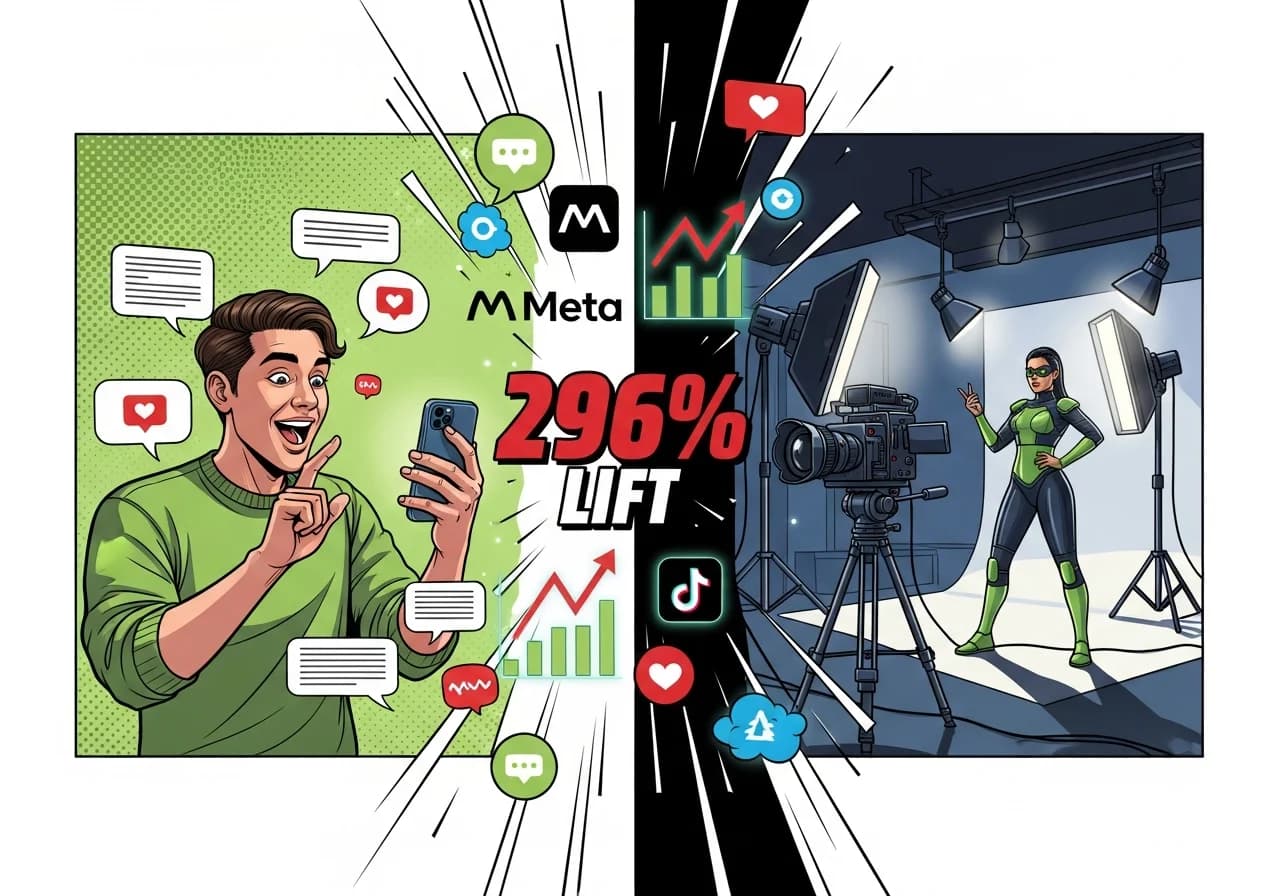
On TikTok, creator-led ads drive 70% higher click-through rates than non-creator brand ads at the same cost per thousand impressions. Meta Partnership Ads showed a 296% performance boost versus traditional creative in recent case studies.
Here's where it gets interesting. Emplifi reported a 10.38x conversion-rate lift for UGC-driven posts compared to non-UGC content in Q3 2025. On product pages, shoppers who interact with UGC elements like reviews, Q&A, or user photos show a 102% conversion-rate lift.
But before you dump all your studio creative, consider this: Nielsen research shows creative quality contributes roughly 50% to sales lift. Execution matters more than style alone.
UGC Performance Breakdown by Platform
| Platform | UGC Advantage | Key Metric | When It Works Best |
|---|---|---|---|
| TikTok | 70% higher CTR | Creator-led vs brand ads | Direct response, native content |
| Meta | 296% lift | Partnership Ads vs standard | Social proof, authentic testimonials |
| Product Pages | 102% conversion lift | UGC interaction vs none | E-commerce, consideration phase |
| General Digital | 217% lead gen | UGC vs traditional | Mid-funnel, peer validation |
When Studio Ads Actually Win
Here's what nobody talks about enough. Polished studio creative dominates in specific scenarios that matter for serious revenue.
Studio ads crush it for:
- Premium and luxury brand positioning where production value signals quality
- Complex storytelling that requires multiple scenes or emotional arcs
- Top-of-funnel brand awareness campaigns focused on long-term perception
- High-consideration categories like financial services, healthcare, or B2B where credibility drives decisions
Think about it. Would you trust your retirement planning to a brand running shaky smartphone footage? Probably not. Production quality becomes a trust signal in certain verticals.
The AI UGC Advantage
AI-generated UGC-style content offers three massive benefits over traditional studio production.
Cost efficiency. AI UGC creation runs $10-$100 per ad variation compared to $5,000-$10,000+ for studio shoots. You can test 50 AI variations for the cost of one studio day.
Speed. Create 10 variations in hours instead of weeks. When you spot a trending sound or format on TikTok, you can capitalize immediately rather than waiting for production schedules.
Testing velocity. Rapid iteration lets you find winners faster. Instead of betting everything on one expensive studio shoot, you test dozens of angles and scale what converts.
The authenticity factor matters too. Platform algorithms on TikTok and Meta actively reward native-looking content that matches organic user behavior. UGC-style ads blend into feeds instead of screaming "advertisement."
As detailed in our complete guide to AI video ads, AI tools now enable brands to maintain that authentic feel at scale.
The AI Perception Problem
Here's where AI UGC gets tricky. NIQ research from 2024 found AI-generated ads more likely to be perceived as boring or confusing when the AI is obvious. Weaker memory activation, lower brand recall.
Kantar's 2024 analysis reinforces this. Creatives using GenAI "non-obviously" perform better than those with distracting synthetic visuals. When viewers can tell it's AI, engagement drops.
Virtual and AI influencers face similar challenges. Multiple academic studies from 2023-2025 show they're perceived as less authentic than human creators, with lower purchase intent.
Consumer sentiment data reveals many US adults actively avoid or distrust brands using obvious AI ads. Gen Z shows more openness, but skepticism still runs high across demographics.
The solution? Make AI creative that doesn't look like AI creative. Focus on natural movements, realistic lighting, authentic dialogue patterns. Platforms like Virvid specifically optimize for this non-obvious approach, following Kantar's guidance to avoid synthetic tells while maintaining authentic UGC aesthetics.
Strategic Framework: When to Use What
Smart brands don't choose between UGC and studio. They deploy both strategically.
Use UGC-style content for:
- Direct-response campaigns optimizing for immediate conversions
- Mid-funnel testing where you need rapid A/B iterations
- Platform-native formats on TikTok and Instagram Reels
- Products with strong peer validation (beauty, fashion, tech gadgets)
- Audience segments that value authenticity over polish
Use studio creative for:
- Top-of-funnel brand storytelling and awareness
- Trust-sensitive categories requiring credibility signals
- Premium product launches where production value matters
- Emotional narratives needing cinematic execution
- Long-form content on YouTube or connected TV
The hybrid approach often wins. Shoot studio-quality hero assets for major campaigns, then use AI tools to create localized variations, test different hooks, or adapt messaging for micro-segments. This combines brand consistency with testing agility.
You can learn more about AI vs traditional video ad performance in our detailed comparison.
Platform-Specific Advantages
TikTok Spark Ads and Meta Partnership Ads exist specifically to amplify authentic content while preserving creator identity and social proof. These formats let you leverage existing UGC performance with paid reach.
TikTok's Symphony Creative Studio now enables AI UGC ad generation with platform-native optimization built in. It understands what works on TikTok specifically and tailors output accordingly.
Meta's algorithm increasingly favors content that feels organic rather than promotional. Partnership Ads maintain that authentic feel while giving you targeting and budget control.
For YouTube Shorts, the line blurs. Some brands find polished mini-documentaries outperform scrappy UGC, especially for educational or expertise-driven content. Test both.
Testing Framework That Actually Works
Stop guessing. Run clean experiments.
Set up a four-cell split test:
- Real people, standard editing
- Real people with AI-assisted variations (different hooks, CTAs, pacing)
- AI presenter or avatar
- AI presenter with localized variants for different audience segments
Run each variation with identical targeting and budget for 3-7 days minimum. Track these metrics obsessively:
- 2-3 second hold rate (did they stop scrolling?)
- Mid-view completion (did they watch halfway?)
- Click-through rate
- Cost per acquisition or return on ad spend
Monitor which format wins by category, average order value, and audience demographics. A beauty product might crush with AI UGC while a financial service needs studio credibility.
Document platform-specific differences. What wins on TikTok might flop on Meta. What converts Gen Z might lose millennials.
Scale the winner aggressively while continuing to test new angles. Creative fatigue hits fast in 2026. You need constant refresh.
Consider using tools optimized for rapid creative iteration. The best AI video ad generators for e-commerce now include UGC format templates that avoid obvious AI tells while enabling fast testing.
Disclosure Requirements You Can't Ignore
Legal compliance isn't optional. Here's what you must do.
FTC Endorsement Guides apply to UGC-style ads. You must disclose material connections between endorsers and your brand. You cannot fabricate testimonials or present paid partnerships as organic content without disclosure.
Platform policies vary. TikTok requires AI disclosure for synthetic content. Meta labels AI-generated ads automatically in many cases. Check current requirements before launching campaigns.
New York law now requires disclosure for AI avatars in certain commercial contexts. State regulations are evolving fast.
Get legal review on your creative if you're pushing boundaries. A viral ad that triggers regulatory action isn't worth it.
Full details on Meta AI video ad formats and requirements can help you stay compliant.
Category-Specific Performance Patterns
Fashion and beauty brands see massive UGC advantage. That 3.2x engagement lift for fashion reflects how much peer validation drives purchase decisions in these categories.
Health and wellness splits. Supplements and fitness gear often convert better with UGC testimonials. Medical devices and pharmaceuticals need studio credibility and regulatory compliance.
B2B software shows surprising UGC success when it focuses on real user workflows rather than feature lists. Case study-style content from actual customers outperforms slick product demos.
Luxury goods require careful balancing. Some premium brands successfully use UGC to show aspirational lifestyle context while maintaining studio hero assets for product showcases.
High-ticket items need more consideration time. Studio creative excels here because it supports the extended decision journey with information-rich content.
The Bottom Line
Neither format wins universally. Your winning strategy depends on objectives, category, audience, and platform.
Test both. Run real experiments with clean measurement. Let data override opinions.
For many brands in 2026, the optimal approach combines studio hero assets with AI-generated UGC variations for rapid testing and localization. You get brand consistency where it matters and testing agility where you need it.
Start with one platform and format. Run your four-cell test. Scale what converts. Keep iterating.
The brands dominating paid social in 2026 aren't picking sides. They're intelligently deploying the right creative format for each specific goal, then testing relentlessly to beat their own benchmarks.
For creators and brands looking to generate high-quality AI UGC ads quickly, check out our free UGC video script generator to start testing authentic-style content today.