

AI Video Ads vs Traditional Video Ads: Cost, Performance & ROI Comparison
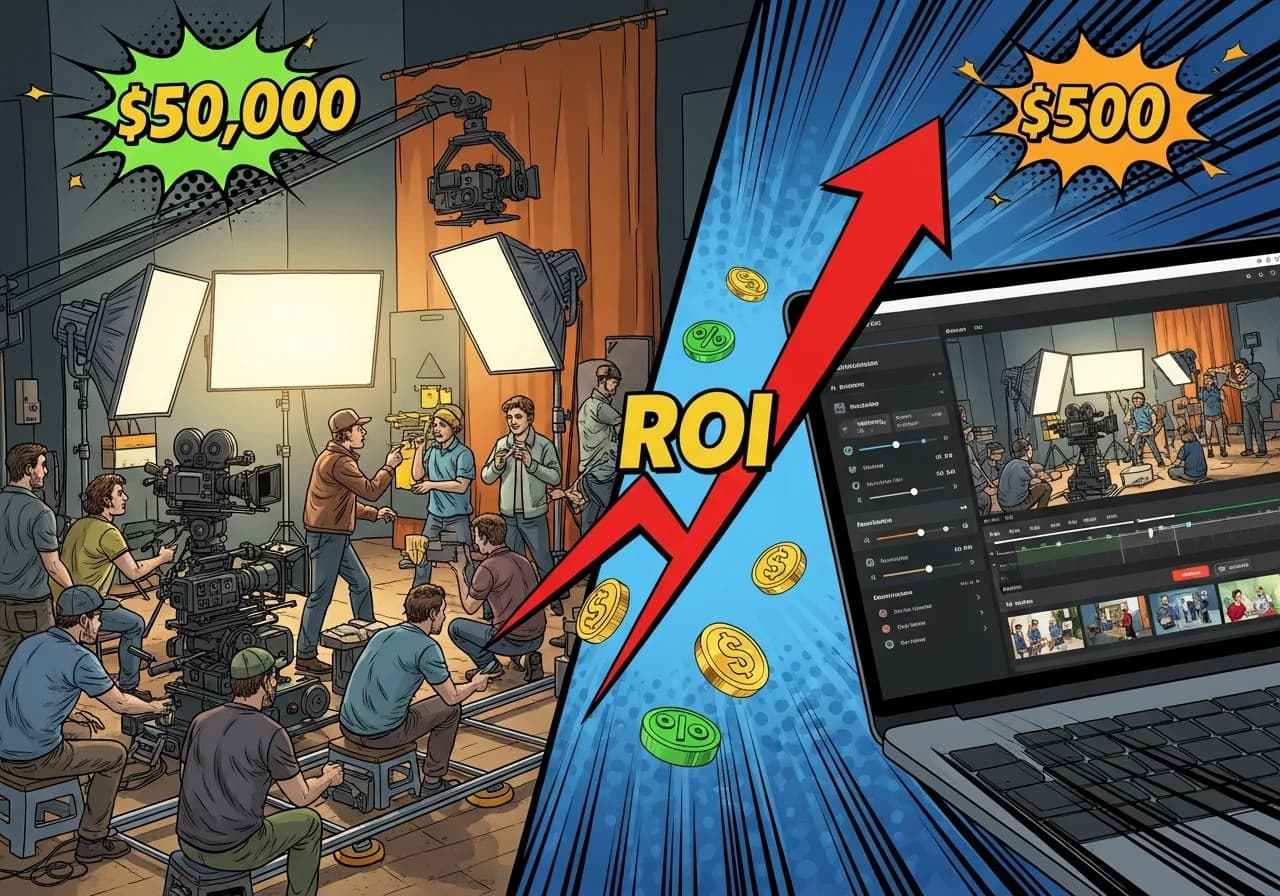
AI-generated video ads slash production costs by 96%. Consumer research reveals they trigger weaker memory activation and negative brand perception when the AI origin is obvious.
This creates a strategic paradox for marketers in 2026. The same tools delivering massive efficiency gains may undermine brand effectiveness. Companies like Klarna ($10M annual savings) and Headway (40% ROI increase) prove AI works well for performance marketing, while NIQ's December 2024 brain-scan research shows traditional production remains valuable for brand building and trust-sensitive campaigns.
The solution: strategic deployment based on campaign objectives and consumer psychology, not choosing one approach over the other.
Table of Contents
- Production Costs Have Fundamentally Diverged
- Real Brand Case Studies: The Good, The Great, and The Cautionary
- Platform Performance Data vs Consumer Perception Research
- When to Use AI vs Traditional: Strategic Deployment Guide
- ROI Calculation Framework: The Math Behind the Hype
- The Market is Bifurcating Around Hybrid Strategies
Production Costs Have Fundamentally Diverged
The economics of video production have split into two distinct universes in 2026.
Traditional Production Costs
According to Simulmedia's 2025 industry guide, traditional 30-second commercials cost $10,000 to $50,000, with high-end productions reaching $200,000 or more. Simple corporate videos run $2,000 to $8,000. Super Bowl spots averaged $8 million in production costs alone during 2025.
The breakdown for a typical $30,000 commercial includes:
- Pre-production (scripting, storyboarding, casting): $5,000–$8,000
- Production day (crew, equipment, talent): $12,000–$18,000
- Post-production (editing, color, sound, graphics): $8,000–$12,000
- Timeline: 4–8 weeks from concept to final delivery
AI Production Costs
AI video tools operate at a fraction of these costs. HeyGen's Creator plan runs $29/month for unlimited 1080p videos without watermarks. Synthesia's Starter tier costs $29/month for 10 minutes of avatar-based content. Runway ML offers video generation at $15–$35/month, while Pika Labs starts at just $8/month.
When calculating all-in costs including subscription time, prompting iterations, and basic editing, most AI-generated marketing videos cost $100–$1,000 total, representing savings of 70–99% versus traditional production.
Platforms like Virvid have streamlined this even further, allowing marketers to generate trending AI video ads in minutes with built-in styles, voices, and music optimized for platforms like TikTok, Instagram Reels, and YouTube Shorts.
| Production Type | Traditional Cost | AI Cost | Savings Percentage |
|---|---|---|---|
| 30-second commercial | $10,000–$50,000 | $1,000–$2,000 | 96–98% |
| Corporate explainer | $2,000–$8,000 | $100–$500 | 87–95% |
| 100-product catalog videos | $200,000+ | $2,000–$6,000 | 97–99% |
| Localized versions (10 languages) | $100,000+ | $1,000–$3,000 | 97–99% |
The Time Equation
Traditional video production requires 4–8 weeks from concept to final delivery. AI workflows compress this to hours or days.
Magic Hour's analysis documented Synthesia's case study with Modern Canada showing 90% faster delivery alongside $6,000 per-video savings. For marketers running performance campaigns where speed matters, this time compression becomes as valuable as the cost savings.
Real Brand Case Studies: The Good, The Great, and The Cautionary
Kalshi's $2,000 NBA Finals Ad
In June 2025, prediction market Kalshi aired a fully AI-generated 30-second commercial during Game 3 of the NBA Finals. According to NPR's coverage, the production details tell the story:
Production cost: Approximately $2,000
Production time: Two days of work by AI filmmaker PJ Accetturo using Google Veo 3
Traditional agency quotes: $250,000 to $500,000 for equivalent placement
Cost reduction: 95%+
The ad generated over 20 million impressions and 3 million views on X alone. Kalshi acknowledged in their marketing materials that they "will not completely abandon more traditional forms... in the end, humans want to connect with humans."
This dual messaging captures the industry's emerging consensus.
Headway's 40% ROI Improvement
The Ukrainian edtech company with 110+ million users achieved measurable results by systematically integrating AI into their video ad workflow. Their stack included HeyGen, Midjourney, and D-ID.
Results from H1 2024:
- 40% increase in video ad ROI
- 3.3 billion impressions generated
- UGC-style AI content driving 30–50% of subscriptions and free trials
- Campaigns blending user-generated content with AI imagery showed up to 60% higher engagement
Headway's approach demonstrates the power of treating AI as a creative multiplier rather than a replacement, combining AI-generated visuals with authentic user testimonials and strategic messaging.
Klarna's $10M Annual Savings
In Q1 2024, the Swedish fintech reported the most quantified AI marketing success in the industry. Their transformation included:
- $10 million in annual AI-attributed savings
- 25% reduction in external agency spend ($4 million run rate)
- $6 million in image production savings
- Production cycles collapsed from six weeks to seven days
- By year-end, 87% of employees used GenAI daily
- 80% of copywriting flowed through their internal AI tool
Klarna's enterprise-wide adoption demonstrates how AI can transform entire marketing operations when implemented systematically.
Mondelēz's $40M+ Investment
The Oreo and Cadbury parent company invested over $40 million with Publicis Groupe and Accenture to build a proprietary generative AI platform. According to Best Media Info, they're reporting:
- 30–50% reduction in marketing content production costs
- Traditional animation expenses dropping from "hundreds of thousands of dollars" to "orders of magnitude smaller"
- Target: AI-generated TV ads by the 2026 holiday season
- Aspiration: A 2027 Super Bowl AI spot
Coca-Cola's Holiday Debacle (The Cautionary Tale)
Not every AI experiment succeeds. Coca-Cola's 2024 holiday campaign provides a counterweight to the success stories.
Their AI remake of the iconic 1995 "Holidays Are Coming" commercial used four different generative AI models. Despite initially scoring a perfect 5.9 from System1's testing, it sparked significant public backlash:
- Critics called it "soulless" and "devoid of creativity"
- Social media response was overwhelmingly negative
- The disconnect between test scores and actual public reception highlighted AI's limitations for emotionally resonant brand content
The lesson: algorithms can predict engagement but struggle to capture the human elements that make brand moments memorable.
Platform Performance Data vs Consumer Perception Research
The data reveals a fascinating split between what performs and what people say they want.
Platform Performance: AI Wins on Metrics
Meta's September 2024 announcement validated AI's performance marketing credentials:
- Campaigns using generative AI features achieved +11% higher click-through rates
- +7.6% higher conversion rates versus non-AI campaigns
- Over one million advertisers used Meta's AI tools
- Generated 15 million ads in a single month
Additional data from AdAmigo's 2025 benchmarks shows AI-driven ads delivering:
- 22% higher returns on average
- $4.52 ROAS per dollar spent
- Particularly strong performance in ecommerce and DTC categories
Google's Nielsen Marketing Mix Modeling study analyzed 50,000+ brand campaigns from July 2022 to June 2024:
- YouTube AI-powered video campaigns delivered +17% higher ROAS versus manually optimized campaigns
- Performance Max showed +8% ROAS and +10% sales effectiveness versus standalone Search
- Small business advertisers using conversational AI were 63% more likely to achieve "Good" or "Excellent" ad strength scores
Consumer Perception: AI Faces Skepticism
NielsenIQ's December 2024 research using EEG brain measurements revealed troubling dynamics for AI-generated creative content.
The NIQ study tested over 2,000 participants viewing AI-generated ads and found:
- AI-generated ads were perceived as significantly more "annoying," "boring," and "confusing"
- Even high-quality AI output elicited weaker memory activation than traditional ads
- Strange or unrealistic visual elements created highest cognitive strain with lowest memorability
- A negative halo effect dampened perceptions of both the ad and the brand
"Brands and agencies need to be cautious, as our study reveals that consumers are quite sensitive to the authenticity of ad creatives," warned Ramon Melgarejo, NIQ's President of Strategic Analytics, in Marketing Dive's coverage.
Additional consumer sentiment research shows:
- Kantar's Media Reactions 2024 study: 41% of consumers are bothered by AI-generated ads (versus just 29% of marketers)
- Early 2025 eMarketer poll: roughly two-thirds of adults feel uncomfortable with AI-generated advertising
- NIQ's broader research shows the perception gap widens when consumers know content is AI-generated
The Strategic Implication
This creates a paradox. AI ads perform better on direct response metrics but may damage long-term brand perception. The resolution requires strategic segmentation of use cases.
When to Use AI vs Traditional: Strategic Deployment Guide
The data points toward clear use-case segmentation rather than blanket adoption.
AI Excels For:
High-volume performance marketing
- Testing 10–20 creative variations weekly where rapid iteration outweighs production polish
- Direct response campaigns optimized for conversions, not brand building
- Platforms like Virvid enable this rapid testing without production bottlenecks
Localization at scale
- AI dubbing across 15+ languages efficiently (TikTok Symphony, Rask)
- Adapting single concepts to multiple regional markets quickly
- Product catalog videos requiring dozens or hundreds of variations
UGC-style content
- Authentic, raw-feeling ads where production quality isn't a feature
- Creator-style content for TikTok, Instagram Reels, YouTube Shorts
- Testimonial-style formats where "realness" matters more than polish
Pre-production and ideation
- Storyboarding and concept visualization before committing to expensive shoots
- Casting ideation (Nike generated 5,000+ Midjourney images for pre-production)
- Testing visual directions before traditional production begins
Resource-constrained teams
- SMBs competing with larger brands' content volume
- In-house teams without video production expertise
- Startups needing professional-looking content on limited budgets
Stock footage replacement
- As one industry expert told TJ Digital, AI is "an OK replacement for stock footage"
- Generic B-roll and establishing shots
- Background visuals for explainer videos
Traditional Remains Superior For:
Hero brand campaigns
- Where emotional resonance drives long-term brand value
- Annual tentpole campaigns that define brand positioning
- Content designed for memorability and cultural impact
Trust-sensitive categories
- Healthcare and pharmaceutical advertising
- Financial services and banking
- Legal services and professional firms
- Charitable causes and nonprofit fundraising
Premium positioning
- Luxury brands where production quality signals product quality
- High-ticket B2B offerings where perceived professionalism matters
- Brands competing on craftsmanship and attention to detail
Serious or memorial content
- Public service announcements
- Crisis communications
- Content where AI's occasional uncanny elements could be devastating
- Sensitive social issues requiring human judgment
Conservative audiences
- Demographics skeptical of technological mediation
- Industries with traditional buyer personas (real estate, legal, senior-focused)
- Markets where "authenticity" means human-created content
As detailed in our guide on AI UGC Ads vs Studio Ads, the key is matching production method to campaign objective and audience expectations.
Georgia State marketing professor Alok Saboo captured the opportunity in NPR's analysis: "AI will lower the entry barrier for some of the smaller brands who can't afford a traditional video ad campaign."
ROI Calculation Framework: The Math Behind the Hype
Let's work through actual numbers to understand the ROI potential.
Scenario 1: $100,000 Media Budget Campaign
Industry guidance from Simulmedia suggests allocating 20% to production and 80% to media placement.
Traditional approach:
- Production budget: $20,000 (enough for one polished 30-second spot, maybe 2-3 variations)
- Media budget: $80,000
- Creative testing capability: Limited (1–3 variations)
- Total investment: $100,000
AI-augmented approach:
- Production budget: $2,000 (subscription + iteration time for multiple variations using tools like Virvid's AI video script generator)
- Media budget: $98,000 (+22.5% more media spend from production savings)
- Creative testing capability: 10–20 variations weekly
- Total investment: $100,000
The ROI improvement comes from two sources:
Increased media spend: That extra $18,000 in media placement, assuming typical $4.52 ROAS from Amra & Elma's data, generates an additional $81,360 in returns.
Optimized creative selection: Testing 10-20 variations weekly versus 1-3 total allows you to identify winners faster. Meta's data shows AI-optimized creative delivers +11% CTR and +7.6% conversions. Combined, this yields 20-50% higher campaign ROI.
Headway's 40% ROI improvement validates this framework at scale.
Scenario 2: 100-Product Catalog Video Campaign
Traditional approach:
- Per-video cost: $2,000–$3,000 minimum
- Total production: $200,000–$300,000
- Timeline: 12–16 weeks for full campaign
- Iteration cost: prohibitively expensive (each change requires reshoots)
AI approach:
- Per-video cost: $20–$60 using template-based AI tools
- Total production: $2,000–$6,000
- Timeline: 1–2 weeks for full campaign
- Iteration cost: minimal (regenerate with new parameters)
Cost reduction: 97–99%
The savings can be redirected to:
- Increased media spend across more channels
- More frequent creative refreshes (monthly vs. quarterly)
- Expanded testing of messaging variations
- Additional product lines previously too expensive to advertise
Scenario 3: Localization Campaign (10 Markets)
Traditional approach:
- Base video production: $30,000
- Localization per market (re-shoot with local talent, re-edit): $8,000–$12,000
- Total for 10 markets: $110,000–$150,000
AI approach:
- Base video production: $1,500
- AI dubbing per market: $50–$200
- Total for 10 markets: $2,000–$3,500
Cost reduction: 97–98%
According to TikTok Symphony's capabilities, AI dubbing maintains lip-sync and emotional tone across 15+ languages, enabling truly global campaigns at previously impossible price points.
The Compound Effect
Companies reporting systematic AI creative adoption cite:
- 30% drops in cost-per-acquisition
- 22% increases in conversion rates
- 40–60% improvements in total campaign ROI when production savings are reinvested strategically
The math consistently favors AI for volume and testing, with the caveat that brand-building campaigns still benefit from traditional production's emotional impact.
The Market is Bifurcating Around Hybrid Strategies
The industry isn't choosing between AI and traditional. It's developing hybrid workflows that deploy each where it creates the most value.
Adoption Projections
IAB's July 2025 Digital Video Ad Spend report found:
- 50% of advertisers already using GenAI to create video ads as of mid-2025
- Projections reaching 86% by 2026
- Buyers expect GenAI creative to represent 40% of all video ads by 2026
Wyzowl's 2025 data showed AI adoption for video creation actually dropped 24 percentage points from 2024, suggesting a shift from broad experimentation to selective, strategic application.
The market is maturing from "try AI for everything" to "use AI for specific workflows."
Platform Integration Becomes Unavoidable
The major advertising platforms are making AI optimization the default:
Meta's Advantage+ suite:
- Now defaults to AI optimization
- CEO Zuckerberg targeting a "one-click ad option" by 2026
- Brands provide only a URL and budget, AI handles creative generation and optimization
- Meta phasing out older manual options) in favor of Advantage+ tools
TikTok Symphony:
- Text-to-video generation
- AI dubbing across 15+ languages
- Symphony Avatars for creator-style content at scale
- Built-in trend analysis and format recommendations
Google's Demand Gen:
- Automatically creates video ads from provided assets
- Advertisers seeing 20%+ conversion increases in H1 2025
- Integration with YouTube Shorts and Discovery formats
- AI-powered audience targeting and bid optimization
For more platform-specific strategies, see our guides on Meta AI Video Ads and YouTube AI Video Ads.
Agency Investments Signal Long-Term Commitment
Major holding companies are betting billions on AI capabilities:
- WPP: Spending £250 million annually on AI and data strategy with a new $400 million Google Cloud partnership
- Publicis: Invested €300 million over three years and leads industry growth at 5.9%
- Omnicom, IPG, Dentsu: Each investing $50M–$200M in AI infrastructure and talent
According to Digiday's analysis, the advertising industry's AI investments soared in 2024, with total spending approaching $2 billion across the industry.
Governance and Disclosure Requirements
The rapid adoption has created governance challenges:
- IAB research shows 70%+ of marketers have encountered AI incidents (hallucinations, bias, off-brand content)
- Yet only 35% plan increased investment in AI oversight
- 13+ US states now mandate AI disclosure for political ads
- New York's pending Synthetic Performer Disclosure Bill would extend requirements to any advertisement
According to AdExchanger's analysis, marketers must navigate an increasingly complex patchwork of disclosure requirements.
Meta's September 2024 product updates include built-in labeling for AI-generated content, while LinkedIn and other platforms implement similar transparency measures.
The Winning Hybrid Workflow
Leading brands are settling on a three-tier approach:
Tier 1: AI-First Production
- Performance campaigns optimized for conversions
- High-volume testing and iteration
- Quick-turnaround seasonal promotions
- Localization and personalization at scale
- Use platforms like Virvid or HeyGen
Tier 2: AI-Assisted Traditional
- Use AI for pre-production, storyboarding, casting ideation
- Traditional shoot for core footage
- AI for post-production enhancement, versioning, localization
- Combines quality of traditional with efficiency of AI
Tier 3: Pure Traditional
- Hero brand campaigns
- Annual tentpole moments
- Trust-sensitive and premium positioning
- Content designed for cultural impact and long-term brand value
Key insight: AI adoption isn't binary. The winning strategy deploys each approach where it creates the most value for specific campaign objectives.
Conclusion: Strategic Deployment Beats Blanket Adoption
The AI-versus-traditional framing misses the strategic point entirely.
Performance data consistently shows AI optimization delivers measurable improvements: +11% CTR at Meta, +17% ROAS at YouTube, 40% ROI increase at Headway. Meanwhile, consumer research reveals AI-generated content triggers weaker memory encoding and negative perception when the AI origin is obvious.
Both datasets are correct. They're measuring different things.
The winning approach in 2026:
Deploy AI for what it does brilliantly:
- Rapid testing and iteration
- Volume production at scale
- Localization and personalization
- Performance creative optimized for conversions
- Resource-constrained teams punching above their weight
Preserve human-crafted production for what machines still struggle to replicate:
- Emotional resonance and cultural moments
- Brand trust and premium positioning
- Serious or sensitive subject matter
- Long-term memory activation and brand building
Kalshi's dual messaging, celebrating their $2,000 NBA Finals ad while acknowledging "humans want to connect with humans," captures the emerging industry consensus. As we detail in our Complete Guide to AI Video Ads That Convert, the question isn't which approach to choose, but how to architect a production ecosystem that deploys each where it creates the most value.
Start testing today. Use our free AI video script generator to create your first performance campaign scripts, then measure the results against your traditional campaigns. The data will tell you exactly where AI fits in your specific marketing mix.
If you're an agency or creator helping others with AI video creation, consider joining Virvid's affiliate program (30% recurring lifetime commission) to monetize your expertise while providing value to your clients.
The 96% cost savings are real. So are the perception challenges. Your job is to deploy each approach strategically, measure carefully, and iterate based on actual performance. That's how you'll achieve the 20 to 50% ROI improvements companies like Headway, Klarna, and Mondelēz are already realizing.