

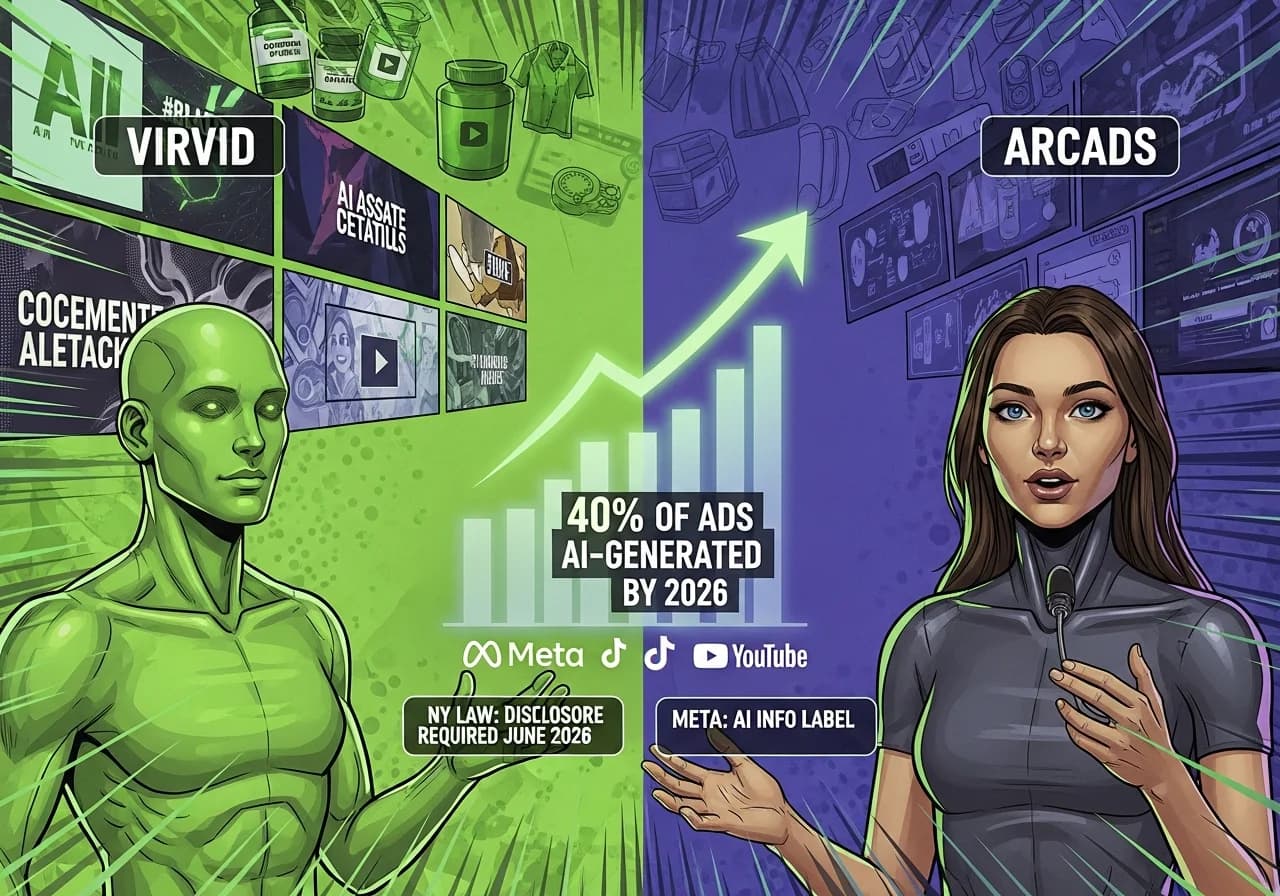
Virvid vs Arcads.ai: Best AI Video Ad Generator for E-commerce in 2026
The choice between Virvid and Arcads.ai ultimately depends on your e-commerce video strategy: versatile, format-diverse content for organic reach, or specialized avatar-based testimonial ads for paid campaigns.
Table of Contents
- The AI Video Ad Landscape in 2026
- Two Distinct Philosophies
- Comprehensive Platform Comparison
- Avatar Libraries and Authenticity
- Voice Quality Showdown
- Format Variety and Content Options
- Pricing Models Explained
- Compliance and Legal Requirements
- Performance Data and Real Results
- How Top Competitors Stack Up
- When to Use Each Platform
- What's Actually Working in 2026
The AI Video Ad Landscape in 2026
AI video advertising has reached a critical inflection point. According to IAB's July 2025 report, a striking 86% of advertisers are now using or planning to use generative AI to build video creative. The market projects 40% of all ads will be AI-generated by 2026, representing a massive shift in how e-commerce brands create content.
But there's a catch.
NIQ research from December 2024 reveals a critical finding that changes everything: consumers intuitively identify most AI-generated ads as artificial, creating a "negative halo effect" that damages brand perception. Using EEG brain activity monitoring on 2,000+ participants, the study found AI ads were rated as "annoying," "boring," and "confusing" compared to traditional ads.
The global social ad spend is projected to hit $276 billion in 2026. With new compliance requirements and sophisticated consumer detection, choosing the right AI video tool has never been more important.
New Legal Requirements You Need to Know
On December 11, 2025, New York Governor Kathy Hochul signed legislation requiring conspicuous disclosure when advertisements use AI-generated "synthetic performers." The law takes effect approximately June 2026.
Key requirements:
- Penalties range from $1,000 for first violations to $5,000 per instance for repeat offenses
- Applies to digitally-created media appearing as real persons
- Requires clear labeling that content is AI-generated
- Enforceable against advertisers and platforms
Meta has expanded its AI labeling requirements throughout 2025, automatically tagging content with AI-generated photorealistic humans with visible "AI info" labels next to the Sponsored tag.
TikTok removed 51,618 synthetic media videos and permanently banned 8,600 accounts in late 2025, a 340% increase in enforcement versus 2024.
Two Distinct Philosophies
Virvid and Arcads.ai represent fundamentally different approaches to AI video creation. Understanding this distinction is essential before choosing your platform.
Arcads.ai: The Testimonial Specialist
Arcads.ai specializes exclusively in AI avatar testimonial ads, talking-head videos where photorealistic digital humans deliver scripted pitches directly to camera.
Platform highlights:
- 1,000+ AI actors trained on consenting real humans
- 95%+ lip-sync accuracy for English
- 29-35 languages supported
- Starting at approximately €100/month (~$110 USD) for 10 videos
- Focused on UGC-style promotional content at scale
According to reviews on Marketer Milk, Arcads positions itself as the go-to solution for testimonial-style advertising where a digital human endorses your product.
Virvid: The Versatile Format Generator
Virvid takes a completely different path as a comprehensive AI shorts generator focused on trending social content formats. Rather than avatar testimonials, Virvid produces faceless AI-generated visual narratives.
Platform highlights:
- 20+ trending visual styles (anime, cinematic, 3D, comic, documentary)
- 30+ voice avatars optimized for different content types
- 20+ languages with format-specific voice optimization
- Starting at $19/month for 200 credits
- Emphasizes versatility and organic social reach
As covered in our complete guide to AI video ads that convert, platforms like Virvid enable high-volume content creation for e-commerce brands building organic audiences across TikTok, Instagram Reels, and YouTube Shorts.
This fundamental difference shapes everything from pricing structure to ideal use cases. You're not comparing apples to apples, you're comparing a specialized testimonial ad generator against a versatile format-diverse content platform.
Comprehensive Platform Comparison
Here's how the leading AI video ad generators stack up across key metrics:
| Feature | Virvid | Arcads.ai | HeyGen | Creatify |
|---|---|---|---|---|
| Entry Price | $19/mo | €100/mo (~$110) | $29/mo | $33/mo |
| Pricing Model | Credits (roll over) | Per-video (no rollover) | Unlimited videos | Credits |
| Visual Avatars | None (faceless) | 1,000+ talking heads | 1,100+ avatars | 500+ avatars |
| Voice Options | 30+ AI voices | 140+ voices | 1,000+ voices | 170+ voices |
| Languages | 20+ | 29-35 | 175+ | 29+ |
| Max Resolution | HD | 1080p | 4K (Team plan) | HD |
| Format Variety | 20+ visual styles | Testimonial-focused | Multi-format | UGC + demos |
| URL-to-Video | No | No | No | Yes |
| Batch Creation | Limited | 100+ variants | Yes | Yes |
| Built-in Editor | Yes | Limited | Yes | Yes |
| Music Library | 1,000+ tracks | No | Media library | Limited |
| Free Trial | Yes (credits) | No | 3 videos/mo | 10 credits |
This comparison reveals strategic positioning differences. HeyGen leads on multilingual support with 175+ languages, perfect for global campaigns. Creatify offers unique URL-to-video automation for rapid e-commerce ad creation.
Virvid stands out with its 1,000+ copyright-free music tracks sorted by trending tags, a feature critical for social video that other platforms overlook. The platform's free trial with actual credits lets you test before committing, unlike Arcads which requires payment upfront.
Avatar Libraries and Authenticity
The avatar library question reveals the sharpest contrast between these platforms.
Arcads' Talking-Head Approach
Arcads.ai's 1,000+ AI actors span diverse demographics including age, gender, and ethnicity. Each actor is trained on a real human who consented to their likeness being used, a positioning Arcads emphasizes for ethical AI.
Customization options include:
- Casual bedroom settings
- Professional studio backgrounds
- Multiple wardrobe choices per actor
- Pitch and speed voice adjustments
- Speech-to-Speech emotional transfer
User reviews paint a nuanced picture. According to Marketer Milk's detailed review, some actors achieve remarkable realism: "Vincent sounds so realistic I would not be able to tell it's AI."
However, Arcads' Trustpilot score of 3.1/5 based on 51 reviews reflects polarization: 53% five-star ratings against 41% one-star ratings. Common complaints mention voices that "do not move and/or sound natural" in certain cases.
Virvid's Faceless Strategy
Virvid sidesteps the uncanny valley problem entirely by producing faceless content, with no digital humans attempting to pass as real people.
Instead, the platform generates:
- AI-generated visuals in 20+ styles (anime, cinematic, 3D, comic, documentary)
- Synchronized realistic voice narration
- Trending visual formats updated weekly
- Dynamic caption styles and animation effects
- Character consistency throughout videos when using story formats
This approach aligns with a growing trend: according to Zebracat's 2025 statistics, 53% of ad creatives on TikTok and YouTube Shorts now use faceless formats.
For e-commerce brands, the authenticity question becomes: do you need someone "appearing" to endorse your product (Arcads), or can your message be delivered through compelling visual storytelling without a human face (Virvid)?
The NIQ study's finding that consumers experience a "negative halo effect" from obviously AI content suggests faceless approaches may carry lower brand perception risk.
Voice Quality Showdown
Voice technology represents one of the most important differentiators between platforms.
Virvid's Format-Specific Optimization
Virvid offers 30+ ultra-realistic voice avatars specifically optimized for different content formats rather than generic text-to-speech:
- UGC-style narration voices
- Documentary-style delivery
- Horror/scary story voices
- Motivational/inspirational tones
- Tutorial explanation voices
- True crime narration styles
You can "sound like a UGC creator or professional narrator in one click," according to the platform. This format-specific optimization means the same script sounds completely different depending on which content style you're creating.
For brands exploring different ad approaches, platforms like Virvid offer flexibility. As we discuss in AI UGC ads vs studio ads: which converts better, voice quality dramatically impacts perceived authenticity.
Arcads' Emotional Voice Transfer
Arcads counters with 140+ voices featuring pitch and speed customization, plus Speech-to-Speech (STS) technology that transfers your own voice's emotional intonation to an avatar.
This creates more nuanced delivery than standard text-to-speech. However, some users report:
- Slight delays in tonal languages like Vietnamese
- Results that sound "overly Americanised" even with other regional options
- Inconsistent emotional range depending on which avatar is selected
| Voice Capability | Virvid | Arcads.ai |
|---|---|---|
| Total Voices | 30+ | 140+ |
| Format Optimization | Yes (by content type) | General-purpose |
| Speech-to-Speech | No | Yes |
| Voice Cloning | No | No (human-based actors) |
| Emotional Range | Format-dependent | Variable by actor |
| Lip-Sync Quality | N/A (audio only) | 95%+ English |
Format Variety and Content Options
This is where the platforms diverge most dramatically.
Arcads' Testimonial Focus
Arcads offers format options specifically designed for promotional advertising:
- Talking Actors - Traditional testimonial style
- Unboxing POV - Avatar unboxing your product
- Show Your App - Avatar holding phone displaying your landing page
- Promotional Scripts - Direct sales pitches
These formats work exceptionally well for digital products. However, Marketer Milk's review notes that Arcads handles only ~20% of physical product ad needs because avatars cannot physically hold, demonstrate, or interact with tangible products.
Digital products (SaaS, courses, apps) can use Arcads for ~80% of ad creation. This limitation is critical for e-commerce brands selling physical goods.
Virvid's Comprehensive Format Library
Virvid offers 20+ trending visual styles with script formats spanning:
Visual Styles:
- Anime and manga aesthetics
- Cinematic/realistic photography
- 3D rendered scenes
- Comic and webcomic styles
- POV (point-of-view) perspectives
- Retro and vintage looks
- Documentary footage style
- Horror and dark themes
Script Formats:
- UGC-style personal recommendations
- "Did-you-know" educational content
- Ranking and listicle videos
- Tutorial and how-to guides
- Horror and scary stories
- True crime narratives
- AI-generated story content
This versatility matters for e-commerce because different products and audiences respond to different content approaches:
- Supplement brands → Documentary-style educational content
- Fashion brands → Trending visual aesthetics
- Tech products → Faceless explainer formats
- Entertainment products → Story-driven content
The platform's weekly updates based on current viral trends ensure formats stay algorithmically relevant. This is particularly valuable given how quickly social media trends evolve.
Virvid's faceless approach works equally well for physical and digital products since no avatar-product interaction is required. You can create product demos, testimonials, educational content, and trending videos without worrying about what an avatar can physically demonstrate.
If you're creating scripts, you can use tools like the free AI video script generator or the UGC video script generator to get format-specific templates optimized for different platforms.
Pricing Models Explained
The pricing comparison reveals strategic differences in how each platform expects to be used.
Virvid's Credit-Based System
Virvid uses a credit-based model designed for high-volume content creators:
Lite Plan - $19/month:
- 200 credits
- ~30 shorts per month
- Credits roll over while subscription active
- Effective cost: $0.63 per video
Essential Plan - $59/month:
- 800 credits
- ~120 shorts per month
- Better visual quality options
- Longer video support
Pro Plan - $119/month:
- 2,000 credits
- ~300 shorts per month
- Priority support
- Custom style requests
The credit rollover feature is significant. Unlike platforms that waste unused credits monthly, Virvid lets you accumulate credits while your subscription stays active. This flexibility suits brands with variable content needs.
Arcads' Per-Video Pricing
Arcads uses a per-video pricing model targeting performance marketers:
Starter - €100/month (~$110 USD):
- 10 videos
- No credit rollover
- Effective cost: ~$11 per video
Growth - €200/month:
- 20 videos
- Batch creation tools
- A/B testing capabilities
Enterprise - Custom pricing:
- 100+ videos
- Dedicated support
- Custom avatars
Critics cite concerns about "no free trial, forced to pay $110 before trying" and credits not rolling over when subscriptions lapse.
The higher per-video cost reflects Arcads' positioning for paid ad campaigns where individual creative quality matters more than volume. For brands running Facebook or TikTok ads with $500+ daily budgets, spending $11 per creative to test variations makes sense.
How Other Platforms Compare
| Pricing Tier | Virvid | Arcads.ai | HeyGen | Synthesia |
|---|---|---|---|---|
| Entry Level | $19/mo (200 credits) | €100/mo (10 videos) | $29/mo (unlimited) | $18/mo annual (10 min) |
| Mid-Tier | $59/mo (800 credits) | €200/mo (20 videos) | $39/seat (Team) | $64/mo annual (30 min) |
| Pro/Enterprise | $119/mo (2,000 credits) | Custom | Custom | Custom |
| Cost Per Video | ~$0.63 | ~$11 | Unlimited | ~$3/minute |
| Annual Discount | 2 months free | 50% off (promotional) | ~17% | ~30% |
HeyGen's unlimited model at $29/month offers the best value for brands needing high volume with avatar-based content. However, it lacks Virvid's format variety and trending style updates.
Compliance and Legal Requirements
Compliance features have become critical differentiators in 2026.
Understanding New York's AI Disclosure Law
New York's S.8420-A legislation signed December 11, 2025 establishes strict requirements for AI advertising:
Key provisions:
- Conspicuous disclosure required for AI-generated "synthetic performers"
- Applies to digitally-created media appearing as real persons
- $1,000 penalty for first violations
- $5,000 per instance for repeat offenses
- Takes effect approximately June 2026
The law defines synthetic performers as AI-generated content depicting what appears to be a real person. This clearly covers Arcads' talking-head avatars.
Virvid's faceless approach may provide a compliance advantage. Since the law specifically targets content "depicting a real person" that's AI-generated, faceless narrated content with AI-generated visuals could fall outside the synthetic performer definition.
However, brands should consult legal counsel for their specific use case. Regulations continue evolving.
Meta's Automatic AI Labeling
Meta's expanding labeling requirements automatically tag content created with tools embedding C2PA metadata.
What gets labeled:
- Ads featuring AI-generated photorealistic humans receive "AI info" labels
- Labels appear next to the Sponsored tag
- Users can click to see disclosure details
- Labels cannot be removed by advertisers
This matters because NIQ's research shows consumers react negatively to obvious AI content. Ads that trigger Meta's labeling may perform worse than faceless alternatives that feel more native.
TikTok's Aggressive Enforcement
According to TikTok's updated AI content guidelines, the platform has dramatically increased enforcement:
- Removed 51,618 synthetic media videos in late 2025
- Permanently banned 8,600 accounts
- Represents a 340% increase in enforcement versus 2024
- Focuses on content that misleads viewers about whether it's AI-generated
| Compliance Feature | Virvid | Arcads.ai | Regulatory Requirement |
|---|---|---|---|
| AI Disclosure Tools | Not specified | Recommends disclosure | NY Law: Mandatory June 2026 |
| GDPR/CCPA Compliance | Not specified | Yes | General data protection |
| C2PA Metadata | Not specified | Not specified | Meta auto-labeling |
| Actor Consent Documentation | N/A (no avatars) | Yes | Ethical AI use |
| Content Moderation | Not specified | Yes | Platform policies |
Performance Data and Real Results
Let's look at what the data actually shows about AI video ad performance in 2026.
The Authenticity Problem
NIQ's groundbreaking December 2024 study used EEG brain activity monitoring on 2,000+ participants to measure subconscious responses to AI ads.
Key findings:
- Consumers intuitively identified most AI-generated ads as artificial without prompting
- AI ads were rated as "annoying," "boring," and "confusing" versus traditional ads
- Even "high quality" AI ads showed weaker memory activation in brain scans
- The only ad not perceived as AI was created through "considerable iterative editing" by an advertising professional
"Brands and agencies are innovating at a rapid pace, leveraging AI-generated content in their advertising," said Ramon Melgarejo, President of Strategic Analytics & Insights at NIQ. "They need to be cautious, as our study reveals that consumers are quite sensitive to the authenticity of ad creatives."
Despite Warnings, Results Are Mixed
According to Zebracat's 2025 advertising statistics, AI-enhanced campaigns still deliver measurable results:
Performance metrics:
- Meta ROAS: $4.52 per dollar spent (AdAmigo 2025)
- AI campaign lift: 22% higher returns vs. average campaigns (Madgicx 2025)
- UGC conversion impact: Up to 161% higher conversions (Speed Commerce)
- AI product videos: 40% conversion boost (Fibre2Fashion)
- TikTok AI receptivity: 1.4x more receptive to AI-incorporated ads (TikTok Newsroom)
The resolution appears to be hybrid approaches. David Cohen, CEO of IAB, noted: "The democratization of advertising and marketing is entering an exciting new phase."
The key seems to be using AI for efficiency and testing while maintaining human creative oversight, exactly the workflow Virvid enables with its diverse format library and what Arcads supports through batch testing capabilities.
What's Actually Converting in 2026
According to IAB's July 2025 report:
- 86% of buyers are using or planning to use GenAI to build video creative
- 40% of all ads expected to be AI-generated by 2026
- Top use case: Creative testing at scale (20-200 variations daily)
- Winning strategy: AI handles production, humans provide creative direction
Platforms like Virvid support this high-volume testing approach. As discussed in our Meta AI video ads guide, the brands seeing strongest results create dozens of format variations and let platform algorithms identify winners.
How Top Competitors Stack Up
Beyond Virvid and Arcads, several other platforms compete in the AI video ad space.
HeyGen: The Multilingual Leader
HeyGen offers the broadest language support with 175+ languages and 1,100+ avatars.
Strengths:
- $29/month Creator plan with unlimited video generation
- Voice cloning included on paid plans
- 4K resolution on Team plans
- Rated #1 on G2's 2025 Top 100
- Best for global localization at scale
Weaknesses:
- Less format variety than Virvid
- No built-in music library
- Avatar-based (shares uncanny valley risks)
Creatify: E-commerce Automation
Creatify differentiates with URL-to-video automation, paste a product link and get complete ad creatives with AI-generated scripts.
Strengths:
- $33/month starting price
- 500+ avatars
- Shopify integration
- Purpose-built for e-commerce
- Minimal manual input required
Weaknesses:
- Limited to avatar-based testimonials
- Smaller music library than Virvid
- Credit-based pricing can get expensive at scale
Synthesia: Corporate and Training Focus
Synthesia positions for corporate and training content with interactive elements.
Strengths:
- $18-89/month pricing
- 120+ languages
- Interactive elements (quizzes, branching paths, CTAs)
- Enterprise features (SSO, SCORM export)
Weaknesses:
- Less focused on UGC-style ads
- Higher per-minute costs for advertising use cases
- Overkill for simple social content
InVideo AI: Product Demonstration Specialist
According to InVideo's UGC tools comparison, InVideo AI uniquely offers AI actors that can physically hold and showcase products.
Strengths:
- $28/month Plus plan
- Actors can hold physical products
- 50+ languages with voice cloning
- Best for physical product demos requiring product-human interaction
Weaknesses:
- Smaller avatar library than competitors
- Less format variety than Virvid
- Focus on demos rather than trending content
MakeUGC: Budget Testimonials
MakeUGC claims similar product-holding capability with rapid testimonial creation.
Strengths:
- Approximately $10 per video
- 100+ avatars
- Product showcase capability
- Four-step testimonial creation
Weaknesses:
- Limited format options
- Less comprehensive than full platforms
- Best for straightforward testimonial content only
What Happened to Rephrase.ai?
Contrary to some reports of a 2024 shutdown, Rephrase.ai was acquired by Adobe on November 22, 2023 and integrated into Adobe's creative suite. It's no longer available as a standalone platform.
When to Use Each Platform
Based on real use cases and performance data, here's when each platform makes sense.
Choose Virvid When You Need:
High-volume organic content:
- Building social presence across TikTok, Reels, YouTube Shorts
- Creating 20-30+ videos weekly
- Budget constraints requiring low per-video costs ($0.63/video)
Format diversity:
- Testing multiple content styles (educational, entertainment, trending)
- Adapting to weekly social media trends
- Avoiding one-note avatar testimonials
Physical product marketing:
- Selling tangible goods that don't require avatar interaction
- Creating faceless product demos
- Educational content about your products
Compliance simplicity:
- Avoiding synthetic performer disclosure requirements
- Reducing brand perception risk from obvious AI
- Creating content that feels native to platforms
Creative flexibility:
- Format-specific voice optimization
- 1,000+ copyright-free music tracks
- Weekly trend updates
Virvid excels at organic social reach and versatile content creation. The platform's strength lies in helping brands post daily or multiple times daily without the typical production bottleneck.
Choose Arcads When You Need:
Paid testimonial campaigns:
- Running Facebook, Instagram, or TikTok ads with daily budgets $500+
- UGC-style testimonial ads at scale
- Professional talking-head endorsements
A/B testing at scale:
- Creating 100+ variations per campaign
- Split-testing different actors, scripts, backgrounds
- Performance marketing optimization
Digital product sales:
- SaaS, online courses, digital downloads
- Products where testimonials drive conversions
- No physical product demonstration needed
Speech-to-Speech customization:
- Emotional voice transfer from your own recordings
- Nuanced delivery requiring human vocal patterns
- Custom voice characteristics for brand alignment
Higher creative budgets:
- Can afford $11/video for professional quality
- Prioritize individual creative quality over volume
- Running paid campaigns where creative quality drives ROI
Arcads positions for serious advertising operations where testimonial quality and batch testing capabilities justify the higher per-video investment.
Consider Alternatives When You Need:
Avatars holding products:
- InVideo AI or MakeUGC for physical product interaction
- Demonstration videos requiring avatar-product contact
URL-to-video automation:
- Creatify for rapid e-commerce ad generation
- Minimal manual input requirements
Multilingual scale (175+ languages):
- HeyGen for global campaign localization
- Voice cloning for consistent brand voices
Corporate training content:
- Synthesia for interactive learning modules
- SCORM export and LMS integration
As we explore in YouTube AI video ads guide for 2026, different platforms excel at different content types. Match your platform choice to your specific use case rather than seeking one tool for everything.
What's Actually Working in 2026
Based on current performance data and industry trends, here's what e-commerce brands should know.
High-Volume Creative Testing Dominates
Brands creating 20-200 ad variations daily and using AI to identify winners outperform those producing polished single creatives. Both Virvid's format variety and Arcads' batch creation support this approach.
Why it works:
- Platform algorithms need data to optimize
- Consumer preferences vary unpredictably
- Testing reveals unexpected winners
- Scale provides statistical significance
Faceless Content Continues Rising
According to Zebracat's statistics, faceless formats now represent 53% of ad creatives on short-form platforms.
Contributing factors:
- Avoids uncanny valley perception issues
- Simpler compliance (no synthetic performer concerns)
- Feels more native to social platforms
- Horror and dark cartoon content shows 200-400% higher engagement than typical vlogs
Virvid specifically supports this trend with visual styles optimized for faceless content that performs.
Hybrid AI-Human Workflows Win
NIQ's study found the only undetectable AI ad came from "considerable iterative editing" by a professional. This suggests the winning formula:
- AI handles production: Speed, scale, and technical execution
- Humans provide creative direction: Strategy, messaging, brand alignment
- Iterative refinement: Test, measure, improve
Platforms enabling this workflow outperform pure automation tools.
Platform-Native Content Performs Best
Content that matches each platform's native aesthetic performs better than obviously promotional content:
- TikTok: Trending sounds, POV perspectives, authentic-feeling creators
- Instagram Reels: High-quality visuals, lifestyle integration, aspirational content
- YouTube Shorts: Educational value, entertainment, longer-form storytelling
Virvid updates its format library weekly based on what's actually going viral, ensuring your content stays algorithmically relevant. This continuous optimization matters as platform preferences shift.
Compliance Awareness Is Rising
With New York's law taking effect June 2026 and Meta expanding labeling, brands are increasingly concerned about:
- Legal compliance costs and risks
- Brand perception damage from obvious AI labeling
- Consumer trust issues with synthetic content
- Platform enforcement unpredictability
Tools offering compliance features or approaches that minimize regulatory exposure (like faceless content) gain advantage.
ROI Metrics Are Evolving
Traditional metrics remain important, but brands are adding new measurements:
Traditional:
- ROAS, CTR, conversion rate, CPA
New AI-specific metrics:
- Authentic feel scores (survey data)
- Memory activation (when available)
- Brand perception lift vs. traditional ads
- Compliance risk assessment
- Creative testing velocity
The brands measuring these comprehensive metrics make better platform and creative decisions.
Final Recommendations
Here's the bottom line after analyzing platform features, compliance requirements, and performance data.
For Most E-commerce Brands
Start with Virvid for organic content creation. At $19/month producing ~30 videos, the platform enables daily posting across TikTok, Reels, and YouTube Shorts without budget strain.
Why Virvid makes sense for most brands:
- Low risk: Free trial with actual credits
- High volume: $0.63 per video enables testing
- Format diversity: Find what resonates with your audience
- Compliance simplicity: Faceless content reduces disclosure concerns
- Trending updates: Stay algorithmically relevant without manual research
Build your organic audience first. Then layer in paid advertising with tools like Arcads for specific testimonial campaigns when you have budget and proven product-market fit.
For Performance Marketers
If you're already running paid ads with $500+ daily budgets, Arcads' testimonial focus makes sense for specific use cases.
When Arcads justifies the investment:
- Digital products (SaaS, courses, apps) where testimonials convert
- A/B testing budgets allowing 20-100 creative variations
- Proven ROAS justifying $11/video creative costs
- Speech-to-Speech requirements for emotional delivery
- Team capacity for compliance management
Just understand the limitations: ~20% of physical product needs versus ~80% for digital products.
For Comprehensive Strategies
Many successful e-commerce brands use both approaches:
- Virvid for organic reach and content variety
- Arcads (or alternatives like HeyGen, MakeUGC) for paid testimonial campaigns
- Platform-specific optimization for each use case
This hybrid strategy maximizes strengths while minimizing weaknesses. You get volume and versatility for organic growth plus specialized testimonials for paid conversion campaigns.
Looking Ahead to 2026
As Marta Cyhan-Bowles, Chief Communications Officer at NIQ warned: "This research provides critical guardrails. Our neuroscience-driven approach reveals how consumers nonconsciously process AI-generated content and highlights the fine line between innovation and discomfort."
Success in AI video advertising will belong to brands that:
- Prioritize authenticity over pure automation
- Maintain compliance with evolving regulations
- Use AI strategically for speed and scale
- Preserve human creative oversight
- Test relentlessly to find what actually converts
The tools exist. The market opportunity is massive. The brands that balance efficiency with authenticity, using platforms like Virvid for versatile content creation and specialized tools where appropriate, will win the 2026 AI video advertising landscape.
Start with organic content. Build your audience. Test formats. Measure results. Then scale what works.
That's the playbook for AI video ads that actually convert in 2026.