

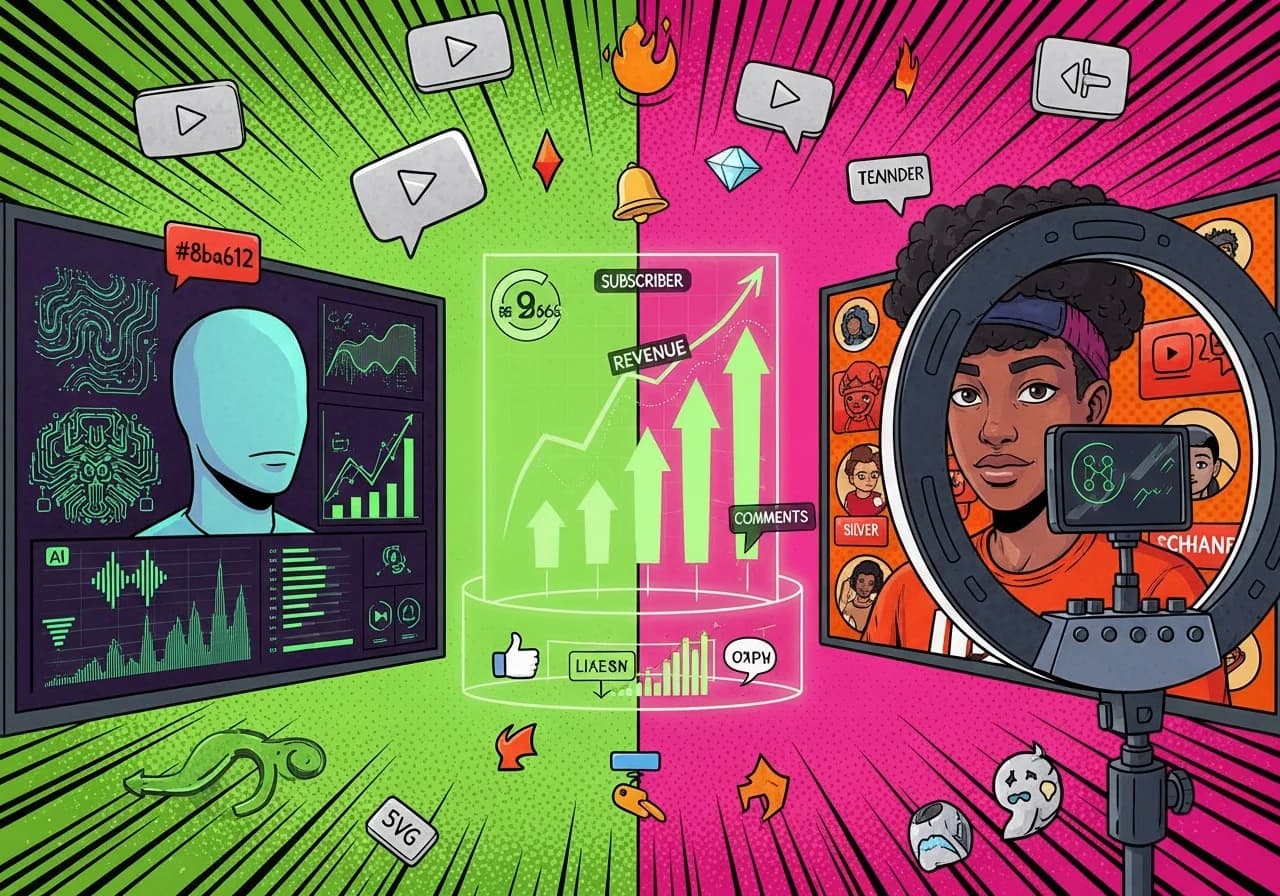
Faceless vs Face-On-Camera YouTube Channels: Growth, Monetization & Engagement
Neither format is definitively better in 2025, but they serve dramatically different goals and growth paths.
Face-on-camera channels build faster trust through parasocial relationships and enjoy 25-30% higher thumbnail click-through rates. Faceless channels offer superior scalability, privacy protection, and often command higher RPMs in B2B niches.
The creator economy has matured enough that both formats now generate substantial revenue. Kurzgesagt reached 24.8 million subscribers without ever showing a face. WatchMojo built a $200,000+ monthly ad revenue empire with zero on-camera talent. Meanwhile, MrBeast's face-forward approach helped him amass 450 million subscribers and build a $700 million annual empire.
The data reveals that format matters far less than execution, niche selection, and consistency.
As explored in our comprehensive faceless YouTube channel guide, the right choice depends entirely on your goals.
Table of Contents
- How the Algorithm Treats Face and Faceless Content
- The Trust Equation Behind Parasocial Relationships
- Revenue Reality Check: RPM and Monetization by Format
- Engagement Metrics Reveal Format-Specific Strengths
- Scalability: Where Faceless Channels Dominate
- YouTube's July 2025 Policy Update Clarified
- Case Studies Prove Both Formats Can Succeed Massively
- When Faceless Is the Right Choice
- When Showing Your Face Creates Clear Advantages
- The Hybrid Approach Growing in Popularity
How the Algorithm Treats Face and Faceless Content {#how-the-algorithm-treats-face-and-faceless-content}
YouTube's recommendation system doesn't explicitly favor faces, but human psychology does.
According to research from AmpiFire analyzing top-performing videos in 2025, videos with human faces in thumbnails receive an average of 921,000 more views than those without.
This isn't algorithmic bias. It's evolutionary wiring. Our brains prioritize processing faces over other visual elements within milliseconds.
Thumbnail Performance Data
The numbers tell a compelling story:
- Thumbnails featuring faces with strong emotion increase CTR by 20-30%
- Top creators like MrBeast achieve 8-12% click-through rates through systematic thumbnail testing
- Average channels hover around 3-4% CTR
- The "sadness paradox": while happy faces appear in 25.3% of thumbnails, sad faces (only 1.8% of thumbnails) achieve the highest average views at 2.3 million per video
But here's where it gets interesting for faceless creators.
YouTube's Senior Director of Growth & Discovery, Todd Beaupré, clarified the algorithm's actual priorities in a January 2025 interview. According to Search Engine Journal's deep dive into YouTube's recommendation system, "We introduced this concept of satisfaction, we're trying to understand not just about the viewer's behavior and what they do, but how do they feel about the time they're spending."
The platform processes over 80 billion signals daily to determine satisfaction. CTR is just one piece.
Algorithm Priorities for All Formats
YouTube measures these signals equally regardless of face presence:
- Watch time and completion rates
- Likes, dislikes, and survey responses
- Search behavior and rewatches
- Shares and saves
- Click-through rate from impressions
Faceless channels that deliver genuine value can absolutely thrive. YouTube's Test & Compare feature, broadly rolled out in June 2024, now allows creators to A/B test up to three thumbnails per video.
Increasingly, faceless channels are discovering that well-designed graphic thumbnails can compete with face-based alternatives in their specific niches. Tools like Virvid help faceless creators maintain consistent visual branding while producing content at scale, which is critical for competing in saturated markets.
The Trust Equation Behind Parasocial Relationships {#the-trust-equation-behind-parasocial-relationships}
A February 2025 study published in the International Journal of Research in Marketing examined exactly how face presence impacts engagement.
The key finding challenges assumptions: moderate face presence at the beginning of videos facilitates optimal engagement, not maximum face time throughout.
Even more revealing, the face presence effect is less pronounced for influencers with higher follower counts.
The Trust Bootstrap Effect
This suggests face-showing provides what researchers call a "trust bootstrap" effect:
- Smaller creators benefit enormously from faces because viewers haven't yet established loyalty
- Once that trust exists through consistent quality content, the face becomes less critical
- Established faceless brands can maintain engagement through visual consistency and voice recognition
The science of parasocial relationships helps explain why. Cambridge Dictionary named "parasocial" its Word of the Year for 2025, reflecting how mainstream this concept has become.
A 2024 Scientific Reports study (N=3,085) found something remarkable: strong parasocial relationships with YouTube creators were rated more effective at fulfilling emotional needs than relationships with real-life acquaintances. Only close friends and family scored higher.
Competitive Advantages by Format
| Format | Primary Trust Mechanism | Engagement Driver | Best For |
|---|---|---|---|
| Face-On-Camera | Parasocial relationships | Emotional connection | Personal brands, coaching, lifestyle |
| Faceless | Consistent quality & value | Information utility | Tutorials, education, B2B content |
| Hybrid | Both personality & systems | Balanced approach | Media businesses, scaled operations |
For face-on-camera creators, parasocial bonds represent a massive competitive advantage. Viewers who feel emotionally connected watch more videos, buy more products, and remain loyal through algorithm shifts.
Faceless channels can still build engagement, but through different mechanisms. When you can't rely on charismatic camera presence, your research quality, creativity, and production value must compensate entirely.
This is why platforms like Virvid focus on helping faceless creators maintain professional production quality at scale, enabling them to compete through volume and consistency rather than personality.
Revenue Reality Check: RPM and Monetization by Format {#revenue-reality-check-rpm-and-monetization-by-format}
The monetization myth that faceless channels can't generate serious revenue died long ago.
According to VidBoard.ai's 2025 analysis, faceless automation channels frequently earn $15-40 per 1,000 views, often commanding higher CPMs than face-based vlogs because tutorial and educational content attracts advertisers paying premium rates.
High-RPM Niches Favor Faceless Formats
B2B advertisers care about audience demographics and intent, not whether a face appears on screen.
Top-earning faceless niches in 2025:
- Finance explainer channels: $10-15 RPM
- English learning content: $11.88 RPM
- Tech tutorials and software reviews: $8-12 RPM
- Business and entrepreneurship: $9-14 RPM
- Legal and tax advice: $12-18 RPM
Compare this to lifestyle vlogs that typically earn $2-5 RPM despite showing faces throughout.
Real Revenue Examples from Successful Faceless Channels
| Channel | Subscribers | Format | Monthly Ad Revenue (Est.) |
|---|---|---|---|
| DaFuq!?Boom! | 43M | Animation/Gaming | $500,000 - $1,300,000 |
| The Infographics Show | 14M | Animated explainers | $100,000 - $300,000 |
| WatchMojo | 25.9M | Voiceover lists | $69,000 - $206,000 |
| Lofi Girl | 15.3M | Music streams | Variable (streaming revenue) |
Sponsorship dynamics differ between formats, however. Face-on-camera creators typically command 20-30% higher sponsorship rates in lifestyle niches because brands want ambassadors, not just ad placements.
A 100K subscriber face channel might secure $5,000-$10,000 per dedicated integration, while an equivalent faceless channel in the same niche might cap around $1,000-$5,000.
The Counterpoint for Product-Focused Content
But there's an important nuance. Research shows product demonstrations reach 27% higher engagement when shown without a distracting presenter face.
For these content types, faceless formats actually convert better:
- Tech reviews and unboxings
- Software tutorials and screen recordings
- Product comparisons and buying guides
- Cooking recipes and crafts
- Assembly instructions
Diversified Monetization Strategies
The real monetization advantage for faceless channels lies in diversification:
Faceless channels excel at:
- Digital products (templates, presets, tools)
- Affiliate marketing for product-focused content
- Licensing content to media companies
- Building multiple revenue streams simultaneously
- Running channels as sellable business assets
Face-on-camera channels dominate:
- High-ticket coaching and consulting
- Personal transformation programs
- Community memberships with direct interaction
- Speaking engagements and appearances
- Brand ambassador deals
If you're building a faceless channel and want to maximize revenue, consider exploring opportunities like the Virvid affiliate program, which offers 30% passive recurring revenue for life. Many faceless creators are already generating substantial passive income promoting AI video tools to their audiences, since these tools directly solve their viewers' content creation challenges.
For more monetization strategies specific to faceless channels, check out our guide on how to monetize faceless YouTube channels in 2026.
Engagement Metrics Reveal Format-Specific Strengths {#engagement-metrics-reveal-format-specific-strengths}
The engagement data paints a nuanced picture. Average YouTube engagement rates hover around 2% across all channels, with 3-7% considered good and 10%+ exceptional.
But these numbers vary significantly by format and niche.
Face-On-Camera Engagement Advantages
Face channels typically generate stronger comment engagement because viewers feel a personal connection:
- More likely to share opinions and ask personal questions
- Higher participation in community discussions
- Gaming and education channels achieve 3-3.5% membership conversion rates
- Stronger Super Chat and donation performance during live streams
Creators keep 70% of Super Chat revenue, making this a significant income stream for channels with strong parasocial bonds.
Faceless Channel Engagement Patterns
Faceless channels show different engagement patterns that are equally valuable:
- Higher save rates as viewers bookmark tutorials and references
- Better return viewing for how-to content and series
- Lower comment rates but higher quality, question-focused comments
- Search-driven traffic that's less dependent on subscriber notification clicks
Product demonstrations and tutorials generate fewer parasocial comments but serve viewer needs more directly. Viewers treat the content as a utility rather than entertainment, which affects metrics differently but doesn't diminish value.
The AI Content Engagement Penalty
However, AI-generated content faces severe engagement penalties regardless of format. Research from 2025 shows 70% lower audience retention for heavily AI-generated content versus human-fronted alternatives.
Even low-quality human narration outperforms the best AI narration on retention metrics. This is a critical consideration for faceless creators tempted by full automation.
The solution isn't avoiding AI entirely but using it strategically. Platforms like Virvid combine AI efficiency with human creative input, letting you generate trending video scripts while maintaining authentic voiceover and editorial control. This hybrid approach avoids the retention penalty while capturing the speed benefits.
Membership and Community Revenue Comparison
| Metric | Face-On-Camera | Faceless | Key Driver |
|---|---|---|---|
| Membership conversion | 3-3.5% | 1.5-2% | Parasocial bond strength |
| Super Chat per stream | $1,500-$3,500 | $300-$800 | Personal connection |
| Comment engagement | 4-8% | 2-4% | Community feeling |
| Video saves | 1-2% | 3-5% | Utility value |
The takeaway: face-on-camera channels monetize community better, while faceless channels serve as evergreen resources that viewers return to repeatedly.
Scalability: Where Faceless Channels Dominate {#scalability-where-faceless-channels-dominate}
If you're building a media business rather than a personal brand, faceless formats offer structural advantages that compound over time.
The math is straightforward. Face-on-camera channels depend on a single person's time, energy, and continued motivation. Faceless channels can systematize every aspect of production.
Real-World Scaling Examples
One creator, Noah Morris, scaled to seven figures annually managing over 20 faceless channels while dedicating just one day per week to oversight.
That's impossible with face-dependent content.
The "MyMind" channel (3.2 million subscribers) scaled from 1 to 5 videos weekly using automation workflows, achieving 400% growth in monthly views.
Team Building and Modular Production
Faceless channel production breaks into modular tasks that can be outsourced:
- Scriptwriting: $30-80 per script from freelance writers
- Voiceover: $50-100 or AI alternatives at fraction of cost
- Video editing: $50-300 depending on complexity
- Thumbnail design: $15-50 per thumbnail
Each task can be assigned to different specialists without breaking the brand identity. A single face-on-camera creator would need to personally appear in every video indefinitely.
For creators looking to scale production while maintaining quality, our guide on YouTube automation for faceless channels covers systems for producing 100+ videos monthly.
Running Multiple Channels Simultaneously
Many successful operators manage 5+ channels across different niches:
- Batching content production for efficiency
- Cross-pollinating audiences between related channels
- Testing different formats without risking main brand
- Diversifying income across multiple revenue streams
This is only practical with faceless formats. You can't personally appear in 5 videos daily across different channels.
Tools like Virvid make multi-channel management feasible by enabling you to generate trending video scripts and produce consistent content across all your channels without the bottleneck of personal recording time.
Exit Strategy and Business Valuation
When selling a YouTube channel as a business asset, faceless channels command higher valuation multiples due to transferability.
Industry data shows channel sale prices ranging from 12-36x monthly net profit, but face-dependent channels often sell at significant discounts due to "key person risk."
As Motion Invest notes: "It is easier to sell a faceless channel where the creator is unseen than a talking head channel."
Factors affecting channel sale value:
- Faceless channels: Higher multiples (24-36x) due to transferability
- Face channels: Lower multiples (12-20x) due to personality dependency
- Team-run faceless: Highest multiples, treated as real businesses
- Solo face channels: Lowest multiples, buyer assumes rebuild risk
If you're building YouTube as a business asset to eventually sell, faceless is structurally superior from day one.
YouTube's July 2025 Policy Update Clarified {#youtubes-july-2025-policy-update-clarified}
Fear spread through creator communities when YouTube announced policy updates in July 2025 targeting "inauthentic content."
Headlines claimed faceless channels were under attack. The reality is far more measured.
What Actually Changed
Effective July 15, 2025, YouTube updated guidelines to "better identify mass-produced and repetitious content."
The key change: "Repetitious content" was renamed to "Inauthentic content."
According to Rene Ritchie, YouTube's Head of Editorial & Creator Liaison, "This is a minor update to YouTube's longstanding YPP policies. It's just clarifying what we mean by inauthentic and repetitive content."
Content Flagged for Demonetization
The policy targets specific violations:
- Automatically generated videos with minimal human input
- Highly similar videos uploaded in bulk without variation
- Basic compilations without added commentary or analysis
- Text-to-speech over stock footage without human narration or perspective
- Mass-produced content created solely for revenue without genuine value
What Remains Fully Monetizable
The policy explicitly does not target these faceless formats:
- AI-assisted videos with human narration, editing, or analysis
- Reaction videos and commentary content
- AI used as a tool rather than sole creator
- Faceless channels delivering genuine educational or entertainment value
- Channels using consistent voiceover personalities
- Professionally produced faceless content with creative input
As detailed in this Substack analysis of the July 2025 update, "YouTube is not banning AI content or faceless videos. They're targeting low-effort spam that provides no value to viewers."
Real Enforcement Examples
The distinction matters in practice:
Demonetized examples:
- A channel uploading 150+ AI-generated murder stories with zero human oversight
- Networks spreading AI-generated fake celebrity news
- Channels posting identical motivational slideshows 20 times daily
Safe examples:
- Finance explainer channels using AI research with human scripts
- Educational channels with AI voiceover but unique analysis
- Tutorial channels with screen recordings and human commentary
Legitimate faceless creators operating with genuine creative input continue thriving. The key is using AI as a tool to enhance your work, not replace all human creativity.
Platforms like Virvid are specifically designed to help faceless creators stay on the right side of these policies by combining trending formats with genuine creative control over scripts, visuals, and editing choices.
For more details on staying compliant, see our guide on faceless YouTube channel copyright and fair use.
Case Studies Prove Both Formats Can Succeed Massively {#case-studies-prove-both-formats-can-succeed-massively}
The evidence for both formats exists at the highest levels of YouTube success.
Kurzgesagt: The Gold Standard for Faceless Educational Content
Kurzgesagt, In a Nutshell reached 24.8 million subscribers and 3.4 billion total views using animated explainer videos without any on-camera personality.
Journey highlights:
- Started with founder Philipp Dettmer working solo
- Set initial goal of just 100 subscribers
- By 2024, the team grew to approximately 70 employees
- Revenue model: 65% from viewers (merchandise, Patreon, AdSense), only 24% from sponsorships
The channel proves faceless content can build massive loyal audiences when quality and consistency are prioritized.
WatchMojo: Volume Strategy Success
WatchMojo demonstrates high-volume faceless success with 25.9 million subscribers and a staggering 17.76 billion total views across 31,000+ videos.
Key strategies:
- Uploads 6+ videos daily using team-based production
- Nearly failed during first six years (founders took no salary, used second mortgages)
- Pivot to Top 10 format transformed business
- Now employs 100+ people globally
- Built entirely on voiceover format without any on-camera talent
Lofi Girl: The Power of Ambient Content
Lofi Girl built 15.3 million subscribers around ambient music livestreams without any human presenter.
Milestone moments:
- Celebrated 10th anniversary in March 2025
- Held special "graduation" event in July 2025
- Maintained continuous streaming for 8 years
- Monetizes through music licensing, merchandise, and streaming revenue
HowToBasic: Mystery as a Feature
HowToBasic maintains 17.7 million subscribers while keeping the creator's identity completely anonymous since 2011.
The channel built its entire brand around mystery, proving that anonymity can become a feature rather than a limitation.
Face-Forward Success: MrBeast's Empire
On the face-forward side, MrBeast demonstrates the upper ceiling of personal brand building:
- 450+ million subscribers across all channels
- $600-700 million annual revenue
- Massive production infrastructure with 200+ employees
- Proves faces can scale with sufficient team and budget
Key Lessons from Successful Channels
| Success Factor | Faceless Example | Face Example | Lesson |
|---|---|---|---|
| Consistency | WatchMojo (6+ videos/day) | MrBeast (weekly) | Volume works for faceless |
| Quality | Kurzgesagt (bi-weekly) | Marques Brownlee | Quality over quantity for both |
| Niche Authority | The Infographics Show | Ali Abdaal | Deep expertise wins |
| Brand Identity | Lofi Girl (aesthetic) | Casey Neistat (personality) | Consistency creates recognition |
Both formats can reach the highest levels of YouTube success. The determining factors are execution quality, niche selection, and sustainable systems.
If you're starting a faceless channel and want to explore profitable niches, check out our guide on 20 profitable faceless YouTube channel ideas for 2026.
When Faceless Is the Right Choice {#when-faceless-is-the-right-choice}
Choose faceless formats when privacy matters more than personal brand equity.
Many creators have professional careers, family considerations, or simply prefer anonymity. Faceless channels protect your identity while still enabling substantial income.
Ideal Scenarios for Faceless Channels
Privacy and security concerns:
- Maintaining professional career separation
- Protecting family members from public exposure
- Living in locations where online visibility creates risks
- Avoiding unwanted recognition in daily life
Content strategy advantages:
- Planning to run multiple channels simultaneously
- Targeting search-driven evergreen content
- Creating tutorial and how-to content where personality is secondary
- Building in niches where information quality matters more than presenter charisma
Business model priorities:
- Want to eventually sell channel as transferable business asset
- Plan to scale with team and outsourcing
- Prefer systems over personal time investment
- Targeting B2B audiences and high-RPM niches
High-Performing Faceless Niches in 2025
Based on industry analysis of profitable YouTube niches, these faceless formats consistently perform well:
- Finance and investing: $10-15 RPM, evergreen content
- Tech tutorials and software reviews: High engagement, affiliate opportunities
- Language learning: $11.88 RPM, global audience
- History and science education: Strong watch time, loyal audiences
- Cooking and recipes: Visual focus, minimal personality needed
- Ambient content (study music, nature sounds): Passive viewing, long watch times
For creators uncomfortable on camera or simply preferring privacy, faceless channels provide a proven path to substantial YouTube income without personal exposure.
Tools like the free AI video script generator can help you develop compelling narratives without needing on-camera presence, making faceless content creation more accessible than ever.
When Showing Your Face Creates Clear Advantages {#when-showing-your-face-creates-clear-advantages}
Face-on-camera dominates when building a personal brand is the goal.
If you plan to launch courses, coaching programs, speaking engagements, or consulting services, your face becomes a business asset that compounds in value over time.
Ideal Scenarios for Face-On-Camera Channels
Personal brand building:
- Launching premium coaching or consulting offers
- Building authority in competitive expert niches
- Creating course businesses around your methodology
- Developing speaking career and media appearances
Community-focused channels:
- Membership programs requiring personal connection
- Live stream interaction and Super Chat monetization
- Building tight-knit communities around shared interests
- Channels where personality is the differentiator
Competitive differentiation:
- Entering saturated niches where personality sets you apart
- Creating content where trust and relatability matter
- Building in lifestyle and entertainment categories
- Targeting audiences seeking parasocial connection
High-Performing Face-Forward Niches
These niches heavily favor visible creators:
- Personal finance and investing: Dave Ramsey, Graham Stephan
- Fitness and transformation: Authenticity and results matter
- Lifestyle and daily vlogging: Personality-driven content
- Business and entrepreneurship: Personal credibility crucial
- Gaming with commentary: Personality is the entertainment
The Long-Term Commitment Factor
Choose face-on-camera if you're comfortable with permanent association between your face and content.
This is an asset when it works but limits exit strategies compared to faceless formats. Your channel's value becomes inseparable from your personal brand.
Consider these factors:
- Can you commit to appearing on camera for 3-5+ years?
- Are you comfortable with potential public recognition?
- Does your professional life allow for online visibility?
- Can you maintain consistent appearance and energy on camera?
If the answer to all these is yes, face-on-camera channels offer the fastest path to building strong community bonds and premium monetization through personal brand strength.
The Hybrid Approach Growing in Popularity {#the-hybrid-approach-growing-in-popularity}
Many successful creators blend both formats, capturing advantages from each approach.
Common Hybrid Strategies
Educational content stays faceless, personality moments use face:
- Main tutorial videos remain screen recordings or animated
- Channel updates, Q&As, and milestone videos show creator
- Behind-the-scenes content reveals personality
- Maintains operational efficiency while building connection
Multiple channel strategy:
- Flagship face channel builds personal brand
- Satellite faceless channels in adjacent niches
- Face channel drives authority and sponsorships
- Faceless channels provide scalable revenue streams
Transition strategy:
- Start faceless to validate niche and build skills
- Introduce face gradually once audience is established
- Maintains privacy during early experimentation
- Adds personal connection after proving concept
Benefits of Hybrid Approach
This strategy captures the best of both worlds:
- Operational efficiency from faceless content production
- Community bonds from occasional face appearances
- Scalability through team-produced faceless videos
- Personal brand building for premium monetization
- Flexibility to adjust based on what works for your audience
The hybrid approach works particularly well for creators who started faceless but want to deepen audience relationships. Showing your face periodically satisfies viewer curiosity while maintaining the operational benefits of primarily faceless content.
Testing Your Way to the Right Answer
YouTube's Test & Compare feature lets you empirically determine what works for your specific audience rather than relying on general statistics.
How to Run Effective A/B Tests
YouTube's native A/B testing allows you to upload up to three thumbnail variations per video, including face and faceless versions.
Testing process:
- Create thumbnail variations with and without faces
- Upload all versions when publishing video
- YouTube automatically rotates thumbnails to different viewers
- Platform optimizes for watch time share, not just clicks
- Review results after 14 days or statistical significance
This matters because great thumbnails don't just attract attention, they set accurate expectations that keep viewers watching. A face thumbnail that drives clicks but disappoints viewers will lose to a faceless thumbnail that better represents content.
Testing Best Practices
What to test:
- Face emotional vs faceless graphic thumbnails
- Different facial expressions (surprise, excitement, curiosity)
- Creator face vs subject matter focus
- Text overlay variations with and without face
How to interpret results:
- CTR alone isn't success, watch time matters more
- Lower CTR with higher retention often wins
- Test for at least 14 days to capture different traffic sources
- Account for video topic variations affecting results
Advanced Testing Tools
Third-party tools offer expanded capabilities:
- ThumbnailTest.com: Test 10+ variations vs YouTube's native three
- TubeBuddy: A/B testing with detailed analytics
- VidIQ: Competitor thumbnail analysis and testing
Creators who systematically A/B test see average CTR improvements of 154% within 3 months, with the top 10% achieving over 300% improvement.
Your specific niche, audience, and content style may respond differently than aggregate statistics suggest. Testing reveals what actually works for your channel rather than assumptions based on other creators' results.
The Decision Framework That Matters Most
Neither format guarantees success, and both can fail spectacularly without proper execution.
The choice between faceless and face-on-camera should follow from your goals rather than trend-chasing.
Choose Faceless If You Want:
Privacy and anonymity:
- Maintain separation from professional career
- Protect family from public exposure
- Avoid personal recognition
- Keep creative options open
Scalability and systems:
- Build teams without appearing in every video
- Run multiple channels simultaneously
- Create sellable business assets
- Maximize revenue per hour of personal time
Specific content types:
- Search-driven evergreen tutorials
- Technical education and how-tos
- B2B content and high-CPM niches
- Product reviews and comparisons
- Compilation and list-based content
Choose Face-On-Camera If You Want:
Personal brand building:
- Launch coaching or consulting services
- Build authority for speaking career
- Create premium course businesses
- Establish yourself as industry expert
Community-driven monetization:
- Maximize membership and Super Chat revenue
- Build tight-knit communities
- Create personality-driven entertainment
- Develop parasocial connection advantages
Personality as differentiator:
- Stand out in saturated competitive niches
- Build in lifestyle and vlog categories
- Create content where trust and relatability matter
- Target audiences seeking connection
Consider Hybrid If You Want:
Flexibility and testing:
- Try both approaches to see what resonates
- Build personal connection without full commitment
- Scale some content while personalizing others
- Create media brand with multiple revenue streams
Balanced approach:
- Efficiency of faceless production
- Community bonds from occasional face content
- Personal brand for premium offers
- Scalable systems for volume content
Start Creating Content That Matches Your Goals
The 2025 data confirms what many suspected: format matters far less than consistency, quality, and niche selection.
Both paths lead to substantial creator success. The question is which path aligns with the business and lifestyle you're actually trying to build.
Your next steps:
- Clarify your primary goal: Personal brand vs scalable business
- Choose 1-2 niches from our list of 20 profitable faceless YouTube channel ideas
- Test both formats using YouTube's A/B testing for your specific audience
- Start producing consistently with tools like Virvid to maintain quality at scale
- Track your metrics and double down on what actually works for your channel
Whether you choose faceless for privacy and scale, face-on-camera for community and personal brand, or a hybrid approach combining both advantages, the most important decision is to start creating and learning from real audience feedback.