

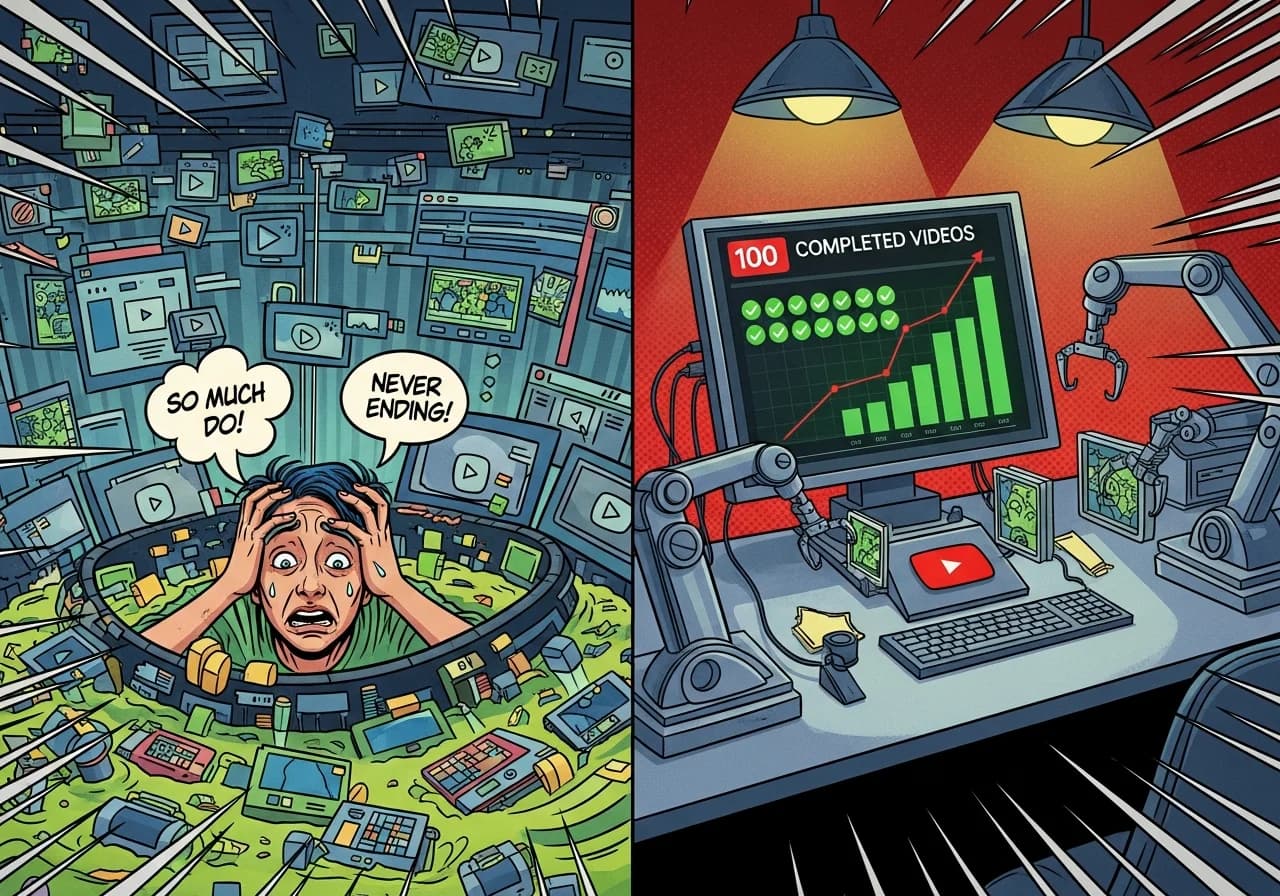
YouTube Automation for Faceless Channels: How to Scale to 100+ Videos/Month
Producing 100 quality videos per month without showing your face is now technically feasible. Sustainable success requires understanding the narrow path between automation efficiency and YouTube's increasingly aggressive anti-spam enforcement.
Table of Contents
- The Creator Economy Context in 2026
- The December 2025 API Quota Change
- YouTube's July 2025 Inauthentic Content Policy
- The 10-Step Policy-Compliant Automation Blueprint
- What You Cannot Automate
- Realistic Cost Structure for 100 Monthly Videos
- Recommended Automation Stack
- Three-Month Scaling Roadmap
- Critical Warnings for Sustainable Automation
The Creator Economy Context in 2026
The creator economy reached $250 billion in 2024 and is projected to hit $480-500 billion by 2027. YouTube specifically contributed $55 billion to U.S. GDP in 2024, supporting nearly 490,000 full-time equivalent jobs.
Key faceless channel statistics:
- Approximately 30-35% of successful new YouTube channels don't feature the creator's face
- YouTube removed 9.5+ million videos in Q4 2024 alone
- Significant portion of removals targeted automated content farms
- Average retention rate across YouTube: 23.7%
- Educational how-to content achieves highest retention at 42.1%
The opportunity is massive, but so are the risks. As covered in our ultimate guide on faceless YouTube channels, success requires balancing automation efficiency with genuine quality.
The December 2025 API Quota Change
A significant but underreported change occurred on December 4, 2025: YouTube reduced the quota cost for video uploads via the Data API from approximately 1,600 units to 100 units per upload, according to Google's API revision history.
What This Means for Automation
| Metric | Before Dec 2025 | After Dec 2025 | Impact |
|---|---|---|---|
| Quota cost per upload | 1,600 units | 100 units | 94% reduction |
| Daily uploads (10K quota) | 6 videos | 100 videos | 16x increase |
| Monthly capacity (API only) | ~180 videos | ~3,000 videos | Effectively unlimited |
With the default 10,000-unit daily quota, creators can now theoretically upload 100 videos per day via API compared to just 6 uploads under the previous cost structure.
For a target of 100 videos per month (averaging 3.3 per day), API quotas are no longer the primary constraint. The new bottleneck is content quality and policy compliance, not technical limits.
Additional Technical Constraints
Account verification requirements:
- Unverified accounts: 15-minute maximum video length
- Verified accounts: Up to 12 hours and 256GB per file
- Verification requires SMS or voice call at youtube.com/verify
Platform-wide daily caps:
- YouTube doesn't publish exact numbers
- User reports suggest verified accounts can upload 50+ videos daily
- Quota resets at midnight Pacific Time
- Strategic scheduling around reset optimizes throughput
Quota increase requests:
- Free process through YouTube API Services Audit and Quota Extension Form
- Requires demonstrating API Terms of Service compliance
- Typical processing time: 3-4 business days
- Videos from unverified API projects (post-July 28, 2020) restricted to private mode until audit completion
YouTube's July 2025 Inauthentic Content Policy
On July 15, 2025, YouTube officially renamed its "repetitious content" policy to "inauthentic content" with expanded enforcement criteria.
The Official Definition
According to YouTube's monetization policies:
"Inauthentic content refers to mass-produced or repetitive content. This includes content that looks like it's made with a template with little to no variation across videos, or content that's easily replicable at scale."
Content Explicitly Ineligible for Monetization
- Readings of materials you didn't create (website text, news feeds)
- Songs modified only by pitch or speed
- Image slideshows with minimal narrative
- Channels uploading stories with only superficial differences between videos
Critical enforcement detail: Violations occur at the channel level, affecting your entire channel, not just individual videos.
What YouTube Explicitly Welcomes
YouTube officially supports AI tools that:
- Enhance storytelling and narrative structure
- Generate scripts and outlines
- Create automatic captions
- Provide autodubbing for multiple languages
- Generate thumbnails
- Clone your own voice for narration
The distinction lies in whether automation replaces human creativity or enhances it. Tools like Virvid exemplify the approved approach, using AI to accelerate production while maintaining genuine variation and storytelling quality.
Altered/Synthetic Content Disclosure Requirements
Effective March 2024, per YouTube's disclosure documentation, creators must disclose when content:
- Makes a real person appear to say or do something they didn't
- Alters footage of real events
- Generates realistic-looking scenes that didn't occur
Implementation details:
- Disclosure toggle appears during upload under "Altered Content"
- Non-disclosure can result in YouTube applying permanent label
- Consistent failures face content removal or Partner Program suspension
- Disclosure does NOT affect monetization eligibility, purely transparency
The 10-Step Policy-Compliant Automation Blueprint
Step 1: Strategy Layer (Human-Driven Niche Selection)
Choose a narrow niche with repeatable format allowing genuine variation. The best candidates share three characteristics:
- Evergreen search demand
- High natural variation within the topic
- Adequate RPM to support production costs
RPM rates by niche (December 2025 data):
| Niche | RPM Range | Best For |
|---|---|---|
| Finance & Investing | $4.95-$16.50 | High-value automation |
| Technology Tutorials | $1.51-$9.08 | Evergreen content |
| Educational How-To | $3-$8 | Best retention (42.1%) |
| Gaming | $0.88-$3.30 | High volume needed |
| Music | $0.50-$1.50 | Difficult economics |
Effective format choices with natural variation:
- State-by-state guides (50 natural variations)
- Product comparison series (different products = inherent uniqueness)
- News analysis with consistent methodology
- Tutorial library (different software features = distinct value)
Each video must offer genuinely different information or perspective, not just different titles on identical templates. For inspiration on profitable niches, check out 20 profitable faceless YouTube niches for 2026.
Step 2: Topic Ideation (Semi-Automated)
Blend automation with human curation:
- Use YouTube Studio's Trends tab
- "Content gaps" feature identifies underserved search demand
- "Breakout videos" shows what's gaining traction
- LLM-generated topic lists using custom prompts
- Build topic queue with priority scoring
- Human approval filters problematic ideas
Weekly review process:
- Budget 2-3 hours for topic review
- Filter out ideas producing near-identical videos
- Prevent downstream waste from non-monetizable content
- Update prompt templates based on what passes review
You can streamline topic generation using tools like the free AI video script generator to test topic viability before committing to full production.
Step 3: Script Generation (AI + Mandatory Human QA)
LLM first-draft specifications:
- Long-form content: 600-1,200 words (5-10 minutes voiceover)
- YouTube Shorts: 90-150 words
- Custom prompting with detailed style guides
- Enforce variety in structure, examples, perspective
The mandatory human QA pass:
- Budget 10-20 minutes per video
- Fact-checking all claims
- Tone and variety review
- Ensure original perspective
Batch review approach:
- Produce 10-15 scripts
- Review all together to catch repetitive patterns
- Track which scripts pass without revision
- Target 70%+ pass rate
- Update style guide when patterns fail consistently
For different content types, consider specialized generators like the tutorial video script generator or true crime video script generator that already encode genre-specific best practices.
Step 4: Voiceover Production (Automated with Quality Control)
High-quality TTS implementation:
- ElevenLabs Voice Design creates distinctive channel voices
- Pro plan: $99/month provides 500 minutes (sufficient for 100 five-minute videos)
- Create 2-3 distinct "characters" for different series
- Prevents monotony triggering viewer fatigue
Policy-compliant voice usage:
- Cloning your own voice for narration: No disclosure required
- Using synthetic voices as if you're someone else: Disclosure required
- Safest approach: Disclose even when technically optional
Batch processing workflow:
- Integrate ElevenLabs API with workflow orchestrators
- Generate overnight batches for week's worth of content
- Quality control checks on pronunciation and pacing
- Alternative budget option: ElevenLabs Creator at $22/month
Step 5: Visual Assembly (The Highest Policy Risk)
Low-effort slideshows with AI voiceover are precisely what YouTube's enforcement targets. Compliant visual production requires intentional variety.
Licensed stock footage sources:
- Storyblocks Unlimited: $30/month with YouTube license
- Artlist Max Pro: $40/month for 8K footage
- Maintain license records for all assets
- Prefer platforms that whitelist YouTube channels
AI-generated B-roll pricing:
- Runway Pro: $35/month for ~450 seconds
- Luma AI: Varies by usage
- Pika: Standard plans available
- Keep prompts varied to avoid repetitive look
Additional visual elements:
- Screen recordings for tutorials
- Motion graphics with actual data visualization
- Dynamic captions (mandatory for accessibility)
- Avoid slideshow loops and static Ken Burns effects
The practical test: If someone watching three of your videos couldn't identify them as from the same channel based on visuals alone, you've failed. Consistent branding with varied execution is the goal.
Platforms like Virvid handle this balance automatically, maintaining consistent brand aesthetics while ensuring each video has genuinely unique visuals that tell the specific story.
Step 6: Thumbnail Generation (Templated But Varied)
YouTube's Test & Compare feature allows A/B testing up to 3 thumbnails per video. Automated channels should use this aggressively.
Thumbnail automation approach:
- Create 10+ base templates with different layouts
- Ensure each video receives unique thumbnail
- Change specific elements beyond just text
- Target CTR above 3% (below this, YouTube stops promoting)
Tool options:
- Canva Pro: $12.95/month for manual creation
- Templated.io: ~$29/month for API-accessible automation
- Generate from video metadata to ensure accuracy
Investment in thumbnail quality directly affects video visibility. Low CTR causes YouTube to stop promoting videos within 48 hours.
Step 7: Metadata Optimization (AI Within Guardrails)
Auto-generate with strict guardrails:
- Titles and descriptions via LLMs
- Prevent clickbait and ensure accuracy
- Include timestamps/chapters (improves SEO and viewer experience)
- 2-5 relevant hashtags (avoid spam)
The altered/synthetic content disclosure toggle:
- Cannot be fully automated
- Requires human review of disclosure requirements
- When in doubt, disclose
- Appears in expanded description
- Does NOT affect monetization
Additional metadata elements:
- Language tracks for international reach
- Alt text for accessibility
- Complete video information
- Algorithm increasingly favors complete metadata
Step 8: Upload Scheduling (Strategic Distribution)
With the December 2025 API quota change, technical limits are no longer the primary constraint. Strategic scheduling still matters.
Scheduling best practices:
- Spread 100 monthly videos as approximately 3-4 per day
- Maintain consistent channel activity
- Avoid triggering spam detection heuristics
- Buffer time for YouTube's pre-publish Checks
- Implement retry logic for transient failures
Video assembly options:
- Shotstack: $99/month for 500 rendering credits
- Remotion with Lambda: ~$2-5/month in AWS costs
- Custom FFmpeg scripts
Workflow orchestration:
- Make.com Pro: $16/month
- Custom Python scripts with YouTube Data API
- Schedule for audience's peak viewing times (varies by niche)
Step 9: Post-Publish Monitoring (Catch Problems Early)
Automated monitoring tracks three critical areas via YouTube Analytics API:
Copyright and ad-suitability:
- Content ID claims
- Ad-suitability status (yellow dollar signs)
- Set alerts for any copyright claim
Performance metrics:
- Retention below 20% triggers review (platform average: 23.7%)
- CTR below 2% signals problems
- For Shorts: swipe-away rate monitoring
- Under 20% in first 3 seconds = strong
- Over 60% = format needs changes
Policy warnings:
- "Inauthentic content" warning is highest priority
- Pause automated uploads immediately if flagged
- Conduct human review of recent content
- Single warning affects entire channel's monetization
Step 10: Quality Control Checkpoints (Protect Channel Health)
Weekly human review of 10% random sample:
- Approximately 10 videos per week at 100 monthly uploads
- Budget 3-4 hours weekly
- Policy compliance verification
- Brand consistency assessment
- Factual accuracy spot-checks
- Viewer feedback analysis
Track trends across reviews:
- Are certain topics consistently lower quality?
- Is a particular script template producing repetition?
- Use findings to refine upstream processes
- Goal: continuous improvement of automation pipeline
For comparing different approaches to content creation, see our analysis of faceless vs face camera YouTube growth.
What You Cannot Automate
Certain functions require human judgment and cannot be safely delegated:
Policy compliance decisions:
- Altered content disclosure assessment
- Fair use evaluation for third-party material
- Ad-suitability review for sensitive topics
- YouTube's systems supplement with human reviewers
Strategic creative direction:
- Determine which niches and formats to pursue
- Automated A/B testing identifies what performs better
- Selecting the option space requires human judgment
- Based on performance data analysis
Copyright and licensing verification:
- Ensure all assets properly cleared for commercial YouTube use
- Stock footage licenses vary significantly
- Some cover YouTube monetization, others don't
- AI-generated content may inadvertently reproduce copyrighted material
Quality threshold enforcement:
- Decide when to kill underperforming formats
- Format with 15% retention hurts channel's algorithmic standing
- Automated metrics flag problems
- Discontinuation decision requires human judgment
Community management:
- Respond to comments genuinely
- Handle viewer reports
- Address any controversy
- Automated replies damage audience trust and risk policy violations
Realistic Cost Structure for 100 Monthly Videos
| Cost Category | Budget Range | Details |
|---|---|---|
| AI Tools | $100-$500/month | Script generation, voiceover (ElevenLabs Pro $99), AI video (Runway Pro $35), LLM API $20-50 |
| Stock Assets | $50-$200/month | Storyblocks $30, music licensing $25-40, images (annual billing saves 15-20%) |
| API/Hosting | $50-$120/month | Cloud storage $5-20, video rendering (Shotstack $99 or Remotion $2-5) |
| Human QA | $1,000-$4,000/month | 20-40 hours review, quality control, strategic oversight (in-house lower, specialized higher) |
| Total | $1,150-$4,700/month | Before any revenue |
Break-even analysis at $3 RPM (conservative mid-tier):
- Low end ($1,150/month): 400,000 monthly views needed
- High end ($4,700/month): 1,600,000 monthly views needed
RPM variations dramatically affect economics:
- Finance niche at $10+ RPM: 115K-470K views for break-even
- Gaming niche at $1 RPM: 1.15M-4.7M views needed
- Geographic factors: English content $10.26 CPM vs India $0.83 CPM
- Seasonal fluctuations: December peak $5.70 CPM, August dip $1.76 CPM
For comprehensive monetization strategies beyond ad revenue, explore 7 revenue streams for faceless YouTube channels in 2026. If you're generating consistent traffic, consider the Virvid affiliate program, which offers 30% recurring lifetime commission, many creators make $21,240+ annually from just 100 referred subscribers.
Recommended Automation Stack
Complete technical architecture:
- All-in-one solution: Virvid offers automated video generation and scheduling that handles the entire pipeline from script to posting across TikTok, YouTube Shorts, and Instagram Reels, with up to 3 videos published daily on complete autopilot while managing multiple channels simultaneously
- Workflow orchestration: Make.com Pro or custom Python with YouTube Data API
- Script generation: Claude or GPT-4 with custom system prompts and style guides
- Voiceover batch processing: ElevenLabs API with Voice Design profiles
- Video assembly: Shotstack API (cloud-based) or Remotion (React programmatic)
- Thumbnail generation: Templated.io API or Photoshop scripting
- Upload scheduling: Custom scripts respecting 100-unit quota per upload
- Monitoring dashboard: YouTube Analytics API with custom alert rules
Three-Month Scaling Roadmap
Month 1: Pipeline Construction (Target 30 Videos)
Focus areas:
- Validate each automation component
- Document what passes "inauthentic" review
- Identify quality thresholds
Expected results:
- 20-30% of initial attempts require significant revision (normal during calibration)
- Functioning end-to-end pipeline
- Zero policy strikes
Success metrics:
- All automation components working
- Clear quality thresholds documented
- No monetization warnings
Month 2: Scale to 60 Videos
Focus areas:
- Analyze retention curves for strongest/weakest formats
- Retention above 30% = expand these formats
- Below 20% = discontinue these formats
- Refine prompts based on QA findings
Expected results:
- Identify top 3 performing formats
- Increase proportion of winners
- QA pass rate above 80%
Success metrics:
- Average retention approaching 23.7% (platform average)
- Clear format winners identified
- Predictable quality output
Month 3: Reach 100 Videos
Focus areas:
- Implement 10% weekly review process
- Establish predictable output-to-revenue ratios
- Systematize exception handling
- Copyright claims and ad-suitability workflows
Expected results:
- Stable monthly output
- Predictable quality levels
- Clear path to monetization
Success metrics:
- 100 videos published
- Positive or break-even unit economics
- No policy warnings or strikes
Critical Warnings for Sustainable Automation
YouTube is actively enforcing against low-quality automation:
- July 2025 policy update reflected increased detection capability
- Channels caught uploading template spam face demonetization
- Severe cases result in termination
- Enforcement trend is toward stricter standards
Many "YouTube automation" courses sell unrealistic promises:
- Claims of passive income ignore substantial QA investment
- Channels with AI-only scripts saw 37% engagement drops after algorithm updates
- Realistic model: AI-assisted production with human quality control
- Not fire-and-forget automation
Successful faceless channels use automation to enhance, not replace:
- BRIGHT SIDE: 44 million subscribers with quality production
- The Infographics Show: 14 million subscribers
- Success built on genuine quality, not template spam
Geographic and niche selection affects economics:
- English-language: $10.26 average CPM
- India-focused: $0.83 average CPM
- December peak: $5.70 CPM
- August dip: $1.76 CPM
For understanding broader copyright considerations when using AI tools and stock footage, review our faceless YouTube copyright and fair use guide.
The Path Forward for Serious Creators
Building a 100-video-per-month faceless channel is genuinely achievable with current tools and within YouTube's policy framework. The December 2025 API quota reduction removed the most frustrating technical bottleneck.
What remains is the harder challenge: producing content that delivers genuine value at scale while maintaining the originality and variety standards YouTube requires.
The creators who will succeed:
- View automation as amplification of creative vision, not replacement
- Invest the 20-40 hours monthly in QA and strategic oversight
- Build feedback loops that continuously improve their pipeline
- Stay informed about policy changes and adapt quickly
For those willing to make that investment, the opportunity is substantial. YouTube's creator economy continues expanding, faceless formats have proven audience demand, and the technical infrastructure for quality production at scale has never been more accessible.
Start with the 30-video Month 1 target, validate your pipeline, and scale deliberately based on data. The channels that will still be thriving in 2027 are being built with that discipline today.