

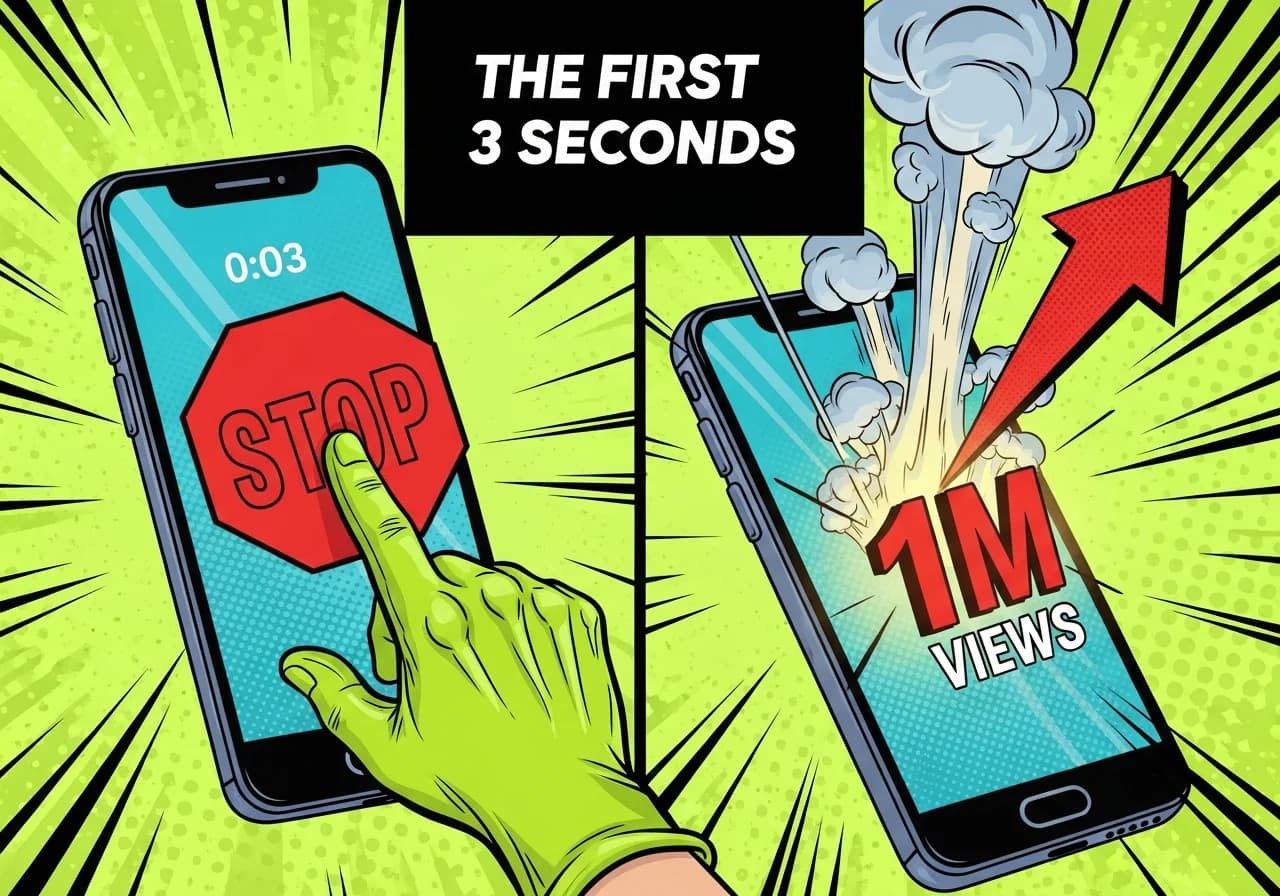
The First 3 Seconds: Hook Structures That Stop Scroll on Shorts
Your hook is not just the opening of your video. On YouTube Shorts, it is the only part that actually controls whether your video gets distributed at all.
Table of Contents
- Why 3 Seconds Decides Everything in 2026
- The 5 Hook Structures That Stop the Scroll
- Hook Anatomy for Faceless Channels Specifically
- How to Write Hooks That Hold Watch Time Too
- Common Hook Mistakes Killing Your Shorts
- Testing and Iterating Your Hooks With Real Data
Why 3 Seconds Decides Everything in 2026
Here is the mechanism creators often miss: YouTube does not wait to see if your content is good before deciding how many people see it.
Since the March 31, 2025 algorithm overhaul, YouTube has operated what Shortimize describes as an "explore-and-exploit" testing framework. Every new Short gets seeded to a small test audience. The algorithm watches a single question: did they swipe away, or did they stay? If your swipe-away rate is high, distribution stops almost immediately, regardless of how good the rest of the video is.
The clearest data on how this plays out in practice comes from Paddy Galloway's study of 3.3 billion Shorts, which found that Shorts with a "Viewed vs. Swiped Away" (VVSA) ratio of 70-90% performed best, while anything under 60% VVSA saw rapid distribution collapse.
| VVSA Range | Algorithm Outcome |
|---|---|
| 70-90% | Strong distribution, content gets pushed broadly |
| 60-70% | Moderate reach, limited growth |
| Under 60% | Distribution pulled, video buried |
| Under 50% | Hook is considered broken by the system |
According to Zebracat's 2025 YouTube Shorts statistics, Shorts with an immediate hook in the first 2 seconds retain 19% more viewers than those with a slow start. Viewers also watch an average of 14.3 seconds per Short before swiping. You have a very small window.
This is why hooks are the core topic in the broader YouTube Algorithm for Faceless Channels guide. Get the hook right, and the rest of the algorithm works for you. Get it wrong, and nothing else matters.
The 5 Hook Structures That Stop the Scroll
Not all hooks work the same way. Each one targets a different psychological trigger. Here are the five that consistently perform across faceless formats based on creator data from 2025.
| Hook Type | Psychological Trigger | Best For | Example |
|---|---|---|---|
| Bold Claim | Challenge existing belief | Education, how-to | "Most creators never grow because of one mistake." |
| Curiosity Gap | Information itch | Stories, reveals | "There's one thing YouTube never tells creators." |
| Micro-Story | Narrative momentum | Personal, emotional | "I lost everything in one week. Here's what I did." |
| Visual Shock | Pattern interrupt | Any format | Unexpected before/after, jarring statistic on screen |
| Direct Question | Personal relevance | Niche-specific topics | "Do you know why your Shorts keep dying at 40%?" |
The Bold Claim Hook
Open with a strong, often counterintuitive statement that challenges something the viewer thinks they already know.
Examples:
- "Most YouTube channels never grow because of one mistake nobody talks about."
- "The productivity advice you have been following your whole life is actually making you slower."
It forces a reaction. The viewer either agrees and wants validation, or disagrees and wants to prove you wrong. Either way, they keep watching. Research into short-form hook performance consistently shows that educational content tends to respond best to direct promise and bold claim structures.
The Curiosity Gap Hook
Hint at something without revealing it. Create an information itch the viewer has to scratch.
Examples:
- "There is one thing YouTube never tells creators about how the algorithm actually works."
- "I found a faceless channel with zero subscribers that gets 500,000 views per video."
This structure works because the human brain actively tries to close knowledge gaps. Once the gap is opened, watching becomes almost involuntary.
The Micro-Story Opening
Drop viewers into the middle of a narrative with no setup needed.
Examples:
- "I lost everything in one week. Here is what happened next."
- "Three months ago I had 47 subscribers. This is what changed."
With no face on screen, the story has to do all the emotional work. Starting mid-scene creates that momentum instantly.
The Visual Shock Hook
For faceless channels, this means your opening frame needs to carry weight before a single word is spoken.
What works:
- An unexpected before-and-after displayed in the first frame.
- A number or statistic so large it fills the screen.
- A visual that is slightly off or unexpected, triggering "wait, what?"
Pair text overlays with audio on every hook, because more than 60% of mobile viewers watch without sound. If your visual shock hook only works with audio, half your potential audience misses it entirely.
The Direct Question Hook
Ask the viewer something they cannot answer quickly, or that makes them realize they do not know something they should.
Examples:
- "Do you actually know what YouTube is doing with your watch time data?"
- "Why do your Shorts keep dying at exactly 40% watch time?"
The question structure works because it makes the content feel personally relevant. The viewer stops being a passive audience and becomes someone with a stake in the answer.
Hook Anatomy for Faceless Channels Specifically
Faceless creators face a specific challenge that creators with a personal brand do not: without a recognizable face or personality on screen, the hook carries the entire emotional weight of the opening.
Strong hooks appear in every top-performing faceless Short, because faceless creators cannot rely on expressions, personality, or parasocial recognition to keep people from swiping. The hook is not optional. It is the product.
What that means practically:
- Your first spoken word should land within half a second of the video starting.
- No music intro, no logo animation, no "hey guys welcome back." Just the hook.
- Captions should appear from the very first word. Not after a two-second delay.
- The opening visual should be the most striking frame in the entire video, not a generic stock image filler.
For faceless channels, it also helps to think about how the hook connects to the rest of the video's structure. The looping structure in Shorts is particularly relevant here: the best hooks set up a natural loop that rewards viewers who stick to the end and watch again.
How to Write Hooks That Hold Watch Time Too
Getting someone to stop scrolling is only half the job. A hook that grabs but does not deliver tanks your average view duration, which is a separate distribution signal. The relationship between those two metrics is worth understanding in depth, and it is covered in detail in the guide on average view duration vs retention.
The core principle: make a promise in the hook, then keep it by the end of the video.
Practical rules for hooks that convert attention into watch time:
- State one clear promise. Not two, not three. One.
- Use present tense and active verbs. "This is why your videos are not growing" hits harder than "Today we will be discussing some reasons why growth can be difficult."
- Avoid over-promising. A hook that sets impossible expectations causes viewers to realize within 10 seconds that the content will not deliver, which creates a sharp drop in the retention curve.
- Keep the language simple. The best hooks are often one short sentence.
If you want to speed up the writing process, a free YouTube Shorts hook generator lets you generate and compare multiple variations for the same topic in seconds. It is a much faster way to stress-test options than rewriting the same line ten times.
Common Hook Mistakes Killing Your Shorts
Most creators know hooks matter. They still make the same mistakes repeatedly.
The most common ones according to creator data and analytics:
- Starting with "In this video I will show you..." which signals low energy and kills curiosity before the first second is over.
- Using a slow zoom-in on a static image with no text or audio for the first two seconds. The algorithm reads early inaction as a negative signal.
- Running a three-second music intro before any spoken content. By the time you start talking, the algorithm has already counted multiple swipe-aways.
- Writing a curiosity gap hook so vague it feels like bait rather than a genuine promise. Viewers have developed strong instincts for hollow teases.
- Asking a question the viewer can easily answer in their head, which removes all tension.
If your "Swiped Away" rate is above 40%, your opening 3 seconds are failing regardless of how strong the rest of the video is. The content never gets a chance.
It is also worth reading about the most common mistakes killing watch time on faceless channels more broadly, since several of the patterns that hurt retention later in a video start with a weak or misleading hook in the first place.
Testing and Iterating Your Hooks With Real Data
The creators who grow fastest treat hooks as a variable to test systematically, not a one-time creative decision.
A simple framework:
- Publish two similar videos in the same week with different hook structures on the same underlying topic.
- In YouTube Studio, go to Content, select your Short, and check the "Viewed vs. Swiped Away" metric under engagement. Aim for 75% or higher.
- Look at the audience retention curve at the 3-second mark. A sharp drop there means the hook failed. A gradual decline means the hook held but the pacing or content drifted.
- Note the hook type that held better, replicate it across your next five videos, then test again.
Shortimize's guide to analyzing Shorts performance (Oct 2025) puts it simply: if 1,000 people see your video in the feed and only 300 watch it, that is a 30% view-through rate. That is your hook failing, not your content.
Platforms like Virvid make this testing faster by letting you generate multiple video variations quickly, so you can publish and collect data without spending hours on production for each experiment.
Start With the Hook, Then Build the Rest
Pick one of the five structures, apply it to your next video, and publish it today. Then open YouTube Studio 24 hours later and look at your VVSA ratio. That single number will tell you more about your hooks than any amount of theory.
The data is clear: Shorts that survive the first 3 seconds go wide. Shorts that do not get buried before most people ever see them. Write the hook first, every time.