

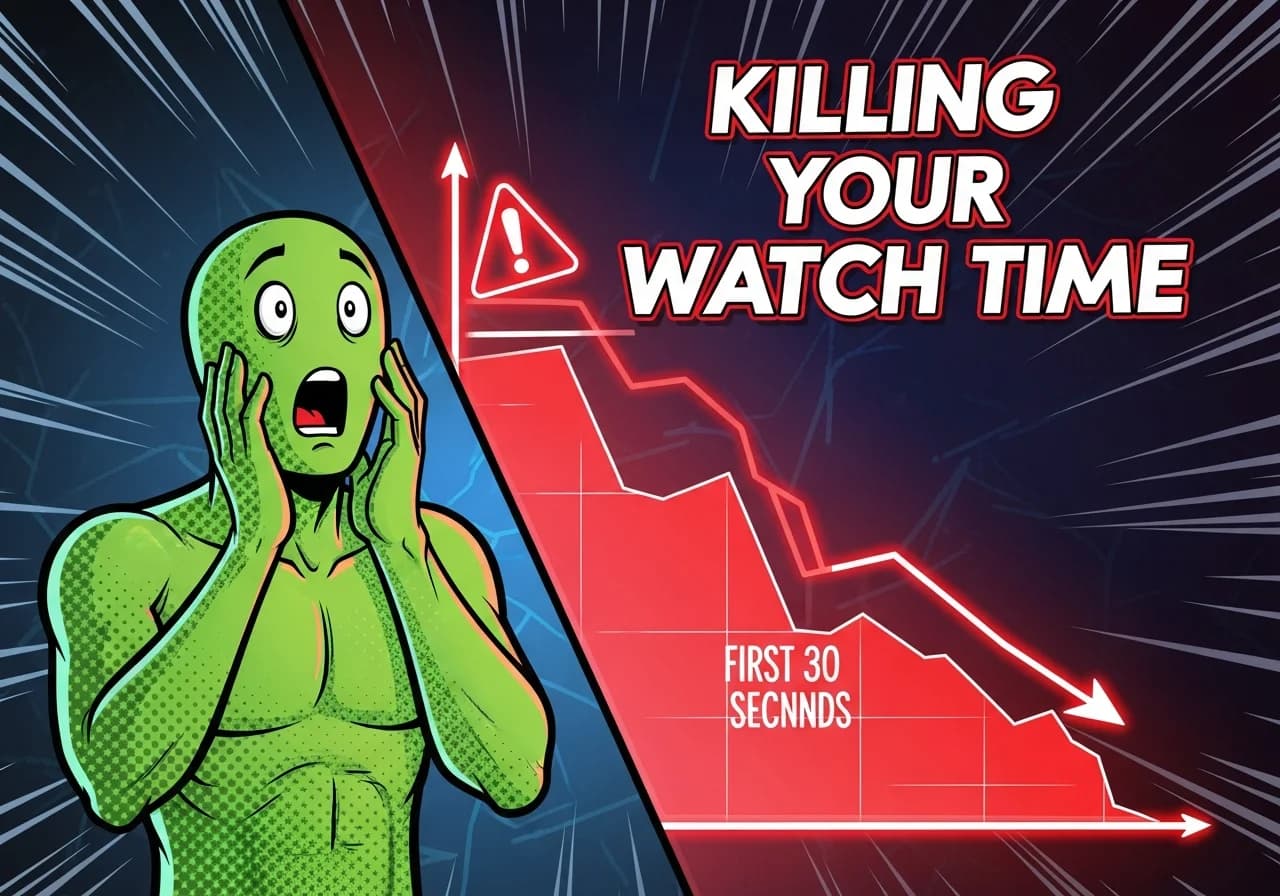
The Mistakes That Kill Watch Time in Faceless Channels
Low watch time on YouTube almost always comes down to the same handful of avoidable mistakes, and faceless channels are especially vulnerable because you can't rely on personal charisma or a recognizable face to carry viewers through a rough patch.
If you've noticed your audience retention graph nosediving in the first 30 seconds, you're not alone. And it's almost certainly fixable. Let's break down what's really happening.
Table of Contents
- Why Watch Time Is Everything for Faceless Channels
- Mistake 1: The Slow Intro
- Mistake 2: Static or Repetitive Visuals
- Mistake 3: Filler, Pauses, and Bloated Scripts
- Mistake 4: Thumbnail-to-Content Mismatch
- Mistake 5: Poor Audio and Robotic Voiceovers
- How to Fix Your Watch Time: A Practical Checklist
- Conclusion
Why Watch Time Is Everything for Faceless Channels
Before diving into specific mistakes, let's be clear on what's at stake. According to Podcastle's December 2025 analysis, audience retention is now the primary score the algorithm uses to decide whether your content gets distributed at all. It's not a vanity metric anymore.
Here's what the benchmarks look like in 2025:
| Format | Healthy Retention | Excellent Retention | What Happens Below |
|---|---|---|---|
| Long-form video | 50%+ average | 60%+ average | Algorithm reduces distribution |
| YouTube Shorts | 70% completion | 85%+ completion | Video stops being pushed |
| First 30 seconds | 70%+ still watching | 80%+ still watching | Video never reaches broad audiences |
For faceless channels in particular, as Apple Daily reported in late 2025, YouTube's algorithm now favors originality, retention, and viewer satisfaction — and penalizes channels that recycle visuals or use robotic voiceovers. You can read more about how these distribution signals work in the YouTube Algorithm for Faceless Channels: Retention, Hooks & What Triggers Distribution.
Mistake 1: The Slow Intro
This is the biggest one. By a lot.
MilX's 2025 algorithm breakdown documented a creator with solid thumbnails and strong topics who was losing 70% of viewers in the first 90 seconds — purely because the intro was too slow. Once she restructured her videos to lead with examples instead of context, she retained 70% of viewers past the 10-minute mark on 15-minute videos.
What a slow intro actually looks like
- "Hey guys, welcome back to the channel, before we get into it make sure to subscribe..."
- A 20-second animated logo or branded intro sequence
- Starting with background context before the hook
- Explaining what you're going to cover instead of just covering it
According to Dataslayer's 2025 YouTube algorithm guide, YouTube tests your video with a small audience immediately after upload. If those first viewers drop off in 30 seconds, your video never reaches a broader audience. The opening matters more than the entire middle section.
The fix
Tighten your intro to a 3–5 second cold open. Start with the result or the most compelling moment. Treat it like a trailer, not a handshake. You can use a free AI video script generator to draft hooks that front-load value instead of padding the opening.
Mistake 2: Static or Repetitive Visuals
Faceless channels live and die on their visuals. When you're not on camera to carry the energy, every frame has to do the work.
The problem most creators run into is B-roll fatigue: the same stock clip running for 8 seconds, the same still image sitting there while the voiceover drones on, the same 3 clips recycled throughout a 10-minute video. Viewers don't always consciously click away, they just... stop watching. The attention drifts, the tab gets switched, and your retention graph takes a hit you don't even see coming.
What the data says
Zebracat's 2025 Shorts statistics show that Shorts with an immediate hook in the first 2 seconds retain 19% more viewers than those with a slow visual start. For long-form, the principle scales: visual variety keeps cognitive engagement alive.
A good rule of thumb is a new visual element every 2–3 seconds. That doesn't mean frantic jump cuts, it means purposeful variation: a zoom, a new clip, a graphic overlay, a text animation. Anything that signals to the brain that something new is happening.
For more on how retention graphs reveal these visual drop-off moments, check out how to read your YouTube analytics retention graphs.
Mistake 3: Filler, Pauses, and Bloated Scripts
Every second of your video is being measured by YouTube against your total runtime. Filler seconds aren't neutral, they're actively pulling your average view duration down.
Common filler patterns in faceless content:
- Long pauses between sentences (often a pacing artifact from AI voiceover tools)
- Repeated recap phrases like "so as I was saying" or "going back to what I mentioned earlier"
- Over-explaining concepts that your audience already understands
- Unnecessary introductions to sections ("now let's move on to the next point, which is...")
"People usually drop off because of slow intros, unclear value, flat pacing, or weak audio/visual clarity, not because the topic is bad." — Podcastle, December 2025
Script tightening tips
Write your script, then cut it by 20%. Read it aloud and remove anything that sounds like a verbal placeholder. Structure every 60–90 second block to deliver one clear, complete idea. Then set up the next idea as a reason to keep watching. This is the looping attention structure that keeps retention graphs flat and healthy.
Mistake 4: Thumbnail-to-Content Mismatch
This one is sneaky because it doesn't look like a watch time problem, it looks like a click problem. But it's actually both.
When your thumbnail or title overpromises, you attract clicks from people who won't find what they came for. They bounce within the first 15–30 seconds — creating a brutal early drop-off signal. According to TubeBuddy's analysis, a low average view duration tells YouTube that something needs adjusting, and it suppresses further distribution accordingly.
The fix is simple: make sure the first 15 seconds of your video directly delivers on whatever your thumbnail promised. If your thumbnail says "5 faceless niches that actually pay," your video should be showing the first niche before the 20-second mark.
This is closely connected to why YouTube stops pushing faceless videos — mismatched expectations are a major trigger.
Mistake 5: Poor Audio and Robotic Voiceovers
Audio is underrated as a retention factor. Viewers will tolerate mediocre visuals far longer than they'll tolerate bad audio. For faceless channels that rely heavily on voiceover, this is a critical point.
Robotic, flat AI voices are increasingly penalized by YouTube's algorithm. As Hootsuite's 2025 algorithm guide explains, YouTube now uses AI models to understand the tone, mood, and quality of your video content. A lifeless voiceover signals low viewer satisfaction before the algorithm even looks at your retention numbers.
The practical fix: invest in high-quality AI voices that match your format (horror narration sounds different from finance explainer), use natural pacing and tonal variation, and avoid AI voices that clip words or sound synthetic.
Platforms like Virvid offer a library of format-specific AI voices optimized for different short-form styles — from UGC to true crime to documentary narration — which helps faceless creators sound human without recording themselves.
How to Fix Your Watch Time: A Practical Checklist
Here's a quick diagnostic you can run on any underperforming faceless video:
- Open YouTube Studio and check the audience retention graph. Find the first major drop-off point.
- If drop-off happens before 30 seconds: your intro is the problem.
- If drop-off happens mid-video: your pacing or visual variety is the problem.
- If drop-off is gradual from the start: your voiceover quality or script density is the problem.
- If you see a spike of drop-off right after a specific moment: you overpromised in your title or thumbnail.
Fix one thing at a time. Test across 3–5 uploads before drawing conclusions. As iMarkInfotech's 2025 algorithm breakdown notes, average view duration is one of the most direct signals YouTube uses to decide whether to recommend a video — improving it even slightly compounds over time across your whole channel.
And if you want to avoid building these problems in from the start, generating your scripts and hooks through a well-structured tool matters more than most creators realize. A free AI video hook generator can help you draft opening lines that actually hold attention, rather than learning through trial and error on published videos.
Conclusion
Watch time problems in faceless channels almost always trace back to the same root causes: intros that waste time, visuals that don't change, scripts that ramble, thumbnails that lie, and voices that sound like a robot reading a terms-of-service document.
The good news is that all of these are fixable, and fixing even one of them compounds across every video you upload. Start with your intro today. Check your retention graph. Cut the first 15 seconds aggressively and see what happens to your next upload.
For a broader look at how all of this connects to distribution and algorithmic reach, the YouTube Algorithm for Faceless Channels guide covers the full picture.