

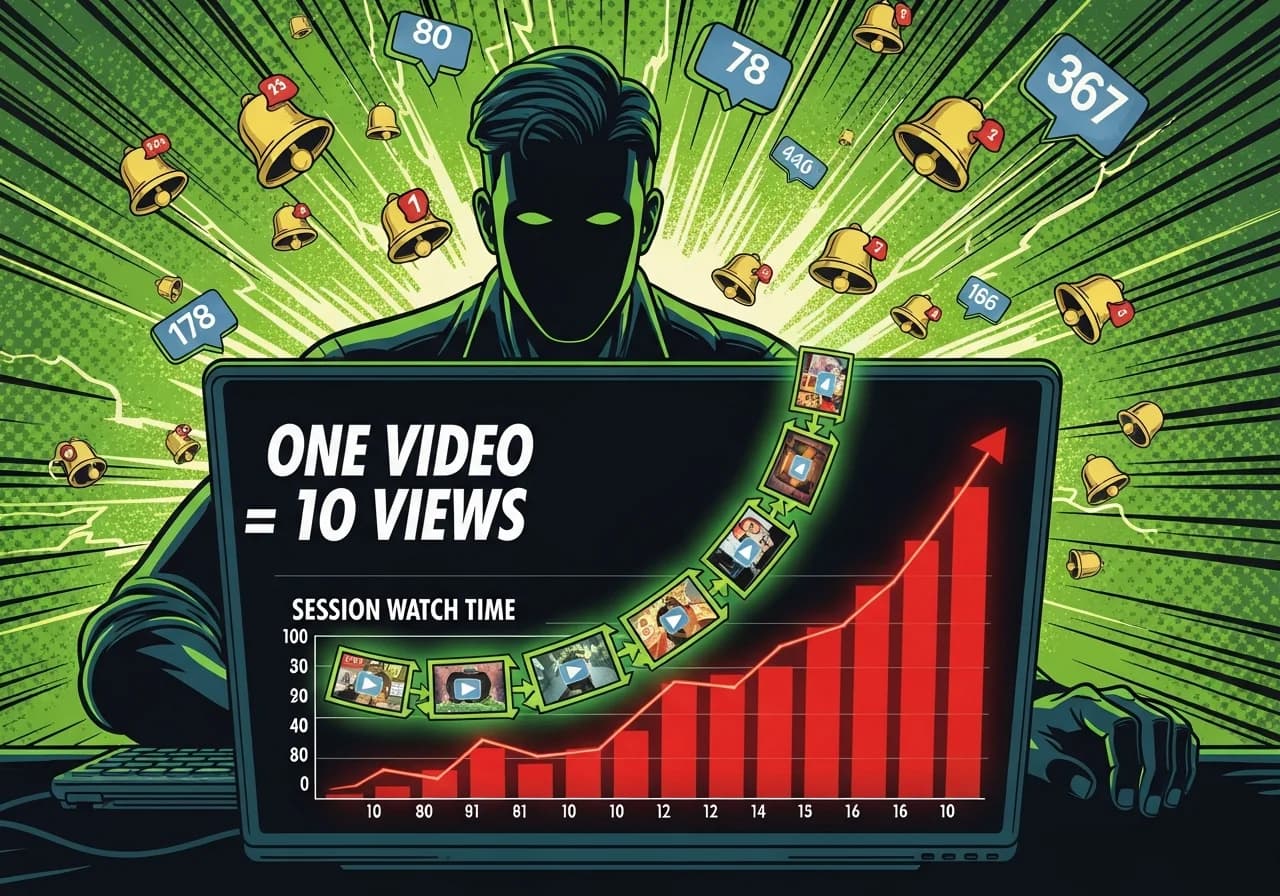
Bingeability: How One Video Leads to 10 More Views
Most creators obsess over making one great video. The YouTube algorithm, however, is optimizing for something bigger: how long you keep a viewer on the platform after your video ends.
That distinction changes everything about how you should build a faceless channel.
Table of Contents
- What "Bingeability" Actually Means to the Algorithm
- Why Session Time Beats Single-Video Watch Time
- The Series Format: Your Most Powerful Binge Tool
- Topic Clustering: How to Make the Algorithm Recommend You to Yourself
- Episodic Hooks: The Structure That Keeps Viewers Coming Back
- How to Build a Binge System for a Faceless Channel
What "Bingeability" Actually Means to the Algorithm
Bingeability is not a YouTube metric you'll find in Studio. It's a pattern the algorithm detects: a viewer watches your video, then immediately watches another one of yours, and maybe another after that.
When that happens repeatedly, YouTube's system registers your channel as a reliable source of session time, and begins recommending you more aggressively across the homepage and suggested feed.
According to vidIQ's 2026 algorithm breakdown, the sequence YouTube loves most is: viewer watches your video, engages, then watches 2–3 more videos. The sequence it penalizes: viewer clicks, watches 20 seconds, closes the app.
One pattern triggers distribution. The other one kills it.
The metric to track
Session continuation rate is what you're really chasing. You won't see it labeled that way in YouTube Analytics, but you can approximate it by looking at Traffic Source data under "YouTube Recommendations" and cross-referencing it with your channel's subscriber watch patterns. If your suggested traffic is growing alongside average session length, you're building bingeability.
Why Session Time Beats Single-Video Watch Time
Here's something the YouTube algorithm has made increasingly clear since its 2025 updates: a video that ends a viewer's session is penalized, even if they watched 90% of it.
As Marketing Agent's analysis of YouTube's recommendation model explains, session continuation (whether viewers watch more content after yours, on your channel or elsewhere) is a direct satisfaction signal. A channel that consistently ends sessions is flagged as a poor experience, regardless of raw retention numbers.
This is why faceless channels with strong series formats outperform one-off viral videos in the long run. A single viral hit brings traffic. A binge-worthy series converts that traffic into session depth, which feeds the algorithm, which brings more traffic.
| Signal | What YouTube Measures | Why It Matters |
|---|---|---|
| Average View Duration | % of a single video watched | Basic retention quality |
| Session Duration | Total time on platform after your video | Long-term algorithmic trust |
| Session Continuation | Whether viewers keep watching after you | Direct recommendation signal |
| "Not Interested" Rate | Viewers rejecting your video | Suppresses future reach |
| Suggested Video Traffic | Views coming from "Up Next" | Proof the algorithm is pushing you |
The session-level metrics in the middle column are what separate growing channels from plateaued ones. As covered in depth in the YouTube Algorithm for Faceless Channels pillar guide, retention and session signals work together, one feeds the other.
The Series Format: Your Most Powerful Binge Tool
A series is the simplest structural answer to the bingeability problem. When you name videos consistently ("Case File #1", "Case File #2"), use matching thumbnails, and build a playlist with autoplay on, you give the algorithm an obvious path: here's what this viewer should watch next.
Hootsuite's YouTube algorithm guide confirms that playlists directly increase session watch time, one of the top algorithmic signals on the platform. But the playlist alone isn't enough. The content needs to make the viewer actually want to keep going.
What makes a series binge-worthy vs. just consistent
- Each episode solves a complete problem or tells a complete story (viewers feel satisfied, not cheated)
- Each episode ends with a tease that makes the next one feel urgent or incomplete without it
- The thumbnail and title system is consistent enough that a viewer recognizes "this is part of the thing I just watched"
- The topic is specific enough that one episode naturally suggests the next (not vague "motivation" videos, but "3 true crime cases that changed US law" followed by "3 more cases from the same era")
Faceless channels have a real structural advantage here. Because there's no personality anchoring the content, the story or information format becomes the brand. That makes episodic content feel natural rather than forced.
Real-world example of the series flywheel
Look at how channels like The Infographics Show built 15 million subscribers. According to AWISEE's 2026 analysis of top faceless channels, these channels consistently use episodic formats that create viewer anticipation between uploads, which generates both session depth and return visits, two of the strongest algorithmic signals available.
Topic Clustering: How to Make the Algorithm Recommend You to Yourself
Topic clustering is the strategy of publishing multiple videos within the same tight semantic area, so YouTube learns exactly who your channel is for and which viewer types to send your way.
When a viewer interested in cold case documentaries watches your "Unsolved 1970s Disappearances" video, YouTube has a decision to make about what to play next. If you have five videos on similar topics, the algorithm has an obvious answer: your next video. If your channel is all over the place, the algorithm sends that viewer to a competitor who does have a cluster.
YouTube uses thematic similarity and audience overlap to surface suggested content. Without a clear cluster, cross-promotion between your own videos simply doesn't happen at scale.
How to build a topic cluster
- Choose a core topic your channel owns (e.g., "historical mysteries", "AI tool tutorials", "personal finance for freelancers")
- Plan 5–8 videos before publishing the first one
- Use consistent vocabulary in titles, descriptions, and tags across all videos in the cluster
- Link between videos verbally inside the content, not just through cards
- Publish the cluster over 4–8 weeks to build algorithmic context before moving to a new cluster
This is also where a free AI video script generator becomes genuinely useful. When you need to produce 6 connected videos on the same topic, having a tool that handles scripting and structure means you can stay in planning mode rather than burning out on production.
Episodic Hooks: The Structure That Keeps Viewers Coming Back
The hook at the end of a video is just as important as the hook at the beginning. This is the part most faceless creators skip, and it's where session depth is either created or lost.
An episodic hook is a spoken or visual tease placed 15–20 seconds before the video ends. It tells the viewer what they'll miss if they stop watching your channel now.
It sounds simple. Most people do it wrong.
Common mistakes with episodic hooks
- Using a generic end screen card with no verbal setup (viewers tune out before the end screen appears)
- Teasing content that's too vague ("coming next week: something interesting")
- Placing the hook after the outro music has already started (viewers are mentally already gone)
- Promising something that doesn't deliver in the next video (destroys trust and tanks return visit rate)
The hook that actually works is specific and curiosity-driven: "In the next video, I'm covering the one detail investigators missed that would have solved this case in 1974. It's in the public record, nobody talks about it." That's a hook that creates genuine urgency.
As discussed in the viewer satisfaction signals article, satisfaction and anticipation aren't opposites. A viewer can feel fully satisfied by one episode and still feel compelled to watch the next, if the hook is honest and specific.
Verbal handoffs inside the video
Beyond end-of-video hooks, weaving internal references earlier in your content pays off for binge sessions. Phrases like "we established in the first part of this series that..." reward viewers who watched episode one and signal to new viewers that there's more context available, which creates curiosity and drives them back to earlier episodes.
How to Build a Binge System for a Faceless Channel
Bingeability doesn't happen by accident. It's a system. Here's how to build one from scratch.
Step 1: Plan the cluster before you film anything. Decide on 5 connected videos. Map which one leads to which, and what the hook will be at the end of each.
Step 2: Name the series consistently. "Dark Files #1 | The Case Nobody Solved" is better than five unrelated titles on related topics.
Step 3: Speak the handoff, don't just card it. Verbal teasers before end screens have 3x more chance of the viewer actually acting on them.
Step 4: Build the playlist immediately. Enable autoplay. Put your strongest video first, not your newest.
Step 5: Review your "Traffic from Suggested Videos" after 7 days. If it's growing, the cluster is working. If not, tighten your topic focus.
Step 6: Use consistent visuals across the series. Same thumbnail style, same color palette. The viewer's brain should recognize "this is part of the thing I was watching" instantly.
Step 7: Post consistently. The algorithm correlates consistent upload cadence with reliable session performance. Gaps between series episodes break the algorithmic momentum you've built.
For faceless creators specifically, the production side of this is where most people get stuck. Writing, scripting, voicing, and editing 6 connected videos at a consistent pace is hard without support. Platforms like Virvid are built exactly for this use case: generating complete faceless AI videos in minutes, including consistent visual styles across a series, so you can post daily or multi-weekly without burning out or losing visual consistency between episodes. That consistency, both in upload frequency and visual branding, is the fuel that keeps a binge system running.
"Our algorithm doesn't pay attention to videos; it pays attention to viewers. Focus on making videos that make your viewers happy," says Todd Beaupré, Senior Director of Growth and Discovery at YouTube, in a conversation with Creator Liaison Rene Ritchie.
That quote matters more for series builders than for anyone else. The viewer who watches episode 3 of your series after already watching episodes 1 and 2 is definitively happy. That's the viewer YouTube wants to serve more content to. Your job is just to make sure the content is there waiting for them.
One Last Thing
The shift from "make a great video" to "build a binge system" is the single biggest mindset change that separates channels that plateau at a few thousand views from channels that grow month over month. You don't need to go viral. You need to be bingeable.
Start with three videos. Pick a tight topic. Name them as a series. Build the playlist. Speak the handoff. Then watch your suggested video traffic start to compound.
If production speed is the bottleneck, that's a solvable problem. For structuring each individual video for watch time, review the mistakes killing watch time on faceless channels guide, and use tools that let you move faster without sacrificing consistency.
Publish the first episode today. The algorithm can't reward a binge system that doesn't exist yet.