

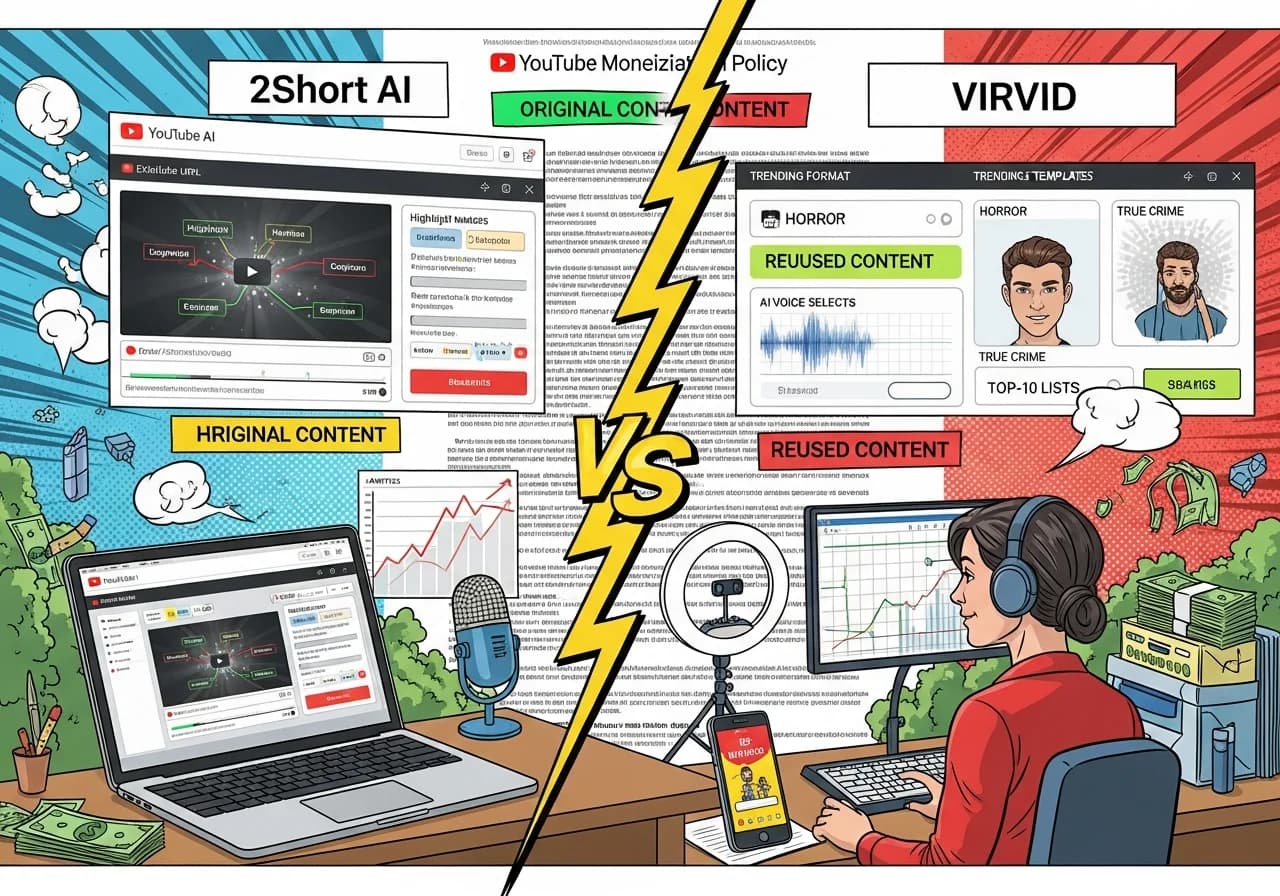
Virvid vs 2Short AI: Which AI YouTube Shorts Tool is Better?
The choice between creating original Shorts and clipping existing videos isn't just workflow preference, it's a monetization strategy that determines whether your channel thrives or gets flagged.
Table of Contents
- The Core Difference: Original vs Repurposed
- YouTube's July 2025 Policy Earthquake
- Feature Comparison: What You Actually Get
- The Competitive Landscape
- Pricing Breakdown
- When to Use Each Tool
The Core Difference: Original vs Repurposed
Here's the split that shapes everything downstream.
2Short AI analyzes existing YouTube videos through their captions, uses AI to identify engaging spoken moments, then extracts those segments into vertical clips. You paste a YouTube URL, the AI finds compelling sections, and you export Shorts. The platform excels at facial tracking through its "Center Stage" feature, keeping speakers centered during horizontal-to-vertical conversion.
However, it notably lacks batch processing, a built-in music library, viral scoring predictions, and scheduling capabilities that competitors offer.
Virvid takes the opposite approach entirely. You enter a topic, select a trending format like horror stories, top-10 lists, documentary style, or true crime, choose an AI voice from 30+ ultra-realistic options in 20+ languages, and the system generates original visuals, scripts, captions, and music in under two minutes. No source video required.
The platform specifically targets faceless channel creators who need scalable, original content without appearing on camera. If you're just getting started and need help crafting compelling scripts, you can use the free AI video script generator or the YouTube Shorts script generator to develop engaging storylines before generating your videos.
| Feature | Virvid | 2Short AI |
|---|---|---|
| Creation Method | Original generation | Video repurposing |
| Source Material | None needed | YouTube URL required |
| Faceless Content | Yes | No |
| Music Library | 1,000+ tracks | None |
| Batch Processing | Unlimited (credit-based) | One at a time |
| AI Voices | 30+ in 20+ languages | N/A |
| Scheduling | No (intentional) | No |
This isn't a minor technical detail. It determines your relationship with YouTube's monetization policies.
YouTube's July 2025 Policy Earthquake
YouTube renamed its "repetitious content" policy to "inauthentic content" effective July 15, 2025, signaling enhanced enforcement against mass-produced videos.
According to YouTube's official policy documentation, the platform explicitly targets "content that looks like it's made with a template with little to no variation across videos, or content that's easily replicable at scale."
What Gets Flagged
Reused content remains ineligible for monetization. This includes:
- Short videos compiled from other social media platforms with minimal changes
- Clips from TV shows edited together without narrative
- Non-verbal reactions to videos without substantive commentary
- Content uploaded identically by other creators
Channels flagged for violations face channel-wide monetization removal, not just individual video penalties.
What's Still Allowed
The policy permits several approaches:
- AI-assisted content with clear human creative input
- Reaction videos with substantive original commentary
- Edited footage with added storyline and analysis
- Original content created with AI tools
As reported by eWEEK in July 2025, YouTube CEO Neal Mohan specifically noted continued investment in AI creative tools like Dream Screen, emphasizing that "using AI doesn't automatically restrict your monetization."
The key distinction: repurposing tools that extract existing content carry risk, while generation tools that create new content align better with policy intent.
Feature Comparison: What You Actually Get
Let's break down what each platform actually delivers.
2Short AI Capabilities
What it does well:
- Fast clip extraction from YouTube videos
- Automated caption detection and editing
- Center Stage facial tracking for speaker framing
- Support for 26+ languages
- Simple URL-to-clip workflow
What it's missing:
- No batch processing (one video at a time)
- No built-in music library
- No viral scoring or performance prediction
- No scheduling or auto-posting
- No original content generation
The platform works purely as a repurposing tool. You need existing video content to feed it.
Virvid Capabilities
What it does well:
- Original content generation from text prompts
- Trending format templates (horror, true crime, documentaries, tutorials)
- 30+ AI voices optimized for specific formats
- 1,000+ copyright-free music tracks sorted by mood
- Consistent character generation across videos
- Animated captions and hooking effects
- Both still images and animated video options
What it's missing:
- No scheduling (intentionally excluded to avoid API detection)
- No virality scoring
The platform works as a complete production suite for faceless content creators. You don't need any source material to start.
If you're exploring different content styles, check out tools like the AI horror video generator or AI documentary video generator to see format-specific options.
The Competitive Landscape
Beyond Virvid and 2Short AI, three major competitors serve the repurposing space.
OpusClip ($15-$29/month)
OpusClip leads in features among clipping tools:
- Virality Score predicts clip performance
- AI B-Roll generates supplementary footage automatically
- Built-in social scheduling posts to YouTube, TikTok, Instagram, LinkedIn, Facebook
- XML export to Premiere and DaVinci Resolve
However, according to analysis from BigVu, Trustpilot reviews average just 2.4/5 stars in 2025, with users citing declining quality after updates and billing frustrations.
Klap ($23-$189/month)
Klap emphasizes language coverage:
- 52 supported languages (versus competitors' 20-26)
- Virality scoring and direct publishing
- Up to 100 videos monthly on highest tier
User reviews show mixed results, with multiple complaints citing difficult subscription cancellation and caption alignment issues.
Dumme AI (~$9/month)
Dumme AI focuses on context preservation, claiming clips maintain narrative structure. However, availability remains limited with multiple reports indicating the platform remains unreleased or inaccessible, making it unsuitable for reliable production workflows.
| Tool | Price | Virality Score | Scheduling | Best For |
|---|---|---|---|---|
| Virvid | $19-$119/mo | No | No | Original faceless content |
| 2Short AI | $9.90-$49.90/mo | No | No | Quick podcast clipping |
| OpusClip | $15-$29/mo | Yes | Yes | Feature-rich repurposing |
| Klap | $23-$189/mo | Yes | Yes | Multi-language repurposing |
| Dumme AI | ~$9/mo | Unknown | No | Currently unavailable |
Pricing Breakdown
Understanding the pricing models reveals each tool's target audience.
2Short AI Pricing
The platform offers the lowest entry point:
- Free: 30 minutes monthly with watermarks
- Lite ($9.90/month): 5 hours AI analysis, 60 minutes fast exports
- Pro ($19.90/month): Unlimited exports
- Premium ($49.90/month): 50 hours analysis, priority support
The credit system measures analysis time rather than output count. A 45-minute podcast consumes 45 minutes of credits regardless of how many clips you generate from it.
Virvid Pricing
Pricing is based on output volume:
- Lite ($19/month): ~30 shorts monthly
- Standard ($59/month): ~120 shorts monthly
- Pro ($119/month): ~330 shorts monthly plus custom style requests
All paid plans include:
- Watermark removal
- 30+ voice avatars
- 1,000+ royalty-free music library
- Unlimited HD exports
- All trending formats and styles
Credits roll over while subscribed, a meaningful difference for inconsistent creators.
For creators with existing long-form libraries, 2Short's lower pricing makes sense. For faceless channel builders starting fresh, platforms like Virvid offer higher per-month cost but generate significantly more original output.
When to Use Each Tool
The decision tree is simpler than it seems.
Choose 2Short AI When:
- You have existing long-form content (podcasts, interviews, educational videos)
- Your content features clear spoken segments with good audio quality
- You need quick repurposing without extensive editing
- Budget constraints favor the $9.90 entry point
- You'll add substantial original commentary to clips (critical for policy compliance)
Choose Virvid When:
- You're building a faceless channel from scratch
- You don't have source videos to repurpose
- YouTube monetization is a priority (original content = lower policy risk)
- You need consistent output across multiple channels
- Your niche suits trending formats: horror, true crime, top-10 lists, educational explainers
Choose OpusClip When:
- You need virality prediction and AI B-roll features
- Direct scheduling to multiple platforms saves significant time
- Professional video editing workflow integration matters
- You can tolerate reported customer service inconsistencies
Choose Klap When:
- Multi-language content is essential (52 languages)
- Higher video volume (100/month) justifies premium pricing
- 4K output quality is required
The Data on Performance
YouTube Shorts now commands 200 billion daily views according to DemandSage) and boasts the highest engagement rate among short-form platforms at 5.91%, outpacing TikTok (5.75%) and Instagram Reels (5.53%).
YouTube's algorithm increasingly favors fresh, original content. A September-October 2024 shift, dubbed "the flattening" by industry observers, deprioritized older Shorts while elevating "Freshness" and "Velocity" signals measuring initial engagement speed.
According to Resourcera's 2025 statistics, channels combining Shorts with long-form content grow 41% faster than single-format channels.
Faceless Content Performance
Faceless content demonstrates strong performance metrics:
- 58% of creators producing faceless videos reported higher retention rates in 2025
- Channels like DaFuq Boom (43M subscribers) prove the model works at scale
- Estimated revenues range from $100,000-$1.3 million monthly for top faceless channels
However, Shorts monetization remains modest: RPM averages $0.01-$0.07 per 1,000 views versus $1.25-$2.50 for standard videos. One million Shorts views typically generates $20-$70 in ad revenue.
This reality shapes tool selection. Shorts build audiences, long-form and sponsorships build income.
The Hidden Advantage of No Auto-Posting
Both Virvid and 2Short AI intentionally exclude automated posting, a seeming limitation that reflects platform intelligence.
Videos posted through platform APIs are detected by algorithms and receive much lower visibility than manually uploaded content. According to Search Engine Journal's July 2025 reporting, this design choice prioritizes organic reach over workflow convenience.
OpusClip and Klap offer scheduling, but the tradeoff is clear: convenience versus algorithmic visibility. For creators prioritizing reach over time savings, manual posting remains advisable despite the friction.
If you're looking to maximize your content strategy while maintaining authenticity, consider diversifying income through programs like the Virvid affiliate program, which offers 30% passive recurring revenue for referring other creators to the platform.
Making the Right Choice
The Virvid versus 2Short AI decision reflects content strategy, not just tool preference.
Creators with existing video libraries and authentic on-camera presence find value in clipping tools. 2Short AI's low entry price and simple interface serve podcast hosts and educators effectively.
But for faceless channel builders entering competitive niches in 2025's stricter policy environment, original content generation offers meaningful advantages: lower monetization risk, consistent output at scale, and trending format templates optimized for current algorithms.
YouTube's direction is clear: originality and human creative input matter. AI assistance remains welcome, mass-produced repetition faces enforcement.
Tools that generate versus tools that extract represent different relationships with that reality. Choose the approach that aligns with your channel's long-term monetization goals, not just immediate convenience.