

Turning Shorts Views into Subscribers
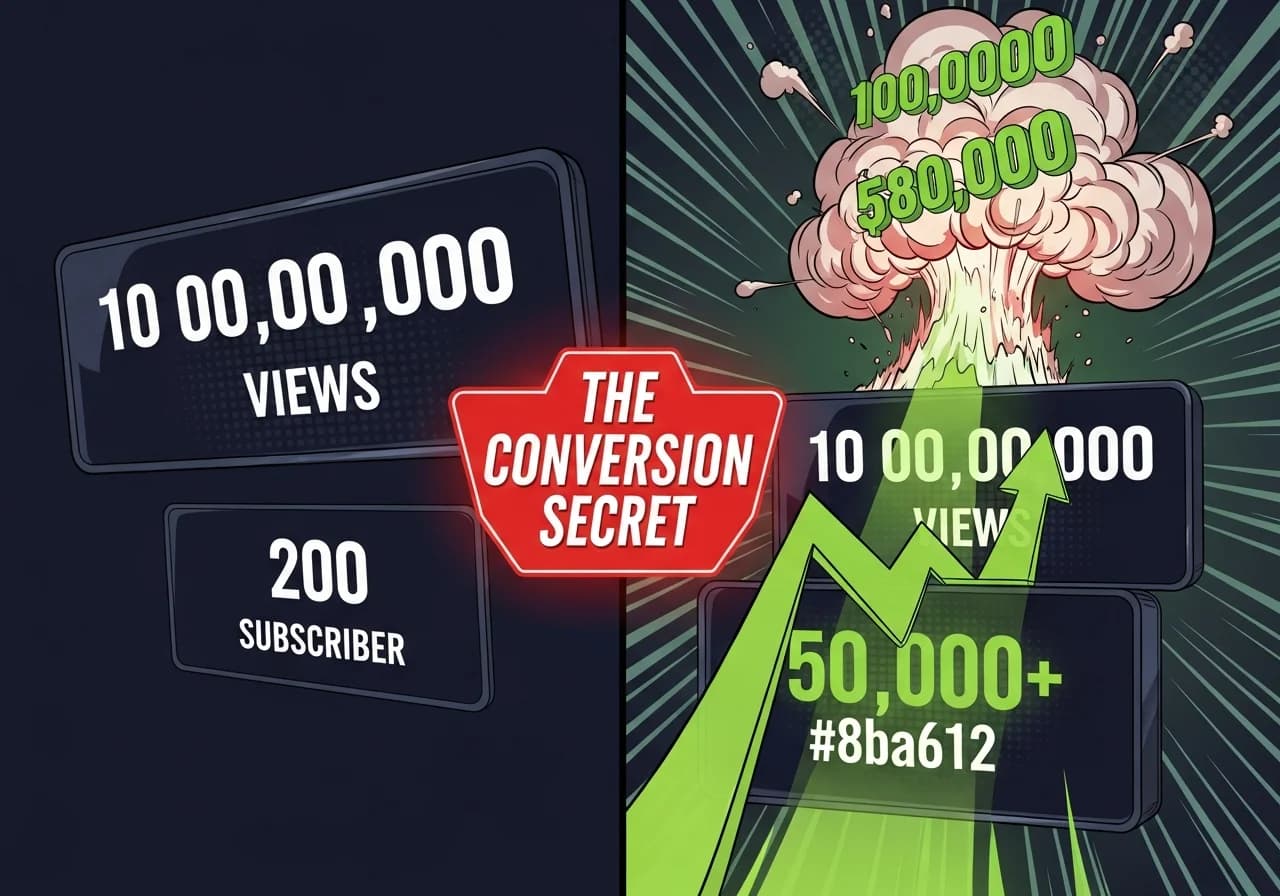
Getting views on Shorts is easy. Converting those views into subscribers is a completely separate skill, and most creators fail at it not because their content is bad, but because they've never thought about it deliberately.
Table of Contents
- Why Shorts Views Don't Automatically Become Subscribers
- The Series Hook: The Most Underused Subscriber Tool
- CTA Timing and Placement That Actually Works
- Channel Identity Branding for Faceless Creators
- Pinned Comments, Descriptions, and the Long-Form Bridge
- Track and Optimize Your Conversion Rate
Why Shorts Views Don't Automatically Become Subscribers
This is the stat that surprises most creators: according to Loopex Digital's Q1 2026 YouTube Shorts report, 74% of all Shorts views come from non-subscribers. Shorts is the primary discovery mechanism on YouTube. That's exactly what makes it powerful, and exactly why the conversion problem exists.
Those viewers don't know you. They stumbled on your Short in the feed and watched it because the hook grabbed them. Now that the Short is over, they have no particular reason to subscribe unless you give them one.
The platform average sits at about 16.9 new subscribers per 10,000 Shorts views, according to Voomo's 2025 Shorts statistics breakdown. That's roughly 1.69% conversion. Channels with strong identity branding, clear CTAs, and series-based content regularly hit 2–3% or higher.
The gap between 0.5% and 3% doesn't come from better content quality. It comes from three things: series hooks, CTA strategy, and channel identity.
The Series Hook: The Most Underused Subscriber Tool
If there's one structural change that moves the needle the most, it's this: stop posting standalone Shorts and start posting series.
According to Swydo's YouTube metrics analysis for agencies (2025), videos in a series format achieve 67% higher subscriber conversion rates than standalone content. The reason is straightforward. A viewer who just watched a Short called "Psychology Fact #47" now has a reason to subscribe: they want facts 48, 49, and 50.
A standalone Short, even a great one, gives viewers no forward momentum. A named series creates a subscription trigger because subscribing has a clear value attached to it.
How to Build a Shorts Series for a Faceless Channel
You don't need to number every episode explicitly. The series effect comes from consistent naming, consistent format, and consistent niche. Here's how it works in practice:
- Name your series and show it on screen in the first 2 seconds or the last 5 seconds: "Daily True Crime" or "60-Second Finance Facts"
- Keep the format identical across every Short in the series (same visual style, same voice, same pacing)
- Post on a predictable schedule so subscribers know when to expect new content
- Reference the series in your CTA: "Follow for a new [niche] fact every day"
This is also the model that works extremely well for AI-generated faceless content. When you keep visuals, voice, and format consistent across a series, you build channel recognition even without a face. Platforms like Virvid are built for exactly this workflow, with consistent character support and weekly-updated trending styles that keep your series looking fresh without manual redesigns.
CTA Timing and Placement That Actually Works
Most creators either skip CTAs entirely or drop a generic "like and subscribe" at the end. Neither approach works well. The data is specific on what does.
According to Zebracat's YouTube Shorts CTA research, Shorts with a strong CTA in the caption see 22% more likes and comments than those without. And the final 5 seconds of a Short are among the highest-exposure moments in the entire video, because Shorts loop. A viewer who watches twice will see your final CTA twice.
The Three-CTA Framework for Shorts
Use a maximum of two CTAs per Short. More than that feels like spam. Structure them like this:
- Early CTA (optional, seconds 3–8): brief, ultra-casual, tied to the series "Follow for Part 2"
- Final CTA (last 5 seconds): specific, benefit-focused, visual overlay plus verbal
- Caption CTA: repeat the subscribe reason in text, include a link if relevant
The CTA that converts best is specific to the content just watched. According to Zebracat's guide, generic "subscribe for more" CTAs underperform badly versus content-specific ones. Instead of "subscribe for more videos," say "subscribe so you catch tomorrow's fact" or "follow and I'll show you Part 2 next week."
"When I finally started tailoring CTAs to specific content, my conversion rate tripled overnight. Viewers need context for why your request makes sense right now, based on what they just watched." - Zebracat, YouTube Shorts CTA Guide, 2025
For faceless channels, the visual CTA overlay in the final 5 seconds is especially important because some viewers watch with sound off. Make the text large, high contrast, and action-specific.
Channel Identity Branding for Faceless Creators
Here's the counterintuitive truth about faceless channels: you need more brand identity than face-based creators, not less. When you take away the face, the voice becomes the brand. The visual style becomes the brand. The niche becomes the brand.
A viewer who watches your Short and thinks "I don't know who this is or what this channel is about" will not subscribe. A viewer who watches and immediately understands "this is the channel that does daily psychology facts in that animated style" probably will.
Identity branding for faceless Shorts creators comes down to these elements:
- Consistent voiceover: same AI voice or voice style across every Short in a series
- Consistent visual style: colors, animation style, caption font stay the same across your content
- Consistent niche: every Short should be recognizably from the same category
- Consistent naming: the series name appears on-screen in the same position every time
- Consistent posting cadence: daily or near-daily so the algorithm knows who to show your content to
This consistency is also what makes your channel bingeable. When a new viewer finds one Short and enjoys it, they click through to your channel page. If they see 50 Shorts that all look, feel, and sound the same, that's a channel they subscribe to. If they see 50 random Shorts in different styles, they scroll away.
As covered in the Faceless Shorts Strategy 2026 pillar, identity is the foundation of sustainable channel growth. Views are the top of the funnel. Identity is what converts them.
Pinned Comments, Descriptions, and the Long-Form Bridge
Once a viewer subscribes from a Short, the next goal is to get them watching longer content on your channel. That's where real monetization and deeper audience loyalty happen.
Two data points make this worth acting on immediately:
- Channels that pin a comment linking to a long-form video see a 20% increase in total watch time, according to Zebracat's 2025 Shorts statistics
- The average CTR for Shorts linking to a long-form video is 4.5%, meaning roughly 1 in 22 Shorts viewers will click through to your longer content
The mechanics are simple. After posting every Short, pin a comment that links to your most relevant long-form video or playlist with a short reason to click: "Want the full breakdown? Watch this." You can also add the same link to your video description.
This single habit does several things at once:
- Drives traffic to higher-RPM long-form content
- Increases total channel watch time (a key algorithm signal)
- Gives new subscribers an immediate next step to deepen their engagement
- Increases the probability that a casual Shorts viewer becomes a true channel fan
For more on how Shorts and long-form work together as a revenue system, the article on Shorts versus long-form revenue reality walks through the full income picture.
Track and Optimize Your Conversion Rate
Subscriber conversion is a metric you can track and improve systematically. Most creators never check it, which is why they stay stuck.
In YouTube Studio, go to Analytics, select any Short, and look at "Subscribers gained." This tells you how many people subscribed after watching that specific video. Track this number across your last 20 Shorts and look for patterns.
Metrics to compare across your Shorts:
- Subscribers gained per 1,000 views (your conversion rate per Short)
- Traffic source: what percentage came from the Shorts feed versus search versus suggested
- Audience retention: where do viewers drop off, and does it correlate with lower subscriber conversion
- Click-through from Shorts to other videos: are your pinned comments and description links getting clicks
When you find a Short with an unusually high subscriber conversion rate, analyze it. What format was it? What CTA did you use? What niche did it hit? That's your template. Build your next 10 Shorts around that structure.
AIR Media-Tech's strategy guide notes that channels that consistently use data to identify top-performing formats and scale them see significantly faster subscriber growth than those who post randomly and hope for the best. The data is available in YouTube Studio. Most creators just don't look at it.
For the scripting side of building high-conversion Shorts consistently, a free YouTube Shorts script generator can help you structure CTAs, series hooks, and niche-specific content into every script from the start rather than retrofitting them after production.
Start Converting Today
Pick one Short you posted in the last 30 days that got good views but poor subscriber conversion. Add a pinned comment with a link to your best long-form video. Update the description with a specific CTA. Then write your next Short as the first episode of a named series.
Those three changes will likely double your subscriber conversion rate before you even publish a new video. The niching down Shorts strategy guide goes deeper on how to define your channel identity in a way that maximizes every view you earn.
Views are not the goal. Subscribers are. And subscribers come from structure, not luck.