

Shorts vs Long-Form Revenue: The Truth Most Creators Miss
YouTube Shorts pays dramatically less per view than long-form videos in direct ad revenue, but the creators actually earning the most from Shorts are using them as a discovery and traffic engine, not an ad revenue source.
Table of Contents
- The Raw RPM Numbers: Shorts vs Long-Form
- Why the RPM Gap Is Misleading
- How the Shorts Revenue Model Actually Works
- The Real Shorts Income Stack: Where Creators Actually Earn
- Shorts + Long-Form: The Highest-Earning Strategy
- What This Means for Your Revenue Strategy
The Raw RPM Numbers: Shorts vs Long-Form
Let's start with the honest numbers, because a lot of creators get burned by not knowing these going in.
| Format | Typical RPM Range | Revenue per 1M Views | Creator Revenue Share |
|---|---|---|---|
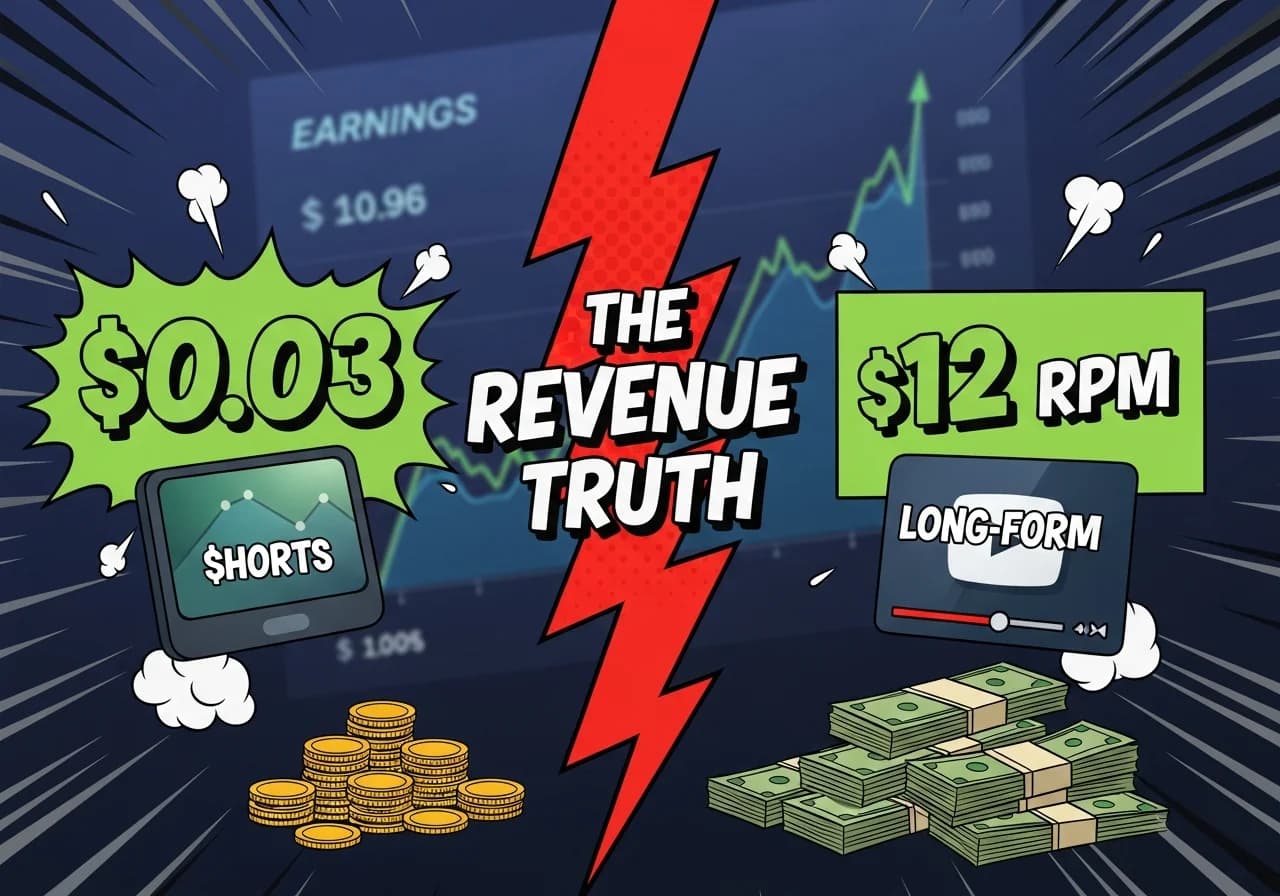
| YouTube Shorts | $0.01–$0.07 | $10–$70 | 45% of pool |
| Long-form (general) | $1–$8 | $1,000–$8,000 | 55% of ad revenue |
| Long-form (finance) | $10–$25 | $10,000–$25,000 | 55% of ad revenue |
| Long-form (gaming) | $1.20–$2.00 | $1,200–$2,000 | 55% of ad revenue |
These numbers are drawn from Shopify's Shorts monetization guide, Influencer Marketing Hub's 2025 RPM benchmark analysis, and OutlierKit's finance niche RPM data.
The gap is real and large. A long-form finance video with 1 million views might earn $15,000. The same view count in Shorts might earn $30–$50 from ads. That's a 300–500x difference in ad revenue at the high end.
Knowing this going in is what separates creators who build sustainable income from those who burn out producing high-volume content for pennies.
Why the RPM Gap Is Misleading
Here's what most takes on this topic miss entirely.
In Q3 2025, Google CEO Sundar Pichai confirmed in the earnings call that Shorts now generate more revenue per watch hour for YouTube than long-form content. YouTube earned $10.26 billion in ad revenue in Q3 alone, with Shorts cited as a primary driver of 15% year-over-year growth.
The platform is extremely well-monetized on Shorts. The revenue is there. The issue is how it flows to creators.
Unlike long-form, where each video earns from ads placed directly in it, Shorts revenue works via a pooled system. All Shorts ads in the feed go into a single revenue pool. That pool is then distributed to creators based on their proportional share of total Shorts views. The result: your individual Short doesn't earn directly from the ad that played in front of it.
By 2025, Shorts ad revenue accounted for 22% of YouTube's total ad revenue distribution according to Loopex Digital's Q1 2026 data report, up from 15% in 2024. The pool is growing fast. But the number of creators sharing it is also growing, which keeps individual RPMs low.
The Creator Revenue Split
On long-form, creators receive 55% of ad revenue. On Shorts, creators receive 45%, and YouTube retains 55%, partly to cover music licensing costs. This is the reverse of the long-form split and another reason Shorts RPMs trail long-form.
One major exception: creators using music in Shorts also share their pool allocation with music rights holders. A Short with two music tracks has its ad revenue split three ways, which further reduces creator earnings per view. According to Digiday's February 2025 analysis of six long-form creators, Shorts RPMs were consistently below $0.20 while their long-form averaged $3–$6.
How the Shorts Revenue Model Actually Works
If you've been confused about why your Shorts earnings look different from your long-form, here's the mechanics.
The pooled model works like this:
- YouTube sells ads between videos in the Shorts feed
- All ad revenue goes into one creator pool (after YouTube's 55% cut and music licensing allocations)
- Your share is determined by your Shorts' proportion of total monetizable Shorts views in your region/pool during that period
- You receive 45% of your allocated portion
This means your Shorts RPM isn't just about your content quality or niche, it's about how many other creators are in the same pool and what's happening with advertiser demand that month.
The good news: advertisers are increasingly valuing Shorts. According to Loopex Digital's data, 43% of U.S. ad buyers say key clients are actively investing in Shorts campaigns. Shorts CPMs are rising, with some creators reporting RPM increases of 150% year-over-year. vidIQ noted one of their own Shorts achieving $0.10 RPM in 2025, significantly above the typical floor.
"The real Shorts ad revenue potential comes from scale. At $0.03 RPM, you need 3.3 million views to earn $100. But at 50 million views per month (which viral faceless channels regularly hit) that becomes $1,500 per month from ads alone, before any other revenue layer." - AIR Media-Tech, Shorts RPM Analysis 2025
The Real Shorts Income Stack: Where Creators Actually Earn
This is where the conversation gets interesting. If you look at how top Shorts earners are actually making money, ad RPM is the smallest piece.
According to Affiliate Booster's 2025 Shorts statistics analysis, 76% of top-earning Shorts creators make more from brand deals and sponsorships than from ad revenue. And only 8% of Shorts creators rely on ads as their primary income source.
The real Shorts income model looks like this:
- Ad revenue from the YPP pool ($0.01–$0.07 RPM): base layer, not the focus
- Affiliate revenue from pinned comments and descriptions: scales with view volume
- Brand sponsorship deals: priced on audience size and engagement, not RPM
- Channel memberships and Super Thanks: convert loyal viewers into recurring revenue
- Long-form content traffic: Shorts funnel new subscribers who then generate higher-RPM ad revenue on regular videos
For faceless Shorts creators in particular, the affiliate revenue layer is often the most scalable. Shorts with product mentions in the first 10 seconds see 22% higher affiliate sales, and 53% of Gen Z have made a purchase after seeing sponsored short-form content, according to Loopex Digital's Q1 2026 report.
If you're building a monetization strategy for a faceless Shorts channel, platforms like Virvid make it realistic to maintain the volume needed to hit meaningful affiliate and brand deal income. Daily automated posting means your channel's monthly view count compounds consistently, which is what attracts sponsors and affiliate conversions.
For creators or agencies who want to also earn passive income from referring others to a fast-growing AI Shorts platform, Virvid's affiliate program pays 30% recurring commission for life on referred subscribers, which compounds significantly at scale.
Shorts + Long-Form: The Highest-Earning Strategy
The most important revenue insight in this entire article: the creators earning the most from YouTube in 2026 are not choosing between Shorts and long-form. They're using Shorts to feed long-form.
The data on this is clear:
- 64% of creators say Shorts improved the performance of their long-form content
- Channels combining Shorts and long-form grow 41% faster than single-format channels
- Shorts that link to other videos have a 4.5% CTR to those videos
- Channels using a Shorts-first funnel report up to 20% higher conversions on their broader content
As AIR Media-Tech found in their channel partner case studies, Shorts drive traffic to long-form videos where actual RPMs are high. One partner's channel doubled revenue in two months after implementing a consistent Shorts strategy, because the Shorts brought new audiences who then watched the higher-RPM long-form content.
This is the full picture the simple "Shorts vs long-form" comparison misses. It's not either/or. Shorts are the top of the funnel where the real monetization happens downstream.
You can explore how to build this dual-format strategy in our Faceless Shorts Strategy 2026 pillar, and for the specific question of whether Shorts alone can sustain a full monetization setup, our guide on whether Shorts alone can monetize a channel walks through the realistic numbers.
What This Means for Your Revenue Strategy
The honest summary: Shorts ad RPM is real but small. If you're expecting to build an income purely from Shorts ad revenue, the math is brutal. At $0.03 RPM, you need 3.3 million views to earn $100.
But if you treat Shorts as your growth engine and discovery layer, the total revenue picture changes completely.
Here's how to think about it practically:
- Post Shorts daily or near-daily to maximize discovery and subscriber growth
- Use affiliate links in every Short's description and first pinned comment
- Qualify for YPP as fast as possible (1,000 subs + 10M views in 90 days at the Shorts threshold)
- Create long-form versions of your best-performing Short topics to earn 50–100x more per view
- Pitch brand deals once you have consistent monthly view counts, since brand deals are priced on audience, not RPM
And for the scripting side of maintaining consistent Shorts output, a free AI video script generator is one of the fastest ways to keep your idea pipeline full without spending hours writing from scratch.
The creators who will dominate Shorts revenue in 2026 are not the ones waiting for RPMs to match long-form. They're the ones building volume, consistency, and a real income stack on top of the discovery that Shorts provides. The posting frequency guide for Shorts growth covers how to build that consistency without burning out.