

How to Sell Digital Products with Faceless AI Content (Courses, Templates, Tools)
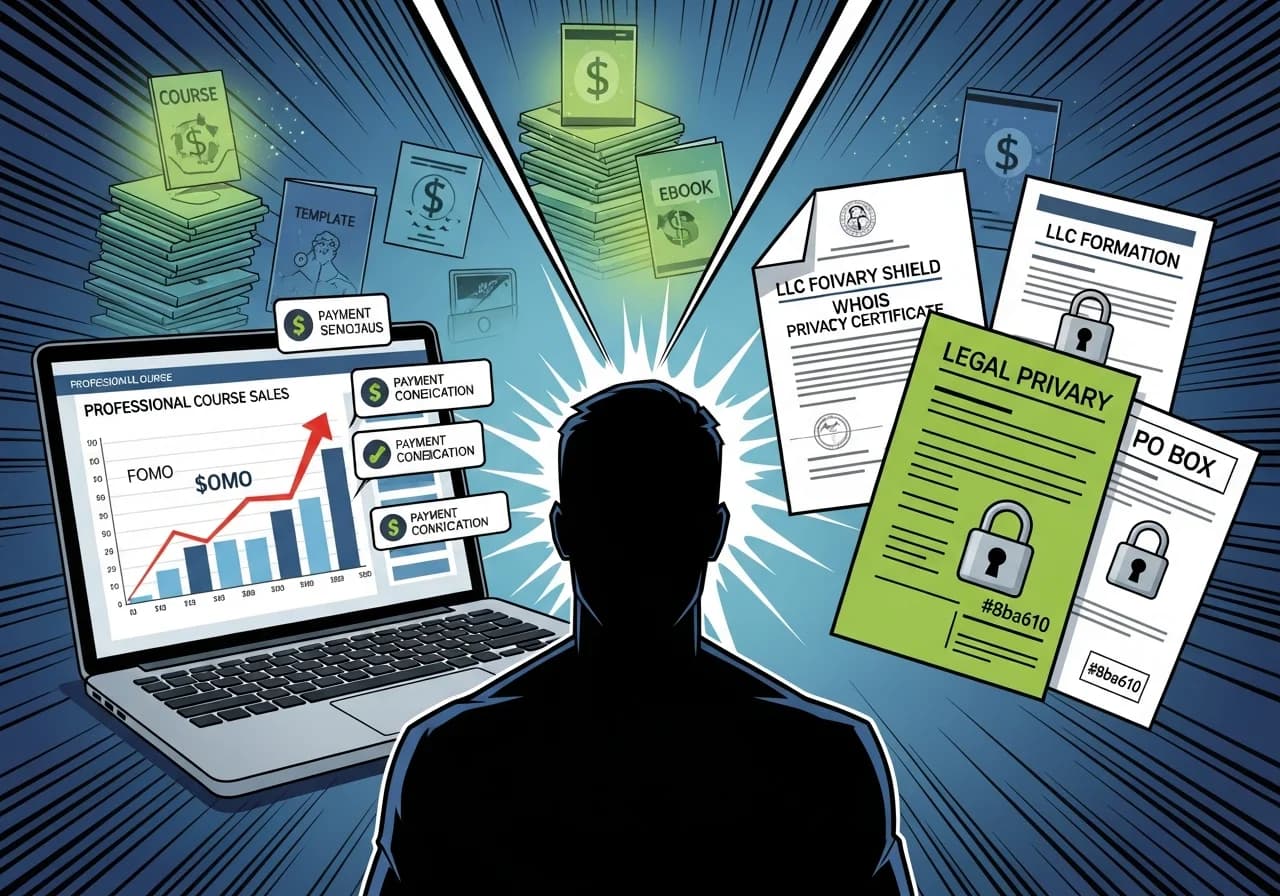
You can build a six-figure digital product business without ever showing your face. Complete anonymity is a myth that trips up most creators.
Table of Contents
- The digital products that actually sell
- Revenue math every creator needs to understand
- The privacy reality check
- Platform comparison
- Your complete privacy setup checklist
- Product creation workflow that actually ships
- Building your sales funnel
- Conversion optimization that moves the needle
- Compliance checklist
- Your launch strategy
- Real revenue timeline
The digital products that actually sell
The global creator economy crossed $250 billion in 2024 according to Goldman Sachs, with projections hitting $480 billion by 2027. Digital products represent a massive slice of this growth, and faceless creators are claiming their share.
Not all digital products perform equally. The sweet spot sits at the intersection of passive delivery, evergreen demand, and strong margins.
Online courses dominate the revenue chart
Online courses remain the highest-margin digital product, with the e-learning market hitting $341.72 billion globally in 2025. Pricing typically ranges from $50-500, with mini-courses at the lower end and comprehensive certification programs commanding premium rates.
For faceless creators, courses work particularly well because you can use:
- Screen recordings demonstrating processes
- AI voiceovers for narration
- Animated presentations and motion graphics
- Stock footage and B-roll
- Tools like Virvid to produce professional video lessons without a camera
Templates, ebooks, and video packs create recurring revenue
Templates and digital downloads offer lower price points but faster sales velocity.
Product types and typical pricing:
- Templates and tools: $10-50 (Notion templates, spreadsheets, calculators, script libraries)
- Ebooks and guides: $7-30 (comprehensive PDF guides upgraded from lead magnets)
- Video packs and assets: $20-100 (LUTs, sound effects, stock footage packs)
- Memberships and communities: $5-25/month (Discord access, resource libraries, monthly template drops)
The strategic play? Stack these products. A YouTube channel driving traffic to a free lead magnet, converting to email subscribers, then selling a $29 template pack with a $197 course upsell, that's where real revenue compounds, as we cover in 9 Ways to Monetize Faceless AI Content in 2026.
Revenue math every creator needs to understand
Before you build anything, understand conversion reality. Average online product conversion rates hover around 1.5-2%. To earn $5,000/month with a $99 course, you need 4,200 unique visitors monthly to a conversion-optimized sales page.
Running the numbers on realistic scenarios
Understanding conversion math prevents disappointment and helps you reverse-engineer your traffic needs.
Scenario 1: Course creator ($197 course, 1.5% conversion)
| Traffic | Conversions | Monthly Revenue |
|---|---|---|
| 5,000 visitors | 75 sales | $14,775 |
| 10,000 visitors | 150 sales | $29,550 |
| 2,500 visitors | 38 sales | $7,486 |
Scenario 2: Template seller ($29 template, 2.5% conversion)
| Traffic | Conversions | Monthly Revenue |
|---|---|---|
| 5,000 visitors | 125 sales | $3,625 |
| 10,000 visitors | 250 sales | $7,250 |
Scenario 3: Stacked funnel ($29 template + 15% upsell to $197 course)
| Initial Sales | Course Upsells | Combined Revenue |
|---|---|---|
| 125 templates | 19 courses | $7,368 |
| 250 templates | 38 courses | $14,736 |
The email list multiplier effect
Email marketing dramatically shifts these numbers. While cold traffic converts at 1-3%, nurtured email lists can hit 15-25% conversion rates for targeted launches according to Bloomreach's benchmarking data.
This is why the funnel matters more than any individual product. Building an email list should be priority one, which ties directly into the strategies we discuss in Email List Building for Faceless Content.
The privacy reality check
Here's where most passive income guides fall short: the legal reality. Complete anonymity isn't possible when selling digital products, but strategic privacy absolutely is.
Payment processor KYC requirements expose your identity internally
Every payment processor requires Know Your Customer (KYC) verification. This isn't optional, it's federal law.
Stripe Connect requirements (2025):
- Full legal name, date of birth, SSN or EIN for businesses
- Government-issued ID verification for amounts exceeding thresholds
- TIN verification triggers at just $600 in payments as of September 2025
- Bank account information with exact name matching
PayPal Business requirements:
- Email and phone verification
- Bank account linking with exact name match
- Business documentation (EIN confirmation, registration certificate, government ID, proof of address)
The key distinction: This information goes to the payment processor, not your customers.
What the public actually sees depends on your setup
With proper structure, customers only see your brand:
Customer-facing (visible):
- Statement descriptor (customizable to business name)
- Business profile name on receipts
- Email address you choose to share
- Branded checkout pages
Private (not shared with customers):
- Personal identification documents
- Home address
- SSN/EIN details
- Bank account information
Your business structure determines your exposure
For maximum privacy separation, you need a legal entity between you and your business activities.
Best states for anonymous LLCs:
| State | Member Disclosure | Formation Fee | Annual Cost | Privacy Level |
|---|---|---|---|---|
| Wyoming | Not required | $100 | $60 | Highest |
| New Mexico | Not required | $50 | $0 | High |
| Delaware | Minimal | $110 | $300 | High |
| Nevada | Protected | Higher | Higher | Medium-High |
March 2025 update: FinCEN issued an interim rule exempting U.S. domestic LLCs from Beneficial Ownership Information (BOI) reporting requirements, a significant win for creator privacy.
Address requirements you can't escape
Several laws require a physical address, but they allow alternatives to your home:
CAN-SPAM Act (email marketing):
Requires valid physical postal address in every commercial email. The FTC confirms these alternatives are compliant:
- P.O. Box registered with USPS
- CMRA (Commercial Mail Receiving Agency), appears as a street address with suite number
WHOIS domain registration:
Domain registration requires name, address, email, and phone. Solution:
- Enable WHOIS privacy protection (free from most registrars)
- Use privacy-supporting TLDs (.com, .net, .org)
- Note: .us domains cannot use WHOIS privacy due to NTIA requirements
Platform comparison
Choosing the right platform affects both your profit margins and privacy exposure. Here's how the major players stack up in 2025.
Complete platform breakdown for faceless creators
| Platform | Monthly Fee | Transaction Fee | Pseudonym Support | Tax Handling | Best For |
|---|---|---|---|---|---|
| Gumroad | $0 | 10% + $0.50 | ✅ Full (profile name) | ✅ Merchant of Record | Simple digital products |
| Payhip | $0-99 | 0-5% | ✅ Store name | ✅ EU/UK VAT auto | Templates, ebooks |
| Teachable | $29-309 | 0-7.5% | Partial (school branding) | ✅ US/EU/UK auto | Courses, memberships |
| Podia | $39-89 | 0-5% | Partial (branding) | Manual | All-in-one creators |
| Thinkific | $49-199+ | Via Stripe | Partial (branding) | Via processor | Serious course creators |
| Shopify | $5-399 | 2.4-2.9% + 30¢ | Business name | Calculation only | Physical + digital hybrid |
Gumroad's privacy edge
Gumroad stands out for pseudonym-friendly features. Your profile name (not legal name) appears on customer bank statements and throughout the platform. As of January 2025, Gumroad became a full Merchant of Record, meaning they handle all global tax collection and remittance automatically.
Teachable's course-specific strengths
For comprehensive courses, Teachable offers superior student experience and marketing tools. The June 2025 pricing restructure introduced new tiers: Starter ($29/month) carries a 7.5% transaction fee, while Builder ($69/month) eliminates transaction fees entirely.
For courses priced at $197+, Builder pays for itself at roughly 12 sales monthly.
Your complete privacy setup checklist
Follow these eight steps in order. Each builds on the previous to create proper separation between your personal identity and your business.
Step 1: Form your LLC strategically
Choose Wyoming or New Mexico for maximum privacy protection. Use a registered agent service so your personal address never appears on public filings.
Cost: $100-200 total
Step 2: Obtain your EIN
Apply directly with the IRS (free, instant online) using your LLC's information. This EIN, not your SSN, becomes your business tax identifier.
Step 3: Open a business bank account
Open an account under your LLC's name using the EIN. This creates clean separation between personal and business finances.
Step 4: Set up your CMRA or PO Box
Establish a physical mailing address for CAN-SPAM compliance. CMRAs provide a street address format (123 Main St, Suite 456) which appears more professional than a PO Box.
Step 5: Register your domain with privacy
Purchase your domain through a registrar offering free WHOIS privacy (Namecheap, Hostinger, NameSilo). Stick to .com, .net, or .org: these support privacy protection.
Step 6: Create professional business email
Set up email under your domain (hello@yourbrand.com). Never use personal email for business communications.
Step 7: Configure payment processor with business details
Connect Stripe or PayPal using your LLC name, EIN, and business bank account. Set your statement descriptor to your brand name.
Step 8: Choose privacy-aligned platforms
Select platforms like Gumroad or Payhip where your profile name (not legal name) appears publicly. Configure all customer-facing settings with your brand identity.
Product creation workflow that actually ships
Most digital products die in planning. Here's the lean approach that gets products to market and generates real feedback.
Validation before creation
Stop building products nobody wants. Validate demand using these signals:
- Search volume: Use Google Trends, Ahrefs, or Ubersuggest to verify people are searching for solutions
- Competitor existence: If nobody sells anything similar, there may be no market
- Audience feedback: Poll your email list or social following directly
- Pre-sales: Offer early-bird pricing before full creation to gauge genuine interest
The MVP approach for digital products
Week 1-2: Create a minimum viable product, not a perfect product. For courses, this means 3-5 core lessons rather than 30. For templates, start with your best 5 designs rather than a bundle of 50.
Week 3: Launch to a small audience for feedback. Iterate based on actual user experience.
Week 4+: Expand and refine based on what's working.
Leveraging AI for content production
This is where faceless creation truly shines. AI tools dramatically accelerate production while maintaining quality.
Content production workflow:
- Research and outline your content structure
- Draft scripts using AI assistance or a free AI video script generator
- Generate visuals using Virvid for professional video content without filming
- Add voiceover using AI tools or professional voice talent
- Edit and package into deliverable format
- Create supporting materials (workbooks, checklists)
The average time saved using AI for video production: 62% according to industry data. For faceless creators, this efficiency is game-changing.
Building your sales funnel
The path from stranger to customer follows predictable stages. Understanding this journey lets you engineer conversions rather than hoping for them.
The YouTube-to-product pipeline
YouTube remains the highest-quality traffic source for digital product creators. Faceless channels dominate several niches. About 30% of successful YouTube channels now operate without showing the creator's face.
High-performing faceless niches:
- Educational animation (Kurzgesagt: 24M+ subscribers)
- Horror/mystery storytelling (Mr. Nightmare: 6.6M subscribers)
- Tech tutorials (Fireship: 3.4M subscribers)
- Documentary-style business analysis
- Lofi/ambient music (Lofi Girl: 15M+ subscribers)
Understanding how to maximize your faceless content's RPM becomes critical here, which we break down in Faceless Content RPM by Niche: Real Earnings Data.
Understanding YouTube's 2023 Shorts policy change
Critical update: As of August 31, 2023, YouTube removed clickable links from Shorts descriptions and comments. This significantly changed the CTA strategy for short-form content.
What still works for Shorts:
- Verbal CTAs directing viewers to your channel profile links
- The Related Video feature linking to long-form content
- Channel profile links (up to 14 prominent links near Subscribe button)
- Text overlays with instructions
What works for long-form:
- Clickable description links (place primary CTA in first 200 characters)
- Info cards and end screens
- Pinned comments with links
- Community posts (requires 500+ subscribers)
The email capture bridge
Your email list is the asset that converts cold traffic to warm buyers. Email marketing converts at 15-25% for targeted launches versus 1-3% for cold traffic.
Lead magnet best practices:
- Solve one specific problem completely
- Deliver immediate value (not a multi-day drip)
- Directly relate to your paid product (qualified leads)
- Gate with single opt-in (double opt-in for German audience: legally required under UWG)
Conversion optimization that moves the needle
Small changes in sales page conversion compound dramatically at scale. A page converting at 2% instead of 1.5% means 33% more revenue from identical traffic.
Sales page elements that drive purchases
High-converting sales pages share common elements. Benchmark: median landing page conversion sits at 6.6% across industries according to Unbounce's analysis of 41,000+ pages, with top performers hitting 11-40%+.
Essential sales page structure:
- Headline addressing the transformation (not just the product)
- Immediate credibility indicators (results, social proof, media logos)
- Clear problem articulation (the reader should feel understood)
- Solution presentation (your product as the answer)
- Specific outcomes and features (what they get, what changes)
- Social proof (testimonials, case studies, numbers)
- Risk reversal (guarantee, refund policy)
- Clear CTA (one primary action, repeated throughout)
Pricing psychology for digital products
How you present price matters as much as the price itself:
- Anchor high, offer lower: Show the "value" before revealing the price
- Payment plans increase access: $197 once vs. 3× $69 captures different buyers
- Bundle strategically: Template pack ($29) + course ($197) + community ($97/year) as $247 bundle
- Time-limited bonuses: Urgency drives action (but only if genuine)
Industry data shows creators using commerce features like payment plans and cart abandonment recovery saw 10%+ sales growth in 2024.
Compliance checklist
Non-compliance carries real penalties. CAN-SPAM violations can reach $53,088 per email (FTC, January 2024 inflation adjustment). Here's your minimum viable compliance stack.
FTC requirements for digital product sellers
Affiliate disclosure (16 CFR Part 255, revised 2023):
- Clear disclosure near affiliate links before users click
- Simple language: "This post contains affiliate links" or "I may earn a commission"
- Same font size and visibility as surrounding text
- Platform-specific placement (visible, not buried)
If you're mentioning revenue from Virvid's affiliate program (which offers 30% recurring commission for life) or any other affiliate relationship, disclosure is mandatory. For creators looking to diversify income, we cover this extensively in Best Affiliate Programs for Faceless AI Content Creators.
Income claims:
- Must reflect typical participant results (not exceptional outliers)
- Account for expenses, not just revenue
- Prominent disclaimer for atypical results
- Substantiated by reliable data
GDPR compliance for EU customers
If you sell to EU customers (and you probably will), GDPR applies regardless of where you're based.
Email marketing requirements:
- Clear checkbox for consent (not pre-ticked)
- Purpose explanation for what emails will be sent
- Easy unsubscribe in every email
- Consent records with timestamp and IP address
- Double opt-in required for German customers (German Act Against Unfair Competition)
Privacy policy requirements:
- Controller identity and contact details
- Processing purposes and legal basis
- Data retention periods
- Data subject rights (access, erasure, portability)
- EU Representative contact (required for non-EU businesses targeting EU)
Digital product refund policies
EU law provides a 14-day withdrawal right for digital purchases, but it can be waived if:
- Consumer expressly consents to immediate performance
- Consumer acknowledges losing withdrawal right
- Confirmation provided via email (not just website display)
Compliant checkout language:
"By clicking 'Buy now,' I agree to immediate download and acknowledge that I will lose my right to withdraw from this purchase once the download begins."
Your launch strategy
The launch phase determines whether your product gains momentum or fades into obscurity. Here's the three-phase approach that maximizes initial impact while building sustainable long-term sales.
Pre-launch: building anticipation (2-4 weeks before)
This phase warms your audience before the cart opens:
- Email sequence: Tease the problem, share your story, preview the solution
- Content alignment: Create YouTube videos and blog posts addressing related topics
- Early-bird list: Capture interested leads with priority access or bonuses
- Social proof gathering: Collect beta user feedback or testimonials
Launch week: concentrated promotion (5-7 days)
Your launch window creates urgency and maximizes visibility:
- Day 1: Open cart with early-bird pricing or bonus stack
- Days 2-4: Case study emails, FAQ content, objection handling
- Days 5-6: Urgency messaging (bonuses expiring, price increasing)
- Day 7: Final call sequence
The demand for high-quality, transformative digital products continues to grow across all major creator platforms. Your launch brings supply to meet it.
Post-launch: the evergreen engine (ongoing)
Launch buzz fades, but evergreen systems sell indefinitely:
- Automated email sequence: Welcome series leading to product pitch
- YouTube content funnel: Videos optimized for search driving to lead magnets
- Webinar or video sales letter: On-demand presentation converting cold traffic
- Retargeting: Re-engage visitors who didn't purchase
Real revenue timeline
Let's ground expectations in reality. Here's a realistic first-year timeline for a faceless creator building from scratch.
Months 1-3: Foundation building
Focus: Content creation, audience building, product development
Revenue: $0-500 (early sales to validate)
Traffic: 100-500 monthly visitors
Key milestones:
- First 100 email subscribers
- MVP product created
- 10-20 content pieces published
Months 4-6: Initial traction
Focus: Consistent publishing, list building, first real launch
Revenue: $500-2,000/month
Traffic: 500-2,000 monthly visitors
Key milestones:
- 500-1,000 email subscribers
- First $1,000 month
- Refining offer based on feedback
Months 7-12: Scaling systems
Focus: Evergreen funnel optimization, second product development, traffic scaling
Revenue: $2,000-10,000/month
Traffic: 2,000-10,000 monthly visitors
Key milestones:
- 3,000+ email subscribers
- Consistent $5,000+ months
- Product ecosystem developing
The compounding effect
What makes digital products powerful is the math: once created, products sell without additional production cost. A faceless creator with 10,000 monthly visitors, 3% opt-in, and $5 revenue per subscriber over time generates $1,500/month in almost pure profit from content published months or years ago.
For those weighing different monetization paths, we compare the economics in CPM vs Affiliate Marketing for Faceless Creators: Which Makes More in 2026.
Start building your faceless digital product business today
Building a faceless digital product business in 2025 is absolutely achievable but requires strategic setup that most creators skip. Complete anonymity isn't possible due to payment processor and tax requirements, but strategic privacy is fully attainable with proper LLC formation, platform selection, and business structure.
The tools have never been better. AI content creation platforms like Virvid eliminate the need for on-camera presence while maintaining professional quality. Platforms like Gumroad and Payhip allow pseudonymous public profiles. And the market demand is clear, 90% of content marketers plan to use AI tools in 2025, and the creator economy continues its trajectory toward $480 billion.
The creators who win aren't the ones with the best faces or most charismatic presence. They're the ones who understand the systems: conversion math, compliant structures, strategic funnels, and compounding content.
Your identity stays private. Your products sell while you sleep. And the business you build becomes an asset, not a job dependent on your daily appearance.