

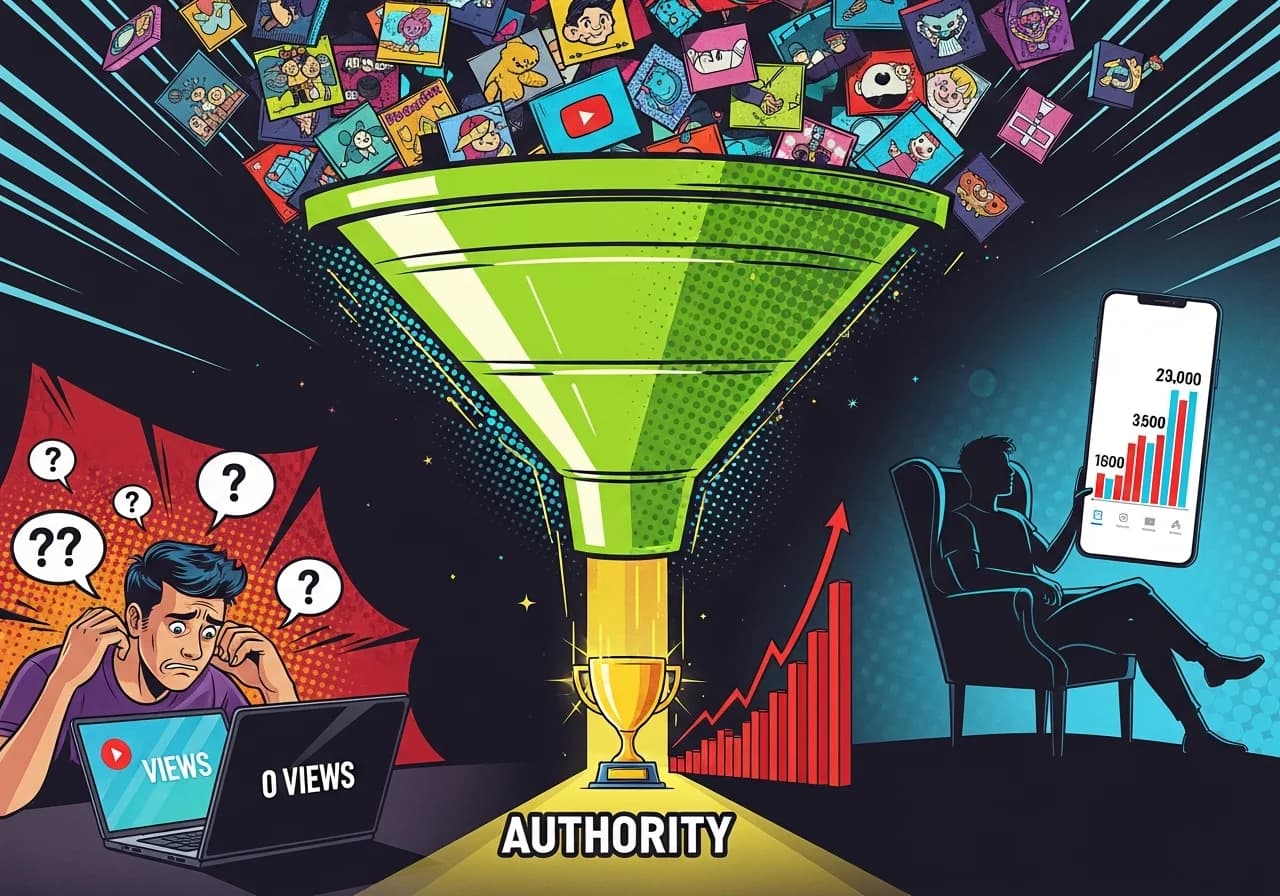
Niching Down with Shorts for Faster Authority
Channels that pick a tight niche and stick to it build algorithmic authority in months. Channels that post broadly on random topics rarely build it at all.
Table of Contents
- Why Your Niche Choice Matters More Than Your Content Quality
- The Niche Ladder: From Broad to Authority-Building
- Topic Clusters: The Engine Behind Niche Authority
- Which Niches Actually Work for Faceless Shorts in 2026?
- How to Pick and Validate Your Niche Before You Post
- Scale Your Niche Without Burning Out
Why Your Niche Choice Matters More Than Your Content Quality {#why-your-niche-choice-matters}
This might sting a little, but it is true. You can make a genuinely good Short and still get no traction if the algorithm does not know who to show it to. And that confusion almost always traces back to a niche problem.
In 2025, YouTube's algorithm shifted to semantic understanding, meaning it no longer just reads your title and tags. It analyzes how your topics connect across videos, what kind of viewer keeps watching, and whether your content fits a recognizable cluster. When your channel posts consistently within one topic area, YouTube maps it clearly and starts recommending it to people who already engage with similar content.
Post randomly across topics? The algorithm gets mixed signals. It has no cluster to place you in, so it tests your videos with small, scattered audiences and rarely pushes them further.
"YouTube is not simply pushing out random small channels. It's specifically highlighting those serving a focused audience and solving a specific set of problems." Todd Opre, Head of YouTube Discovery Team
That quote is the whole strategy in one sentence.
What "niching down" actually means
Niching down is not about limiting yourself forever. It means picking one specific topic cluster to own first, then expanding later from a position of authority.
A channel about "productivity" is a broad niche. A channel about "productivity hacks for remote workers using AI tools" is a tight niche. One gets lost in a sea of similar channels. The other gets recommended to a defined, high-intent audience.
This is the core thesis of the Faceless Shorts Strategy 2026 pillar: niche clarity is not optional, it is the foundation everything else is built on.
The Niche Ladder: From Broad to Authority-Building {#the-niche-ladder}
Not all niches are created equal. A useful way to think about this is a three-tier ladder, where each level down increases your specificity, your RPM, and your conversion rate.
| Tier | Niche Type | Example | Avg. RPM | Authority Speed |
|---|---|---|---|---|
| Tier 1 | Broad entertainment | "Funny videos" | $0.05-0.10 | Very slow |
| Tier 2 | Topic category | "Personal finance" | $0.50-1.50 | Moderate |
| Tier 3 | Problem-aware sub-niche | "Budgeting tips for freelancers" | $3.00-15.00 | Fast |
According to analysis of YouTube Shorts trends from OutlierKit (Jan 2026), finance Shorts alone average a CPM of $4.50, while broad entertainment Shorts sit at under $0.15. The difference is not just revenue. It is also subscriber quality and algorithmic trust.
Most beginners get stuck at Tier 1 because it feels safe to cast a wide net. In practice, you build authority much faster by owning Tier 3. Fewer competitors, clearer audience, and the algorithm has no trouble knowing exactly where to send your content.
As we cover in why Shorts grow channels faster, the reach advantage of Shorts compounds dramatically when the algorithm has a clear audience to target. A tight niche gives it that target.
Topic Clusters: The Engine Behind Niche Authority {#topic-clusters}
A topic cluster is a group of 3 to 5 related sub-topics that all live under your core niche. Each sub-topic becomes a recurring content angle you rotate between.
Here is a simple example for a "budgeting for freelancers" niche:
- Sub-topic A: Income tracking and invoicing tips
- Sub-topic B: Tax-saving hacks for self-employed creators
- Sub-topic C: Budget templates and monthly planning
- Sub-topic D: Tools and apps that automate freelancer finances
Every Short you make fits into one of these four buckets. This does a few things at once:
- It trains the algorithm to place all your content in one semantic cluster
- It makes batch production easy because you always know what to make next
- It cross-references your own videos, keeping viewers watching multiple Shorts in a row
- It signals consistency to YouTube, which rewards regular posting within a topic by pushing your content to a wider audience over time
How clusters compound your growth
Research from AIR Media-Tech (Nov 2025) tracked multiple channels after introducing a focused Shorts strategy. In every case, consistent niche posting led to a clear upward trend in views and revenue within 6 to 8 weeks. One kids' content channel saw month-over-month subscriber growth simply by posting daily within a tight topic cluster, with no change in video quality.
The compounding effect is real. Each video reinforces the ones before it. The algorithm builds more confidence in your channel's identity with every upload. And your subscribers know exactly what they signed up for, so they actually watch your next video when it lands in their feed.
Which Niches Actually Work for Faceless Shorts in 2026? {#which-niches-work}
Not every niche translates equally well to faceless short-form video. The best ones share a few traits: they are visually driven or curiosity-driven, they work without a recognizable host, and they have a large enough audience to sustain daily posting.
Here are the top-performing categories based on TubeBuddy's analysis of over 30 million Shorts (Jan 2026):
- Entertainment and pranks (17%+ of all Shorts views)
- Food and cooking (visually satisfying, highly shareable)
- Crafting and art (low competition, high rewatch value)
- AI tools and tech (fastest emerging category, premium CPM)
- Personal finance (highest CPM, problem-aware audience)
- Life hacks and quick tips (universally relatable, high shareability)
- True crime and scary stories (massive faceless audience, strong retention)
- Health and wellness (large audience, strong affiliate monetization)
For faceless channels specifically, the best performers tend to be formats that do not need a personality on screen. Did-you-know facts, animated storytelling, narrated lists, and tutorial explainers all work well with AI-generated visuals and voiceovers.
The niches to avoid when starting out
A few niches look attractive but rarely pay off for new faceless channels:
- Commentary and opinion content (needs a strong personality to build trust)
- News and current events (too fast-moving to batch-produce)
- Gaming highlights (extremely saturated, hard to stand out without an existing community)
- General motivation (massive competition, very low differentiation)
If you are choosing between two niches, always pick the one where you can answer a specific problem for a specific person, not the one with the most views on trending videos.
How to Pick and Validate Your Niche Before You Post {#how-to-pick-your-niche}
Picking a niche based on gut feel is fine to start, but validation before you commit saves months of wasted effort.
Here is a simple validation process:
- Search your niche keyword on YouTube and filter by Shorts. Are there channels under 100k subscribers getting consistent views? That signals the algorithm is actively distributing content in this space.
- Check if the top-performing channels post consistently within a tight sub-niche, or if they post randomly. If tight-niche channels are winning, that is your green light.
- Look at whether the content format lends itself to a free ai youtube shorts script generator, meaning can you easily produce 30 to 50 variations of this content type without running out of ideas? If yes, it is a scalable niche.
- Estimate the RPM tier. Finance, AI, and software niches attract premium advertisers. Broad entertainment does not. This matters if monetization is part of your plan.
You can start generating script ideas for your niche immediately using the free YouTube Shorts script generator to test whether your niche has enough angle variety before committing to it.
The 30-video rule
Do not judge your niche until you have posted 30 Shorts within it. The algorithm needs data before it can push your content broadly. Gist.ly's 2025 analysis of 500+ faceless channels found that channels which stayed in a focused niche through their first 30 uploads saw dramatically higher recommendation rates than channels that pivoted early.
Stick with it. Analyze retention and subscriber conversion after video 30. Then refine your angle, not your niche.
Scale Your Niche Without Burning Out {#scale-your-niche}
Here is the part most niche guides skip. Knowing your niche is step one. Producing content in that niche daily without burning out is the actual challenge.
The channels that build authority fastest in 2026 are not the ones with the best ideas. They are the ones with the best production systems. A tight niche makes batch production dramatically easier because you always know what to make next. Your topic clusters become a content calendar almost automatically.
Pair that with a system for generating niche-consistent Shorts quickly, and the authority compounds fast. Tools like Virvid are built specifically for this use case: you pick your niche, select a trending style that fits it, generate a script, and the full Short comes out the other side in under two minutes, with visuals, captions, voiceover, and music already matched to your content type. No camera, no editing, no trend-hunting required.
As we explore in detail in the Shorts batch production system guide, the creators who grow fastest are not posting one video at a time. They are batching 10 to 20 Shorts in a single session and scheduling them out across the week.
That is only possible when your niche is tight enough to produce consistently, and your tools are fast enough to keep up with the algorithm's appetite for fresh content.
What consistent niche posting looks like in practice
- Post every day or every other day minimum within your niche cluster
- Rotate between your 3 to 5 sub-topics so content stays fresh without drifting off-topic
- Watch your retention graph weekly and cut any content angle that consistently drops under 40%
- When one sub-topic consistently outperforms the others, lean into it and create more depth there
The posting frequency guide for Shorts growth goes deeper on optimal cadence by channel size, which is worth reading once you have your niche locked in.
Start Narrow, Then Expand
The counterintuitive truth about building a YouTube Shorts channel in 2026 is that going smaller gets you bigger, faster. A channel about everything is a channel the algorithm ignores. A channel about one specific problem for one specific audience is a channel that the algorithm actively tests, distributes, and eventually pushes hard.
Pick your Tier 3 niche today. Map out your three content clusters. Post your first 10 Shorts without wavering from the topic. Then look at your data and double down on what worked.
The authority you build from a tight niche is real, durable, and compounds over time. The views you chase by posting broadly rarely do.