

Mistakes People Make When Switching to Shorts
Switching to YouTube Shorts seems straightforward, but almost every creator coming from long-form makes the same predictable mistakes that quietly kill reach before the algorithm ever gets involved.
Table of Contents
- Why the Swipe Feed Changes Everything
- The Long-Form Pacing Trap
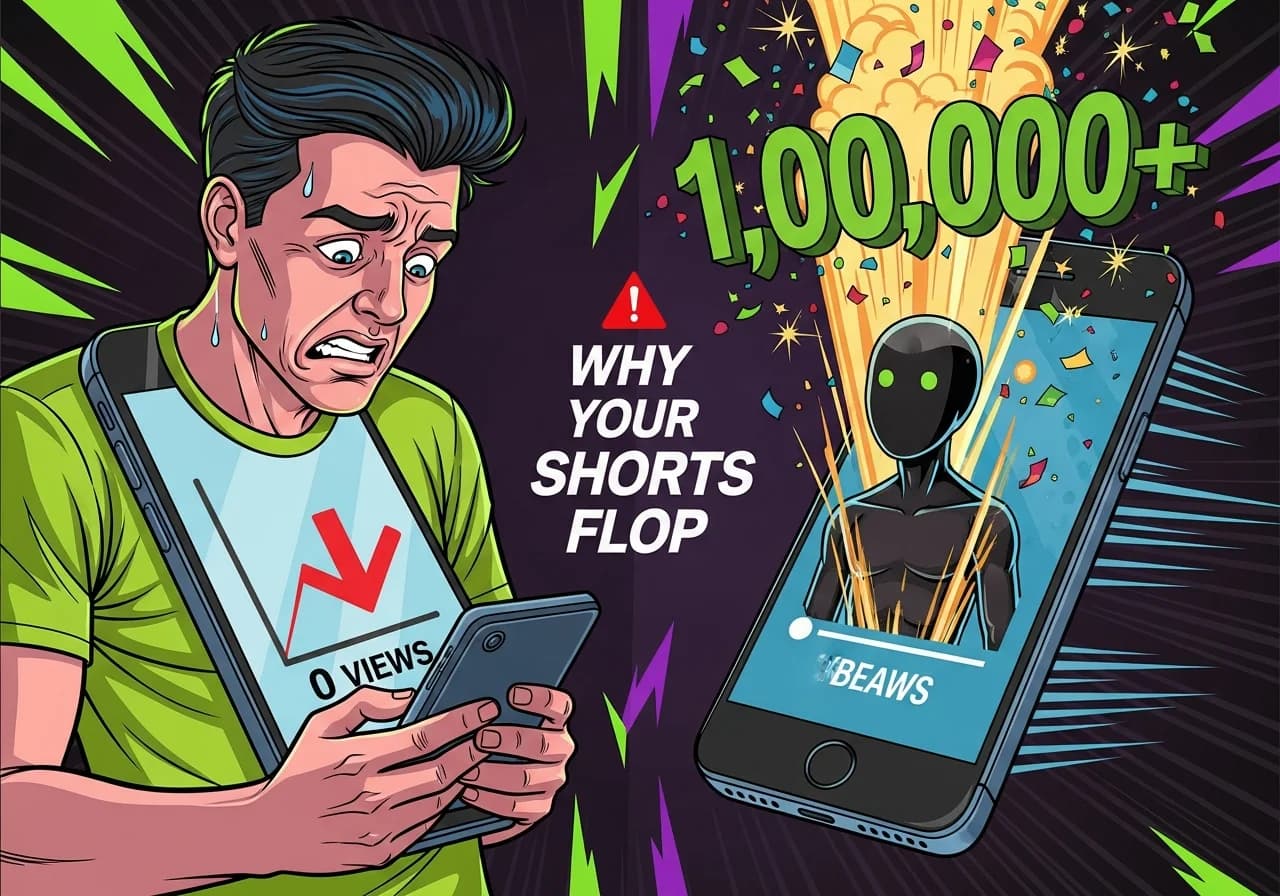
- Weak Hooks: The Actual Reason Your Shorts Flop
- Niche and Consistency Mistakes
- Technical Mistakes That Kill Distribution
- How to Switch to Shorts the Right Way
- The Mindset Shift That Fixes Everything
Why the Swipe Feed Changes Everything
Most creators underestimate how fundamentally different the Shorts feed is from every other format they've made content for. On YouTube proper, a viewer clicks a thumbnail. They made a deliberate choice. They're already committed to giving you a few minutes.
On the Shorts shelf, nobody chose to watch your video. It just appeared. And with one flick of a thumb, it disappears just as fast.
As covered in the Faceless Shorts Strategy 2026 guide, this passive discovery mechanic completely inverts the way content needs to work. You don't earn attention through a compelling title. You earn it in real time, every second, by keeping the person from swiping.
The algorithm reflects this. According to vidIQ's February 2026 breakdown of the YouTube Shorts algorithm, YouTube uses an "explore and exploit" system. Your Short first gets shown to a small seed audience. If that group engages, YouTube widens distribution. If they swipe away, the video stalls. The seed audience's behavior is everything, and you only get one shot.
| Metric | What it Means for Shorts | Target |
|---|---|---|
| Viewed vs. Swiped Away | Did your hook stop the scroll? | 50%+ minimum, 70%+ ideal |
| Average % Viewed | Are people staying through? | 80%+ target |
| Engaged Views | Real interactions (post-March 2025) | Track separately from raw views |
| Completion Rate | Did viewers make it to the end? | 60%+ for Shorts under 30s |
Note: As of March 31, 2025, YouTube changed how views are counted. Any play or loop counts as a view, with no minimum watch time. But only "engaged views" count toward monetization and YPP eligibility, so raw view counts can be misleading.
The Long-Form Pacing Trap
This is the mistake that gets almost everyone coming from long-form. And it's invisible if you don't know to look for it.
In long-form video, you build context. You establish yourself, set up the topic, warm the viewer up, then deliver value. That structure works when someone has chosen to spend 10 minutes with you.
In a Short, that same structure is fatal.
If your most interesting point is 20 seconds in, the data is blunt: 70% of your potential audience has already swiped away before you get there. You can have a genuinely good video and nobody will ever see it.
What long-form creators do wrong:
- Open with "Hey guys, welcome back to my channel" (says nothing, gives no reason to stay)
- Spend the first 5-10 seconds setting up context before delivering value
- Save the "big reveal" or payoff for the end
- Use slow B-roll or ambient footage as an intro
- Script content that reads well as prose but drags on screen
The fix is counter-intuitive but consistent: start with the conclusion. Show the payoff first, then explain how you got there. A cooking Short should open with the finished dish, not with raw ingredients. A tutorial Short should open with the result or the insight, not the backstory.
This is also why understanding viral Shorts structures matters before you even start shooting. The format dictates the script, not the other way around.
Weak Hooks: The Actual Reason Your Shorts Flop
If you look at your YouTube Studio analytics and check the "Audience Retention" tab, you'll usually find the real culprit immediately. A massive drop in the first 1-3 seconds. That's a hook failure, and it's the single most common reason Shorts don't get views.
Opus.pro's research on hook formulas found that more than 60% of mobile viewers watch without sound. That means your hook has to work visually. Text overlays, strong opening images, and captions in the first frame aren't optional extras. They're load-bearing.
Hook mistakes to stop making immediately:
- Generic openers: "Today I'm going to show you..."
- Starting with a question that's too vague: "Want more views?"
- Slow-building mystery without any immediate intrigue
- No text or captions on screen in the first 3 seconds
- Opening with a face-to-camera shot with no context (no text, no setup)
What actually works:
- Specific questions that imply insider knowledge: "Why do your Shorts die at 40% watch time?"
- Showing the end result first (the "payoff preview")
- Starting mid-action with on-screen text that explains what's happening
- A bold statement that challenges a common assumption
"The first frame and first line are your most valuable real estate. A great video that starts weak will be skipped, and the algorithm will never know its greatness." - Analyzed from Opus.pro creator research, November 2025
According to Shortimize's January 2026 retention benchmarks, your intro retention (percentage who make it past 3 seconds) should ideally be above 70%. If it's consistently below 50%, nothing else matters. Fix the hook before you change anything else.
If you're building faceless Shorts and struggle with scripting compelling hooks from scratch, a free AI video hook generator can give you tested formats to work from rather than starting cold.
Niche and Consistency Mistakes
Another common mistake: treating Shorts like a testing ground for random content experiments.
When you post about cooking one week, life hacks the next, and travel the week after, YouTube's algorithm can't figure out who to show your videos to. It needs a consistent signal to build an audience profile for your channel. Without that, your Shorts get tested on mismatched audiences who swipe away fast, which tanks distribution further.
The niche consistency rule is simple: post in a narrow topic area until the algorithm finds your audience, then you can expand carefully.
This doesn't mean every Short has to be identical. You can vary format, angle, and tone within a niche. But the subject matter and target viewer should stay consistent, especially in the first 50-100 uploads.
Research on niching down for Shorts shows that channels that nail a specific niche early grow significantly faster than generalist channels, because the algorithm can confidently match their content to viewers who will actually watch it.
Related niche mistakes:
- Posting the same Short on multiple topics in the same week
- Switching niches after a few bad-performing videos instead of improving execution
- Making content "for everyone" (which effectively reaches no one)
- Ignoring which of your Shorts performed best and why
Technical Mistakes That Kill Distribution
Before strategy, there's a checklist of technical errors that can prevent your Short from entering the Shorts feed at all. These seem basic but get missed more often than you'd think.
| Technical Issue | Impact | Fix |
|---|---|---|
| Horizontal/landscape video | Never autoplays correctly in feed, black bars appear | Always shoot in 9:16 vertical |
| Video over 60s (older uploads) | May not classify as a Short | Keep under 60s or understand 1-3 min rules |
| Set to Private or Unlisted | Zero distribution | Always double-check visibility before publishing |
| "Made for Kids" toggled on | Removes comments, limits reach | Only use for genuinely children-targeted content |
| No #Shorts tag on mixed-content channels | Algorithm may not categorize correctly | Add #Shorts in title or description |
Beyond format, audio and visual quality matter more than many new creators expect. According to YouTube's own creator guidance, low visual quality or poor sound signals low value to viewers during the algorithm's early testing phase, which limits how widely a Short gets pushed.
You don't need expensive equipment. But you do need intentional framing, decent lighting, and clear audio (or well-synced captions as a substitute when going faceless).
How to Switch to Shorts the Right Way
Here's the practical sequence for making the transition from long-form (or from no content at all) to Shorts without burning your early momentum:
- Study the Shorts feed for your niche for at least a week before posting. Watch what's working, identify hook patterns, note where viewer attention is held.
- Pick one narrow niche and commit to it for your first 30-50 Shorts.
- Script your hook first. Write the opening 3 seconds before anything else. If it doesn't create immediate curiosity or show immediate value, rewrite it.
- Start every Short with the payoff or most interesting moment, not the setup.
- Add captions to every Short. They boost retention for sound-off viewers and keep visual attention on screen.
- Check your "viewed vs. swiped away" metric in YouTube Studio after every upload. This is your primary feedback signal.
- Post 3-5 Shorts per week and prioritize quality over volume. Let the data from each video guide the next.
- Identify your top 3 performing Shorts by retention, find what they share, and replicate the pattern.
Platforms like Virvid make this workflow much faster for faceless channels by generating scripts, choosing trending formats, and adding captions automatically, so you can focus on iterating on what the data tells you rather than spending hours on production.
The Mindset Shift That Fixes Everything
Here's the thing most people miss when they switch to Shorts: it's not a simpler format. It's a harder one.
Long-form gives you time to recover from a slow start. Shorts don't. You have to earn every second of attention in real time, with no margin for error at the beginning.
The creators who grow fast on Shorts aren't the ones who post the most. They're the ones who obsess over the first three seconds, study their retention curves, and iterate methodically until they find a hook and format that reliably stops the scroll.
As explained in more depth in the guide on why Shorts grow channels faster, the reach potential on Shorts is real. YouTube Shorts now sees 70 billion daily views. But that reach only comes to creators who've solved retention first.
Pick your niche. Fix your hook. Check your analytics. And post your next Short today.