

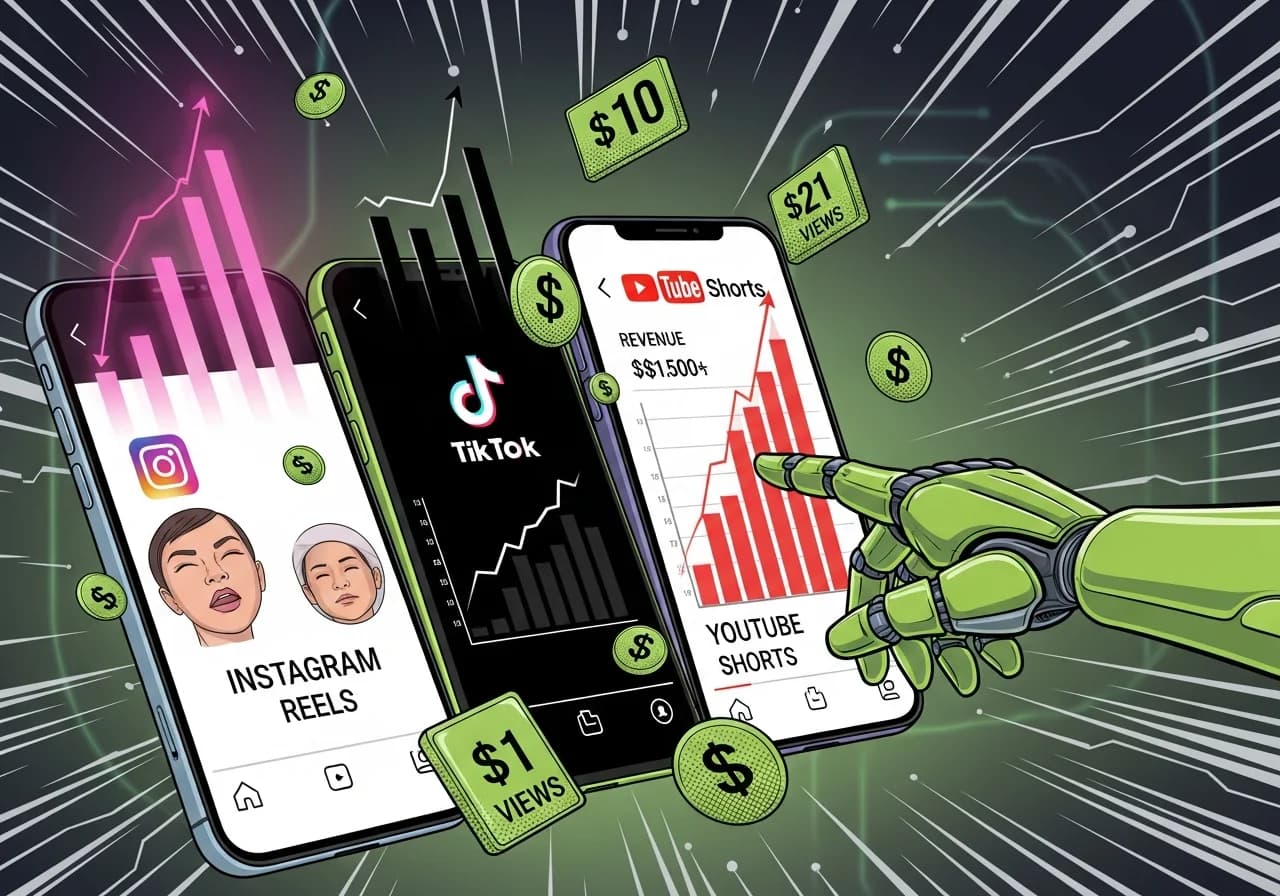
Instagram Reels vs TikTok vs YouTube Shorts: Which Platform to Choose in 2026 for AI Content?
YouTube Shorts offers the most sustainable monetization for AI creators in 2026, with the highest engagement rate (5.91%), predictable ad revenue sharing, and the longest content lifespan, while TikTok delivers unmatched viral potential and Instagram Reels commands premium brand partnership rates.
Table of Contents
- Quick Platform Comparison for AI Creators
- How Each Algorithm Treats AI Content Differently
- Monetization Requirements and Payouts Compared
- Engagement Rates and Reach Statistics
- Best Platform by AI Content Type
- Optimal Video Length and Posting Strategy
- AI Disclosure Policies and Enforcement
Quick Platform Comparison for AI Creators
Before diving deep, here's what matters most for AI content creators choosing between platforms in 2026:
| Factor | YouTube Shorts | TikTok | Instagram Reels |
|---|---|---|---|
| Engagement Rate | 5.91% (highest) | 5.75% | 5.53% |
| RPM (per 1K views) | $0.01-$0.07 | $0.40-$1.00 | $0.01-$0.05 |
| AI Content Policy | Allows original AI-assisted | Strictest enforcement | Algorithmic penalties |
| Best For | Faceless, educational | Viral discovery, UGC | Brand partnerships |
| Monetization Threshold | 1K subs + 10M views | 10K followers + 100K views | 5M views (invite-only) |
The creator economy is projected to reach $1.07 trillion by 2034, with AI as a key driver.
According to Adobe's October 2025 Creators' Toolkit Report, 86% of creators now use generative AI tools. Yet consumer preference for AI content has dropped from 60% in 2023 to just 26% in 2025, signaling that the hybrid approach works best.
As covered in our AI Instagram Reels Ultimate Guide 2026, the key is using AI for efficiency while maintaining authentic creative direction.
How Each Algorithm Treats AI Content Differently
Understanding how each platform's algorithm handles AI-generated content determines your success. All three prioritize watch time, but their treatment of AI varies dramatically.
YouTube Shorts Algorithm
YouTube's algorithm prioritizes completion rate and "loopability" above other metrics. The platform's "explore and exploit" system tests content with small audiences before expanding reach based on performance.
Key algorithm factors for 2025:
- Viewer satisfaction weighted over raw views
- Replays and comments signal quality
- View count changed March 2025: any playback duration now counts
- 42% of Shorts contain AI-generated components
YouTube's July 2025 policy update represents the biggest shift for AI creators. The platform now demonetizes videos that are "mostly AI-generated, repetitive, or lacking real human input."
However, YouTube clarified this targets creators using AI to "replace originality altogether." Content reflecting unique creator ideas remains monetizable even when AI-assisted.
TikTok Algorithm
TikTok gives significant weight to engagement within the first 60 minutes of posting. Videos achieving over 70% completion rate with strong early engagement receive substantial algorithmic boosts.
What makes TikTok unique:
- Each video evaluated independently of account history
- No preferential ranking based on follower count
- Shares and saves weighted highest
- 76% of successful TikTok Shop creators have under 1,000 followers
TikTok became the first platform to automatically detect AI content through C2PA integration in January 2025. The system identifies content from 47 different AI platforms (up from 12 in 2024). Removal rates for unlabeled AI content increased 340% compared to 2024.
Instagram Reels Algorithm
Instagram's algorithm focuses on three signals according to Adam Mosseri's January 2025 statements. As we explored in our Instagram Reels Algorithm Explained guide, understanding these signals is crucial:
- Watch time determines both connected and unconnected reach
- Likes per reach matters most for follower distribution
- Sends/shares per reach drives discovery by new audiences
Instagram creates the most significant penalties for AI content. AI-labeled content experiences 15-80% engagement reduction depending on content type. Pure AI-generated posts can face up to 80% reach reduction, making Instagram the most challenging platform for overtly AI content.
Monetization Requirements and Payouts Compared
The monetization landscape varies substantially across platforms. Here's exactly what you need to qualify and what you can expect to earn.
YouTube Shorts Partner Program
YouTube operates on a two-tier system established in 2023:
Lower threshold (fan funding features):
- 500 subscribers
- 3,000 watch hours OR 3 million Shorts views in 90 days
- Unlocks Super Thanks, Super Chat, memberships
Full monetization:
- 1,000 subscribers
- 4,000 watch hours OR 10 million Shorts views in 90 days
- 45% of allocated ad revenue (vs 55% for long-form)
- RPM typically $0.01-$0.07 per 1,000 views
One million Shorts views generates approximately $30-$200. High-value niches like finance can achieve CPMs up to $4.50, while entertainment hovers around $1.20-$2.00.
TikTok Creator Rewards Program
TikTok's Creator Rewards Program offers significantly higher rates:
Requirements:
- 18+ years old
- 10,000+ followers
- 100,000 valid views in past 30 days
- Videos must be at least 1 minute long
Payouts:
- $0.40-$1.00 per 1,000 qualified views
- Up to 25x higher than legacy Creator Fund
- Per million views: $400-$1,000
TikTok Pulse offers 50% ad revenue sharing for creators in the top 4% by views, requiring 100,000 followers minimum.
Instagram Reels Monetization
Instagram's monetization has contracted in 2025. The Reels Play Bonus program stopped extending new deals in March 2025:
Current requirements:
- 5 million+ views across Reels in last 3 months
- Invitation-only program
- Direct payouts: $0.01-$0.05 per 1,000 views
Alternative programs:
- Breakthrough Bonus: up to $5,000 over three months
- Referral Bonus: up to $20,000 in limited programs
- Exclusive contracts: up to $50,000/month for top creators
Brand deal rates favor Instagram. Influencer CPMs average ~$45 for Reels versus ~$25 for TikTok and ~$35 for YouTube. Mega-influencers can command $10,000-$100,000+ per Reel through partnerships.
For detailed monetization strategies, see our guide on How to Monetize AI Instagram Reels in 2026.
Engagement Rates and Reach Statistics
Current engagement data reveals all three platforms offer substantial organic reach, with smaller creators often outperforming mega-accounts.
YouTube Shorts Statistics (2025)
YouTube Shorts statistics in 2025:
- 200 billion+ daily views (up from 70B in early 2024)
- 2+ billion monthly active users engaging with Shorts
- 40% of Shorts viewers don't use TikTok or Instagram Reels
- 12 million+ Shorts uploaded daily
- 55% of daily active users engage with Shorts
- Largest age segment: 25-34 years (21.5%)
YouTube CEO Neal Mohan announced that YouTube has paid over $70 billion to creators in the past three years.
TikTok Statistics (2025)
TikTok statistics in 2025:
- 1.59 billion monthly active users
- 45-58 minutes average daily time on platform
- Gen Z users average 90 minutes daily
- 34 million videos posted per day
- Average engagement: 4.90% by views
- Small accounts (<100K): 7.50% engagement rate
- Mega accounts (10M+): 2.88% engagement rate
The inverse relationship between follower count and engagement means new AI creators can compete effectively with established channels.
Instagram Reels Statistics (2025)
Instagram Reels statistics in 2025:
- 2+ billion users monthly
- 140-200 billion Reels played daily
- Average engagement rate: 1.23%
- 30.81% reach rate (double other post types)
- 3.5-4.5 billion reshares daily
- 33 minutes average daily usage
- Reels account for 39% of time spent
- Gen Z represents 52.4 million US users
- 18-24 age group forms the largest segment at 31.7%
Best Platform by AI Content Type
Performance data reveals distinct platform advantages depending on your AI content style. Tools like Virvid help you create optimized versions for each platform with trending formats already built in.
Faceless Video Content
Best platform: YouTube Shorts
Faceless channels represent 38% of new creator monetization ventures in 2025. According to industry data:
- Faceless Shorts with AI avatars/voiceovers drive 58% retention boost
- Success examples include Mr. Nightmare (6M+ subs, $21K-$63K monthly)
- YouTube's content lifespan means videos generate traffic for years
- Faceless videos reduce production costs by 40% on average
On TikTok, faceless AI animal rescue and transformation channels exceed 1 million views per video, but the platform prefers live content (receiving 3x more algorithmic distribution).
If you're exploring faceless formats, check out our AI Instagram Reels Video Ideas by Niche for trending concepts that work without showing your face.
UGC-Style AI Content
Best platform: TikTok
User-generated content drives 60% of brand engagement on TikTok in 2025. Key metrics:
- AI UGC campaign achieved 18.5% engagement vs 5.3% for human UGC
- AI UGC costs $99/month unlimited vs $150-$212 per video for humans
- 48% of UGC campaigns now integrate AI-generated elements
- Brands using AI UGC see 90% cost savings
However, authenticity perception remains lower (63% vs 81% for human content), making hybrid approaches most effective.
Educational and Tutorial Content
Best platform: YouTube Shorts
Educational content commands higher CPMs ($10+ for finance/business niches). YouTube's search functionality creates evergreen traffic streams:
- 70% of educational faceless channels use AI voices
- Educational Shorts 50-60 seconds show 76% completion rate
- 100K subscriber channel can charge $1,000-$5,000 per sponsored video
TikTok serves as a discovery mechanism, but YouTube provides superior monetization. You can use our free AI video script generator to create educational scripts optimized for engagement, or try the tutorial video script generator for step-by-step content.
Storytelling and Narrative Content
Best platform: Both TikTok and YouTube
AI-generated animated content now comprises 42% of all animated videos on major streaming platforms:
- TikTok's trend-driven audience embraces dark cartoon and horror animation
- YouTube rewards longer narrative formats with serialized content
- Documentary-style combining AI voiceover with stock footage performs well
For scary story and true crime niches, Virvid offers dedicated formats like the scary story video script generator and true crime video script generator with trending hooks built in.
Optimal Video Length and Posting Strategy
Platform-specific optimization has evolved significantly. Here's the data-backed approach for 2026:
YouTube Shorts Optimization
YouTube Shorts optimization data:
| Metric | Optimal Value |
|---|---|
| Max length | 3 minutes (extended Oct 2024) |
| Optimal length | 50-60 seconds |
| Under 20s retention | 73% |
| Best posting days | Wednesday & Thursday |
| Best posting time | 4 PM |
| Posting frequency | 2-3 Shorts per day |
| Hashtags | 3-8, always include #Shorts |
Videos over 60 seconds must use royalty-free music to avoid Content ID claims. Creators have less than 3 seconds to capture attention.
TikTok Optimization
TikTok optimization data:
| Metric | Optimal Value |
|---|---|
| Max length | 10 min (in-app), 60 min (upload) |
| Engagement sweet spot | 21-34 seconds |
| Monetization minimum | 1+ minute |
| Best posting time | 7-9 PM weekdays |
| Best posting days | Tuesday-Thursday |
| Posting frequency | 3-4x weekly minimum (1-4 daily recommended) |
| Hashtags | 3-5 mixing broad (#FYP) and niche |
The tension between engagement optimization (shorter) and monetization (longer) requires strategic thinking. 50% of user time is spent on videos over 1 minute, suggesting the algorithm increasingly favors longer content.
Instagram Reels Optimization
Instagram Reels optimization data:
| Metric | Optimal Value |
|---|---|
| Max length | 3 min (in-app), 15 min (upload) |
| Algorithm preference | Under 90 seconds |
| Maximum engagement | 15-30 seconds |
| Under 15s completion | 72% (vs 46% for longer) |
| Best posting time | 7-9 PM (61% avg engagement) |
| Posting frequency | 3-4 Reels per week |
| Hashtags | 3-5 targeted (or 20 for max reach) |
50% of Reels are watched without sound, and captions increase retention by 25%. Always add captions.
AI Disclosure Policies and Enforcement
All three platforms now mandate AI disclosure with varying enforcement mechanisms. Understanding these policies is essential to avoid demonetization or removal.
YouTube's July 2025 Policy
YouTube requires disclosure and explicitly demonetizes mass-produced AI videos:
What triggers restrictions:
- Mostly AI-generated content
- Repetitive content lacking human input
- Mass-produced videos replacing originality
What remains allowed:
- AI as a creative tool
- Original AI-assisted content
- Significantly original and authentic work
Disclosure requirements vary: Shorts show AI labels in descriptions, while sensitive topics receive prominent labels above the player. Failure to disclose may result in Partner Program removal.
TikTok's Enforcement System
TikTok maintains the strictest enforcement through automatic C2PA detection:
Detection capabilities:
- Reads metadata from 47 AI platforms
- Adobe Firefly, DALL-E, Microsoft Designer included
- Automatic labeling when detected
Prohibited AI content:
- AI depictions of private citizens
- AI involving minors
- Fake AI news reports
- AI medical advice
- AI celebrity endorsements without disclosure
- Political AI content (advertising banned)
Violations receive immediate strikes with no warnings. 51,618 synthetic media videos were removed and 8,600 accounts permanently banned in late 2025.
Instagram/Meta's Approach
Meta applies "AI info" labels using multiple detection methods:
Detection methods:
- C2PA metadata
- IPTC information
- Embedded watermarks
- Pattern recognition
Even minor edits using Photoshop's Generative Fill trigger automatic labeling because metadata remains embedded. Meta consulted over 120 stakeholders in 34 countries, with 82% of survey respondents favoring warning labels.
Unlike competitors, Meta imposes algorithmic penalties (15-80% engagement reduction) rather than removal, making consequences subtler but potentially more damaging to reach.
Expert Perspectives on AI Content Creation
Industry leaders have provided substantial commentary on AI content trends throughout 2025.
YouTube CEO Neal Mohan explained the platform's philosophy in February 2025: "AI has to be in service of human creativity. They are tools in the hands of creators. They are never meant to replace them."
Mike Polner, VP and Head of Product Marketing for Creators at Adobe, noted in October 2025: "The results of our global Creators' Toolkit Report are staggering: 76 percent of creators say creative generative AI is positively shaping the creator economy, helping them reach new audiences, scale their businesses, and amplify their creative expression."
However, consumer attitudes have declined. Only 26% of consumers prefer AI creator content (down from 60% in 2023), and only 9% of marketers plan to partner with virtual influencers in 2026.
Making Your Platform Decision
The strategic recommendation is clear based on 2025 data:
Choose YouTube Shorts if:
- You want predictable, stable revenue
- You create faceless or educational content
- You prefer longer content lifespan (years vs days)
- You're targeting Millennials (largest age segment: 25-34)
Choose TikTok if:
- You prioritize viral discovery
- You're starting from zero followers
- You create UGC-style or trend-based content
- You can commit to 1+ minute videos for monetization
Choose Instagram Reels if:
- You're pursuing brand partnerships
- You have an existing Instagram following
- You create lifestyle or personality-driven content
- You can afford lower direct payouts for premium CPMs
The most successful AI creators operate across all three platforms, using TikTok for discovery, YouTube for revenue, and Instagram for brand deals. Tools like Virvid make this multi-platform approach practical by generating optimized versions for each platform automatically, with trending formats, copyright-free music, and AI voices already integrated.
Ready to start creating AI content that performs? Pick your niche, choose your primary platform based on the data above, and publish your first short today. The algorithms reward consistency, so the best time to start is now.
For a comprehensive deep-dive into AI reels strategy, check out our complete AI Instagram Reels Ultimate Guide 2026 covering everything from script writing to viral optimization.