

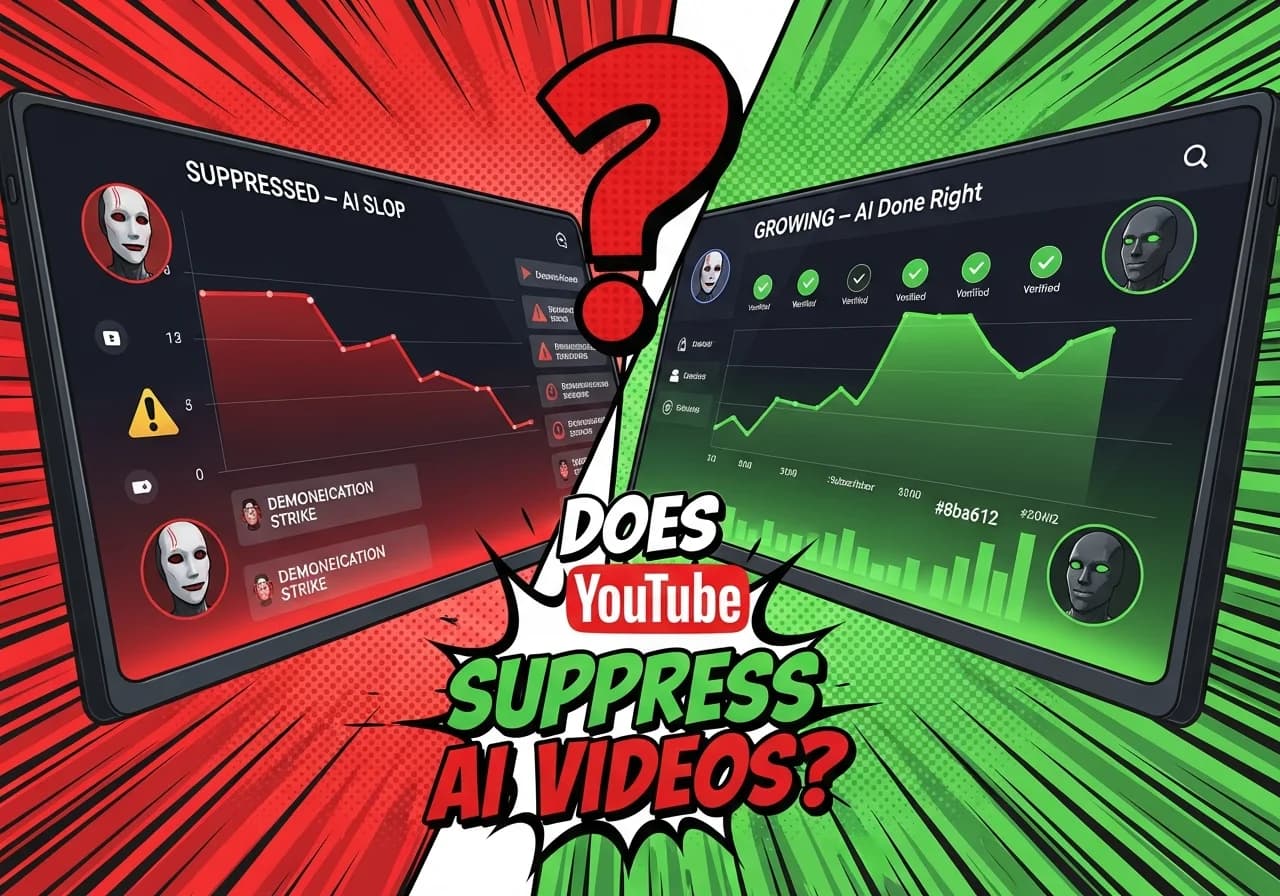
Does AI Content Get Suppressed on YouTube? Myth vs Reality
YouTube does not suppress AI-generated content by default — it suppresses low-performing content, and a lot of AI videos happen to perform poorly for entirely fixable reasons.
That distinction matters a lot if you're building a faceless channel or using AI tools to produce shorts at scale. The myth that "YouTube detects and buries AI videos" is spreading fast, and it's causing creators to misdiagnose their actual problem. Let's clear this up properly.
Table of Contents
- The Short Answer: What YouTube Actually Does
- What the July 2025 Policy Update Really Changed
- The Real Reason Most AI Videos Get Buried
- AI Disclosure Rules: What You Must Do
- AI Channels That Are Actually Growing
- How to Make AI Content YouTube Won't Suppress
- The Bottom Line
The Short Answer: What YouTube Actually Does {#the-short-answer}
Here's the core truth: YouTube's algorithm distributes videos based on viewer behavior signals, not on how the content was produced. Watch time, retention rate, swipe-away rate, engagement, CTR — these are what determine reach. The algorithm has no setting labeled "AI penalty."
| Signal | What YouTube Measures | Why It Matters |
|---|---|---|
| Retention rate | % of video watched | Primary rank factor for Shorts and long-form |
| Swipe-away rate | How fast viewers leave your Short | High swipe-away = suppressed |
| Watch time | Total minutes consumed | Signals value to the algorithm |
| Engagement | Likes, comments, shares | Indicates viewer satisfaction |
| CTR | Clicks on thumbnails (long-form) | Drives initial test audience reach |
As Sprout Social's 2025 algorithm breakdown confirms, failure to label realistic AI-generated content correctly can result in algorithmic suppression or removal from the Partner Program — but that's a compliance issue, not an AI detection sweep. Correctly disclosed AI content gets normal distribution.
What the July 2025 Policy Update Really Changed {#july-2025-policy}
On July 15, 2025, YouTube updated its YouTube Partner Program rules, renaming "repetitious content" to "inauthentic content" and tightening what can be monetized. According to reporting from TechCrunch, YouTube is preparing to crack down on creators' ability to generate revenue from "inauthentic" content — specifically mass-produced videos and other types of repetitive content.
What gets demonetized under the new rules:
- Videos with no original commentary, perspective, or storytelling
- Mass-uploaded content using recycled scripts and robotic voices
- AI-generated videos that simulate real events or real people without disclosure
- Batch uploads with near-duplicate content across multiple channels
What is explicitly NOT penalized:
- AI-assisted scripting, voiceovers, or editing that adds human value
- Faceless channels using AI visuals with original narrative framing
- Properly disclosed synthetic or realistic AI content
- High-quality AI shorts with strong retention metrics
YouTube's own statement is unambiguous: "We welcome creators using AI tools to enhance their storytelling, and channels that use AI in their content remain eligible to monetize." The key distinction is AI as a tool versus AI as a replacement for any creative effort at all.
This is part of a broader pattern. As OutlierKit's 2026 algorithm update summary notes, properly disclosed AI content is not penalized in 2026 — YouTube requires creators to label AI-generated or significantly AI-altered content, and videos with correct labels receive normal algorithmic distribution.
The Real Reason Most AI Videos Get Buried {#real-reason}
Here's where most creators get it wrong. They assume the algorithm flagged their AI content. In reality, their retention was terrible and the algorithm did exactly what it was built to do.
According to Retention Rabbit's May 2025 benchmark report, even low-quality human narration outperforms the best AI narration for holding audience attention. Monotonous AI narration leads to an average 35% higher viewer drop-off within the first 45 seconds compared to human narration. That drop-off signals low quality to YouTube. The video stops being recommended. That's suppression — but it's caused by performance, not AI origin.
The same report found that channels improving average retention by 10 percentage points experience a correlated 25%+ increase in impressions from YouTube's algorithm. Retention drives distribution. If your AI video holds attention, it gets pushed. If it doesn't, it gets buried.
The most common retention killers in AI content:
- Generic robotic voiceover with no variation in pacing or tone
- Repetitive or stock-looking visuals that don't match the story
- Slow or padded intros that don't hook in the first 3 seconds
- Scripts that were clearly templated with no original angle
This is exactly what our pillar guide on the YouTube algorithm for faceless channels covers in depth — retention is the master signal, and AI content lives or dies by the same rules as everything else.
"The algorithm is ruthless about promoting what works and burying what doesn't. Viewer satisfaction drives everything. The 2025 updates don't alter this core truth." — Shortimize, YouTube Shorts Algorithm Analysis (Oct 2025)
AI Disclosure Rules: What You Must Do {#disclosure-rules}
YouTube now requires disclosure for realistic AI-generated content. Here's what that means in practice.
You must disclose when your content:
- Realistically depicts events that didn't happen
- Shows a real person saying or doing something they didn't do
- Uses a realistic AI-generated voice of a real person
- Generates synthetic footage that looks like real recorded video
You do NOT need to disclose when:
- You used AI to write a script (standard writing assistance)
- AI helped with editing, color correction, or noise reduction
- The visuals are clearly animated or stylized (not realistic)
- AI generated background music or non-realistic imagery
In YouTube Studio, the label is under video details: "altered or synthetic content." If your content falls under the realistic category and you skip this label, you risk reduced recommendations or removal — not because of an AI penalty, but because of a policy violation. As TechCrunch reported in October 2025, YouTube has now rolled out likeness-detection technology to YPP creators, specifically to identify and manage AI-generated content featuring the likeness of real people.
AI Channels That Are Actually Growing {#ai-channels-growing}
The suppression narrative falls apart completely when you look at actual data.
A Kapwing study referenced in a December 2025 Techloy analysis examined 15,000 of YouTube's most popular channels and found 278 that produce nothing but AI-generated content. Together, those channels have amassed 63 billion views and an estimated $117 million in annual revenue.
That doesn't sound like suppression.
The channels getting suppressed are the ones producing low-effort, repetitive slop. The ones growing are producing AI content that actually holds viewer attention — with quality visuals, strong hooks, and compelling narrative structures.
For faceless channels specifically, the path is clear. You don't need to show your face to win. You need to understand why YouTube stops pushing faceless videos — and it almost never has anything to do with your production method. It has to do with your retention curve dropping off a cliff after 10 seconds.
How to Make AI Content YouTube Won't Suppress {#how-to-make-it}
The good news is that this is entirely solvable. Here's the practical playbook:
- Hook hard in the first 3 seconds. This is non-negotiable. Write your opening line before anything else. A weak intro destroys retention before the algorithm even gets a chance to evaluate the rest.
- Use quality AI visuals that match your story. Generic stock-looking images kill engagement. The visual layer needs to feel responsive to the narrative, not randomly generated.
- Vary pacing and voice energy. Flat robotic delivery is the single biggest AI content killer. If using AI voiceover, choose voices trained on natural speech patterns and edit for rhythm.
- Keep Shorts between 15 and 35 seconds for maximum retention percentage. According to Hootsuite's Shorts algorithm breakdown, a 30-second Short with 85% watch duration ranks higher than a 60-second Short with only 50% retention.
- Structure your content to loop. Shorts that loop naturally get rewatched, and replays count as additional signals in 2025's updated view-counting system.
- Label AI content correctly in YouTube Studio when required. One minute of compliance work protects your entire channel.
- Post consistently. Regular uploads give the algorithm more data to work with and signal that you're an active creator worth recommending.
If you want to skip the manual complexity of prompting, scripting, and editing separately, tools like Virvid handle the entire pipeline — from trending script formats to quality AI visuals and voiceover — in one workflow. The platform is built specifically for creators who want to produce shorts that perform, not just shorts that exist. You can even try a free AI video script generator at virvid.ai/ai-video-script-generator to see what AI-assisted scripting looks like when it's actually optimized for retention.
Understanding viewer satisfaction signals on YouTube is ultimately the deeper skill — and it applies whether you're using AI or not.
The Bottom Line {#bottom-line}
YouTube is not on a mission to suppress AI content. It's on a mission to surface content that viewers actually watch and enjoy. Most AI videos that underperform do so because they fail that test on viewer behavior grounds — not because of an AI label.
The July 2025 policy update is real, and it has teeth. But it targets spam and deception, not creativity. If you're using AI to tell better stories, produce more consistently, and create content that people actually finish watching, you're doing exactly what YouTube wants.
Stop worrying about AI detection. Start obsessing over your retention curve. That's where the game is won or lost.