

Can a Channel Monetize Using Only Shorts?
Yes, a channel can monetize using only YouTube Shorts, but ad revenue alone will likely disappoint you. The real money in a Shorts-only strategy comes from layering brand deals, affiliates, and your own products on top of a small but growing ad income.
Table of Contents
- The honest truth about Shorts ad revenue
- YouTube Partner Program: the Shorts path
- What you actually earn per 1,000 Shorts views
- Beyond ads: how Shorts-only channels really make money
- The hybrid strategy: Shorts for growth, long-form for revenue
- How to build a monetizable Shorts-only channel in 2026
The honest truth about Shorts ad revenue
Let me save you a lot of frustration upfront. YouTube Shorts are an incredible tool for growth, reach, and audience building. They are not a great tool for direct ad revenue. At least not yet, and not at the scale most new creators are starting from.
According to Q1 2026 data from Loopex Digital, only 8% of Shorts creators rely on ads as their primary income source. That number tells you everything you need to know about the current landscape.
The good news? There are several other monetization paths that work very well for Shorts-heavy channels, and the smartest creators are already using them.
This is part of the bigger picture we cover in the Faceless Shorts Strategy 2026 guide, where we break down how short-form content fits into a full growth and income strategy.
YouTube Partner Program: the Shorts path
YouTube has a dedicated entry path into the Partner Program for Shorts creators, which is genuinely good news compared to where things stood even two years ago.
The two YPP tiers for Shorts
| Tier | Subscribers Required | Shorts Views (90 days) | What You Unlock |
|---|---|---|---|
| Entry (fan funding) | 500+ | 3 million | Super Thanks, memberships, Shopping |
| Full ad revenue | 1,000+ | 10 million | Shorts ad revenue sharing + all features |
| Alternative (long-form) | 1,000+ | 4,000 watch hours (12 months) | Full ad revenue on long videos |
The entry tier gives you fan-funding tools but no cut of ad revenue. To actually earn from Shorts ads, you need to clear that second threshold: 1,000 subscribers and 10 million valid Shorts views in the past 90 days.
Once you qualify, you also need to actively accept the Shorts Monetization Module inside YouTube Studio. Many creators miss this step and wonder why they're not seeing revenue.
How the revenue pool works
YouTube pools all Shorts ad revenue each month, then distributes it based on your share of total engaged views. Creators keep 45% of their allocated revenue; YouTube retains 55%. If you use music in your Shorts, a portion of your allocation also goes toward music licensing, further reducing your take-home.
What you actually earn per 1,000 Shorts views
Here is the data, unvarnished. Shorts RPM (revenue per mille, what you actually receive after YouTube's cut) ranges from $0.01 to $0.07 per 1,000 views for most creators.
| RPM Scenario | Views Needed to Earn $100 | Views Needed to Earn $1,000 |
|---|---|---|
| Low RPM ($0.03) | 3.3 million | 33 million |
| Average RPM ($0.05) | 2 million | 20 million |
| High RPM ($0.07) | 1.4 million | 14.3 million |
To put it in concrete terms: one creator with 7 million Shorts views made approximately $383 in total ad revenue. Another example from attorney Erika Kullberg shows a 48-second Short with 4 million views earned $106, while a 12-minute long-form video with similar views earned over $45,000.
That gap is real, and it is not closing anytime soon.
Niche matters a lot
Not all Shorts are created equal from a revenue standpoint. Finance Shorts earn RPMs up to 10x higher than comedy or lifestyle content. If you are building a faceless Shorts channel and care about ad revenue, picking a high-CPM niche like personal finance, software tools, or business is worth far more than posting volume alone.
Beyond ads: how Shorts-only channels really make money
Since ads alone are hard to live on, successful Shorts-only channels treat ad revenue as a baseline and build real income elsewhere. Here are the streams that actually work.
Brand deals and sponsorships
This is where serious Shorts income comes from. Once your channel hits a few thousand engaged subscribers in a specific niche, brands will pay significantly more for a sponsored mention than YouTube ever will in ad revenue for the same views. A channel with 50,000 subscribers in the finance or tech space can realistically charge $500 to $2,000 per sponsored Short.
Affiliate marketing
Drop affiliate links in your descriptions and pin comments. The key is matching the affiliate product tightly to your content niche. According to data from Loopex Digital, 53% of Gen Z have purchased after seeing sponsored short-form content, which means your audience is primed to buy if the recommendation feels natural.
Super Thanks and memberships
YouTube's Super Thanks feature lets viewers tip directly on a Short. It is not passive income, but it stacks nicely with an engaged community. Channel memberships add recurring revenue that has nothing to do with views or RPM.
Digital products and services
If you are building a faceless channel in any niche with practical value (productivity, finance, tutorials, fitness), you can drive viewers to a course, ebook, template pack, or coaching offer. This is how many full-time Shorts creators actually replaced their day jobs.
"The creators we see building sustainable income from Shorts are not relying on a single revenue stream," notes Matti Haapoja, creator strategist and YouTube educator. "They treat Shorts as the top of a funnel, not the whole business."
The hybrid strategy: Shorts for growth, long-form for revenue
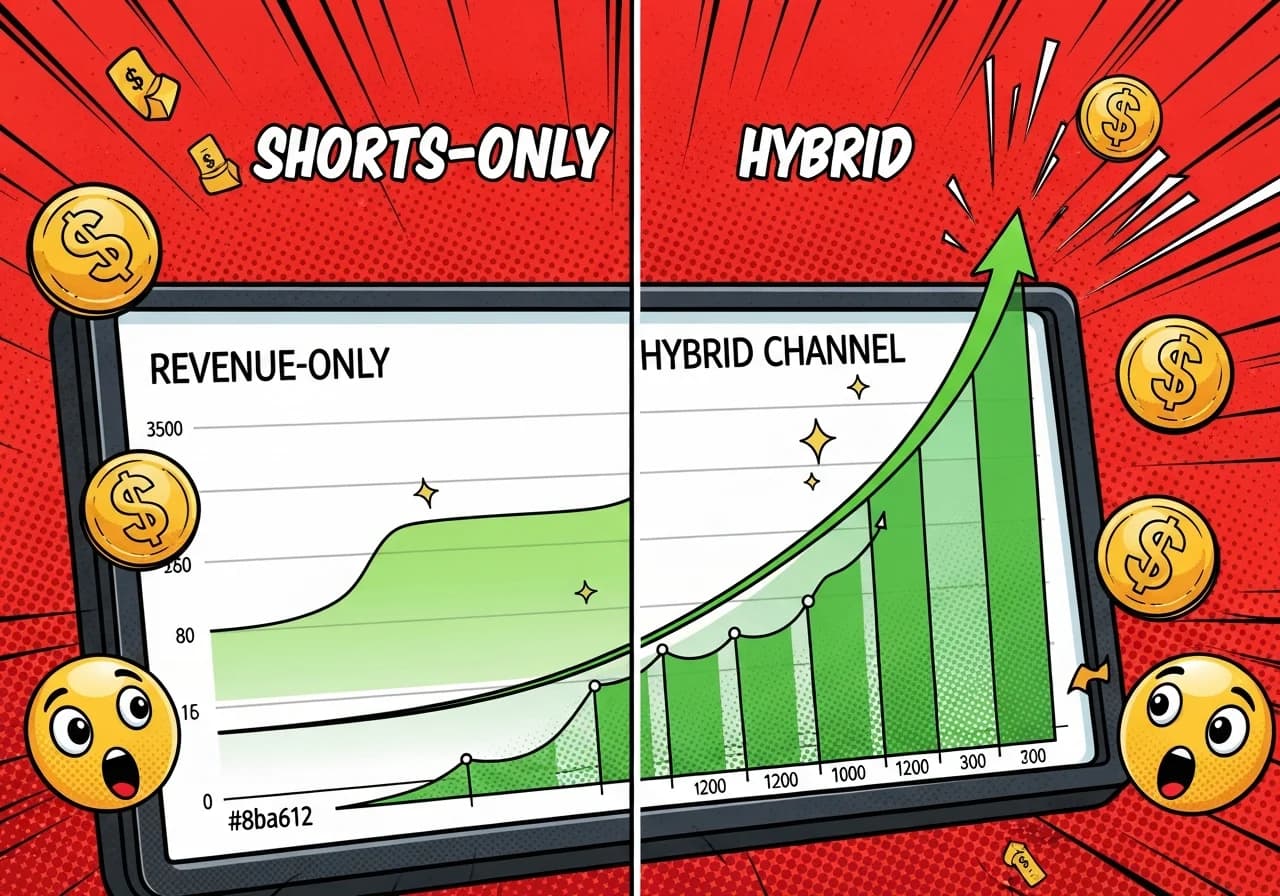
The data is fairly clear here. Channels that use Shorts alongside long-form content grow 41% faster, and the revenue difference is dramatic. Long-form RPMs regularly hit $2 to $10 and can go much higher in premium niches, versus the $0.03 to $0.07 Shorts range.
The play that works for a lot of faceless channels right now:
- Use Shorts to build subscribers fast and get discovered.
- Use even a few long-form videos per month to access the 4,000 watch-hour YPP threshold, which gives you access to far better ad revenue.
- Funnel Shorts viewers toward your long-form library, where each view is worth 10 to 100 times more.
As we break down in more detail in the article on Shorts vs long-form revenue reality, this hybrid approach is not about abandoning Shorts. It is about using them smarter.
AIR Media-Tech's analysis of thousands of creator channels confirms this: a Short hitting 1 million views might generate $150 to $300 in direct ad revenue, but the same Short funneling traffic to a long-form video can multiply the channel's total earnings several times over.
When a Shorts-only strategy does make sense
There are legitimate cases where sticking to Shorts exclusively is the right move, at least initially:
- You are testing a niche and do not want to invest in long-form production yet.
- You are building toward a brand deal model and do not need significant ad revenue.
- You are using the channel as a traffic funnel to a product or service outside YouTube.
- You are prioritizing reach and subscriber growth above current income.
In these scenarios, the focus should be on posting consistency, niche clarity, and having a secondary monetization plan ready before you hit those first milestones.
How to build a monetizable Shorts-only channel in 2026
If you are going the Shorts-only route, here is how to set yourself up for real income.
Step 1: Choose a niche with clear commercial value. Finance, tech, business, and health consistently attract better-paying sponsorships and affiliate programs than entertainment or comedy.
Step 2: Post consistently, ideally daily. Top-performing Shorts creators publish 18 to 22 Shorts per month, and six months of consistent posting leads to a 44% increase in channel growth.
Step 3: Use a free YouTube Shorts script generator to maintain quality and speed up production without burning out. Batch production is what separates channels that survive from those that disappear after a few weeks.
Step 4: Hit the YPP Shorts threshold (1,000 subscribers and 10 million views in 90 days) to unlock ad revenue, then accept the Shorts Monetization Module.
Step 5: Layer in affiliate links, Super Thanks, and one solid brand deal per month once you have a few thousand engaged subscribers. This is where income becomes meaningful.
Step 6: Optimize for retention. Shorts that keep viewers watching past 50 to 70% get significantly more distribution. Your hook in the first two seconds is everything, as we cover in the guide on turning Shorts views into subscribers.
Platforms like Virvid are built specifically for this kind of workflow: picking a trending format, generating a script, selecting a visual style, and publishing daily without spending hours on production. The automated posting to YouTube Shorts, TikTok, and Instagram Reels means you can run a fully consistent channel without it consuming your life.
The bottom line
A Shorts-only channel can absolutely be monetized. What it cannot realistically do is generate meaningful income from ad revenue alone, unless you are pulling tens of millions of views per month.
The creators making real money from Shorts are treating the format as a growth engine, a brand-deal vehicle, and an audience builder, not just a source of YouTube ad checks. Build the audience first, stack the revenue streams second, and let the ad revenue be a nice bonus on top.
Pick your niche, batch your content, stay consistent, and monetize the audience rather than just the platform.