

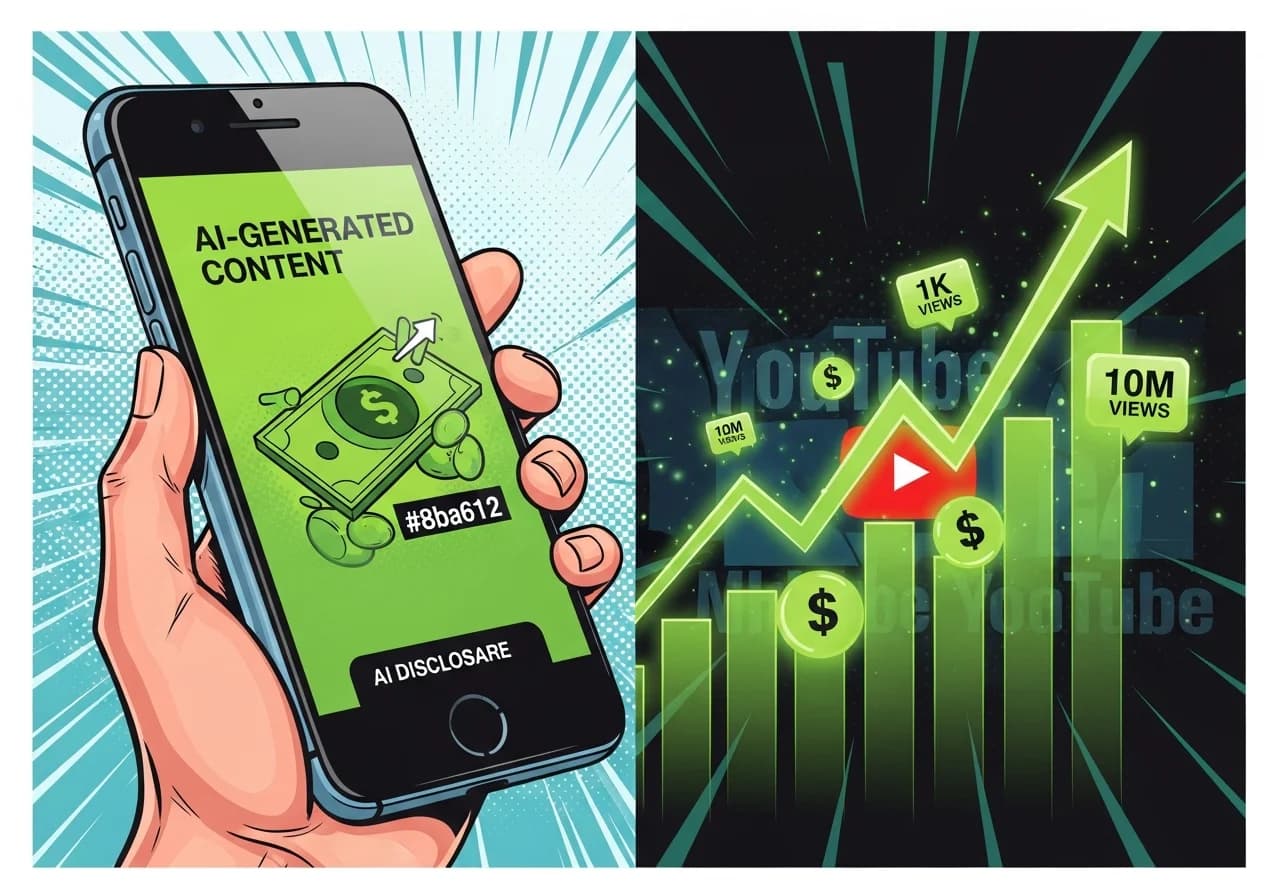
AI YouTube Shorts Monetization Requirements 2026: Complete Eligibility Guide
AI-generated content can be monetized on YouTube Shorts if you meet specific subscriber and view thresholds, properly disclose realistic synthetic content, and demonstrate genuine human creativity to satisfy YouTube's authenticity standards.
Table of Contents
- Two-Tier Partner Program Unlocks Different Revenue Streams
- Mandatory AI Disclosure Rules for Realistic Content
- July 2025 Inauthentic Content Policy Targets Mass Production
- Understanding the 45% Revenue Share Model
- YouTube Shopping Affiliate Program Eligibility
- FTC Disclosure Requirements for Affiliate Content
- Step-by-Step YPP Application Process
- Current Platform Statistics and Growth Metrics
Two-Tier Partner Program Unlocks Different Revenue Streams
YouTube operates a two-tier eligibility system specifically designed to help creators access monetization incrementally, as outlined in YouTube's official Partner Program documentation.
| Tier | Subscribers | View Requirement | Unlocked Features |
|---|---|---|---|
| Expanded YPP | 500 | 3M Shorts views (90 days) OR 3,000 watch hours (12 months) | Super Chat, Super Thanks, Channel Memberships, Merchandise |
| Full YPP | 1,000 | 10M Shorts views (90 days) OR 4,000 watch hours (12 months) | Ad revenue (45%), YouTube Premium revenue, Shopping affiliate |
Expanded YPP Requirements (Fan Funding Tier)
The entry-level tier requires:
- 500 subscribers minimum
- 3 valid public uploads in the past 90 days
- Either 3,000 watch hours (12 months) or 3 million Shorts views (90 days)
- No active Community Guidelines strikes
- 2-step verification enabled on Google account
This tier unlocks Super Chat, Super Stickers, Super Thanks, Channel Memberships, and merchandise shelf, but not ad revenue sharing.
Full YPP Requirements (Ad Revenue Tier)
The complete monetization tier requires:
- 1,000 subscribers minimum
- Either 4,000 watch hours (12 months) or 10 million Shorts views (90 days)
- Same compliance requirements as Expanded tier
- Active AdSense account linked
Watch hours from Shorts don't count toward the 4,000-hour threshold. Only long-form video watch time qualifies. If you're building an AI Shorts strategy, you'll need to hit the 10M Shorts views benchmark instead.
Universal Requirements for Both Tiers
All monetizing creators must meet these baseline standards:
- Residence in an eligible country (100+ supported globally)
- Accept YouTube Partner Program terms and Community Guidelines
- Link an active AdSense account using the same email as YouTube channel
- No copyright strikes or repeated policy violations
- Content adheres to advertiser-friendly guidelines
Creators who join at the 500-subscriber tier automatically become eligible for full ad revenue when reaching higher thresholds, no reapplication needed.
Mandatory AI Disclosure Rules for Realistic Content
YouTube's synthetic content disclosure policy, implemented platform-wide on May 21, 2025, requires creators to label content that could reasonably be mistaken for real footage. According to YouTube's altered content guidelines, disclosure protects viewers from potentially misleading AI-generated material.
When Disclosure Is Mandatory
You must disclose if your AI-generated or digitally altered content:
- Makes a real person appear to say or do something they didn't
- Alters footage of actual events or places to change what happened
- Generates realistic-looking scenes of events that never occurred
- Shows realistic depictions that viewers might believe are authentic
When Disclosure Is NOT Required
No disclosure needed for:
- Clearly fictional or animated content (cartoons, obvious fantasy)
- Aesthetic enhancements (color grading, filters, beauty effects, lighting adjustments)
- Production assistance tools (AI-generated scripts, thumbnails, captions, music)
- Cloning your own voice for voiceovers in your content
- Generative AI backgrounds that don't depict real places or events
How to Properly Disclose AI Content
The disclosure process occurs during upload in YouTube Studio:
- Navigate to the "Altered content" section in upload details
- Select "Yes" when asked about realistic altered or synthetic media
- YouTube automatically adds a label in the video's expanded description: "Altered or synthetic content"
For sensitive topics like elections, ongoing conflicts, public health crises, finance, or coverage of public officials, YouTube applies a more prominent label directly on the video player itself.
Impact on Monetization and Performance
YouTube explicitly states that disclosure has no negative impact on content performance, algorithm recommendation, or monetization eligibility. The penalty only comes from failing to disclose realistic AI content when required, which can result in content removal, lost revenue, or channel suspension.
For Shorts created using YouTube's native AI tools (Dream Screen, Dream Track, Veo 3), the platform automatically applies disclosure labels with no additional creator action required.
Platforms like Virvid help creators generate AI Shorts while maintaining clarity about which elements require disclosure, ensuring compliance without sacrificing creative efficiency.
July 2025 Inauthentic Content Policy Targets Mass Production
The most significant recent policy change occurred on July 15, 2025, when YouTube renamed its "repetitious content" policy to "inauthentic content" and deployed enhanced detection systems. This directly targets AI-generated content farms producing mass volumes of similar videos with minimal human creative input, as reported by TechCrunch in July 2025.
Content Flagged as Inauthentic
YouTube now actively demonetizes:
- Readings of materials the creator didn't produce (automated narration of public domain texts, Wikipedia articles, Reddit posts)
- Songs modified only to change pitch or speed without transformative commentary
- Slideshows with stock images and AI narration lacking original insight or analysis
- Narrative stories with superficial variations (same structure, different names/locations)
- Any content easily replicable at scale using templates or mass-production workflows
Content That Remains Monetization-Eligible
YouTube distinguishes between AI as a replacement for creativity versus AI as a creative tool. Acceptable uses include:
- Reaction videos with meaningful commentary on source material
- Clip compilations that explain connections between segments
- Educational content using AI visuals paired with original teaching
- AI-assisted productions where the creator demonstrates unique insight, editing skill, or narrative development
- Original scripts brought to life with AI-generated visuals
YouTube's Official Position
According to YouTube's monetization policies, this July 2025 update was "clarification of existing policy rather than new restrictions." Mass-produced content has been ineligible for monetization for years, but enhanced AI detection now makes enforcement more effective.
Practical Guidance for AI Creators
To avoid triggering inauthentic content flags:
- Maintain visible creative involvement in each video
- Add original commentary, analysis, or perspective beyond automated narration
- Demonstrate substantive editing decisions that show human judgment
- Provide genuine educational or entertainment value that pure automation couldn't produce
- Use tools that create non-repetitive, original content rather than templated outputs
Platforms like Virvid address this by generating unique, story-driven visuals for each video rather than recycling templates, helping creators stay compliant with authenticity standards. You can experiment with the free AI video script generator to develop original concepts before production.
Understanding the 45% Revenue Share Model
Shorts ad revenue operates on a pooled model that differs from long-form video monetization. According to YouTube's Shorts monetization policies, this system ensures fair distribution while accounting for music licensing.
How the Creator Pool Works
Each month, YouTube follows this allocation process:
- Aggregate all revenue from ads running between videos in the Shorts Feed by country
- Allocate to Creator Pool based on music usage:
- Shorts with no music: 100% to Creator Pool
- Shorts with one music track: ~50% to Creator Pool (remainder to music rights holders)
- Shorts with two+ tracks: ~33% to Creator Pool
- Calculate your share based on percentage of total engaged views from all monetizing creators' Shorts within each country
- Distribute creator earnings: You receive 45% of your allocated share, YouTube retains 55%
Real-World Earnings Calculations
| Views | Low RPM ($0.01) | Mid RPM ($0.05) | High RPM ($0.13) |
|---|---|---|---|
| 100,000 | $1 | $5 | $13 |
| 1,000,000 | $10 | $50 | $130 |
| 10,000,000 | $100 | $500 | $1,300 |
At current RPM rates of $0.01-$0.13 per 1,000 views (varying significantly by niche and geography), practical earnings look like:
- Finance/Investment niches: $0.10-$0.13+ per 1,000 views
- Tech/SaaS content: $0.06-$0.09 per 1,000 views
- Lifestyle/Entertainment: $0.02-$0.04 per 1,000 views
- Gaming content: $0.01-$0.02 per 1,000 views
Super Thanks Revenue (70% Creator Share)
Super Thanks on Shorts operates differently from ad revenue. Viewers purchase tip animations at $2, $5, $10, or $50 price points, and creators receive 70% of that revenue after platform fees.
This feature requires:
- Acceptance of the Commerce Product Module in YouTube Studio settings
- Eligibility for Expanded YPP (500 subscribers minimum)
- Compliance with all Community Guidelines
Super Thanks appears as a button below Shorts, making it easy for engaged viewers to directly support creators beyond ad revenue.
YouTube Shopping Affiliate Program Eligibility
The YouTube Shopping affiliate program allows creators to earn commissions by tagging products in their content. According to YouTube's Shopping affiliate documentation, this provides an additional revenue stream beyond ad sharing.
Eligibility Requirements
To access YouTube Shopping affiliate features:
- YouTube Partner Program membership (full tier with ad revenue)
- More than 10,000 subscribers (not 15,000 as some outdated sources indicate)
- Location in eligible markets: United States, Korea, Indonesia, Thailand, Vietnam, Malaysia, Philippines, India, Singapore, or Brazil
- Not a music channel: Music channels, Official Artist Channels, and music industry partners are ineligible
- Not "Made for Kids": Channels set as children's content are excluded
Commission Structure
Commission rates vary by product category:
- Beauty and Fashion: 12-20%
- Home and Garden: 8-12%
- Health and Wellness: 8-15%
- Consumer Electronics: 5-8%
- Books and Media: 4-10%
Up to 30 products can be tagged per video, appearing via a "View Products" button during playback. The attribution window for earning credit on purchases is generally 30-45 days from click to purchase.
Setup Process
- Navigate to YouTube Studio → Earn → Programs
- Accept the YouTube Shopping affiliate program terms
- Install the YouTube Shopping Chrome extension (available in US, India, Indonesia, Korea, Thailand, Vietnam)
- Browse and save products from participating retailers
- Tag products in your videos during upload or editing
If you're looking for additional passive revenue opportunities, consider the Virvid affiliate program, which offers 30% recurring lifetime commissions, one of the highest-converting affiliate programs in the AI video space, with many affiliates earning $21,240+ annually from just 100 referred subscribers.
FTC Disclosure Requirements for Affiliate Content
The Federal Trade Commission's Endorsement Guides mandate that affiliate relationships and sponsored content be disclosed "clearly and conspicuously." According to FTC's official guidance, this means disclosures must be in the video itself, not merely in the description.
Why Descriptions Alone Are Insufficient
The FTC explicitly states: "Consumers can easily miss disclosures in the video description." For Shorts specifically, viewers often watch without expanding descriptions, making in-video disclosure essential.
Proper Disclosure Methods for Shorts
Text disclosures must be:
- Superimposed over the video
- In an easily readable size and font
- Visible for sufficient time to be read (minimum 3-4 seconds)
- Placed near the endorsement or product mention
Audio disclosures should:
- Accompany visual disclosures when the endorsement is verbal
- Use clear, conversational language
- Occur before or during the endorsement, not after
Acceptable Disclosure Language
✅ Good disclosures:
- "#ad" or "#sponsored" at the beginning
- "Sponsored by [brand name]"
- "I earn commissions from purchases through these links"
- "Thanks to [brand] for partnering on this video"
❌ Insufficient disclosures:
- "#partner" or "#ambassador" alone (too vague)
- "#commissionablelink" (technical jargon)
- Disclosures buried in hashtag lists at description end
- Vague language like "Thanks [brand]" without context
Penalties for Non-Compliance
The maximum civil penalty per violation is $53,088 as of 2025, and each post or video can constitute a separate violation. The FTC has increasingly targeted influencers and creators directly, not just brands, making personal compliance essential.
Step-by-Step YPP Application Process
The YouTube Partner Program application begins once you've met the eligibility thresholds. According to YouTube's official YPP documentation, the process typically takes a few days to one month.
Application Steps
Verify eligibility in YouTube Studio
- Navigate to Monetization tab
- YouTube displays your progress toward thresholds
- Confirm all requirements are met (green checkmarks)
Review and accept Partner Program terms
- Read through monetization policies
- Accept Community Guidelines
- Acknowledge advertiser-friendly content requirements
Link AdSense account
- Existing account: Sign in using the same email as your YouTube channel
- New account: Create through YouTube Studio's guided flow
- Verify tax information and payment details
Submit application
- Click "Apply" to enter review queue
- Status changes to "In Progress"
- Confirmation email sent within 24 hours
Review Timeline and Expectations
Standard review takes:
- Few days to 1 month for most channels
- High application volumes may extend to 4-6 weeks
- Channels requiring multiple evaluations take longer
During review, YouTube evaluates:
- Content originality and quality
- Policy compliance across all videos
- Adherence to Community Guidelines
- Authenticity of traffic and subscribers
Common Rejection Reasons
Applications are rejected for:
- Policy violations: Copyright claims, reused content, spam, misleading metadata
- Artificial traffic: Purchased views, subscribers, or engagement
- Incomplete setup: AdSense issues, missing tax information
- Content quality: Excessive reused material, lack of original value
- Clickbait metadata: Misleading titles, thumbnails, or descriptions
After Rejection
- First rejection: 30-day waiting period before reapplying
- Subsequent rejections: 90-day waiting periods
- Appeal option: Available if you believe rejection was in error
Use the waiting period to address specific issues YouTube identified.
Current Platform Statistics and Growth Metrics
YouTube Shorts has scaled dramatically through 2025, establishing itself as a primary distribution channel for short-form video. Recent data shows the format has reached monetization maturity, making it a financially viable focus for creators.
Viewership and Engagement
According to multiple 2025 industry analyses, YouTube Shorts now generates:
- 70-200 billion daily views (varies by methodology)
- 2+ billion monthly active users globally
- 164.5 million U.S. users projected to reach 175.1 million by 2026
- 70% of YouTube channels now post Shorts content
Engagement metrics favor Shorts over competing platforms:
| Platform | Average Engagement Rate |
|---|---|
| YouTube Shorts | 5.91% |
| TikTok | 5.75% |
| Instagram Reels | 5.53% |
| Facebook Reels | 2.07% |
Revenue Parity Milestone
YouTube CEO Neal Mohan announced in May 2025 that Shorts revenue per watch-hour has reached parity with traditional long-form content in key markets including the United States. This represents a significant maturation of the format's monetization potential.
Additional monetization metrics:
- Shorts monetization accounts for 22% of YouTube's total ad revenue distribution in 2025 (up from 15% in 2024)
- Average Shorts RPM: $0.01-$0.13 per 1,000 views
- Retention rates: 73% for Shorts under 20 seconds
- Hook impact: Strong first 2 seconds see 19% higher overall retention
Content Performance Patterns
Successful Shorts share common characteristics:
- Length: Under 60 seconds (under 20 seconds shows highest retention)
- Hook timing: First 2-3 seconds determine 70% of completion rate
- Posting frequency: Channels posting 3-5x weekly see 2-3x faster growth than once weekly
- Niche consistency: Focused channels grow 40% faster than broad-topic channels
For creators looking to maintain this optimal posting frequency on autopilot, Virvid offers automated video scheduling that generates and posts up to 3 videos daily across YouTube Shorts, TikTok, and Instagram Reels simultaneously, allowing you to grow multiple channels while maintaining the consistency that drives monetization eligibility faster.
Monetizing AI Shorts Successfully in 2026
Monetizing AI-generated YouTube Shorts in 2026 is entirely viable but requires deliberate attention to three overlapping requirements: meeting subscriber and view thresholds, properly disclosing synthetic content that appears realistic, and demonstrating genuine human creativity to avoid "inauthentic content" flags.
The July 2025 policy clarification made clear that YouTube distinguishes between AI as a creative tool versus AI as a replacement for creativity. The former remains welcome and encouraged, while the latter risks demonetization regardless of view counts.
Key Action Items for AI Creators
To build a sustainable monetized Shorts channel:
- Maintain visible creative involvement in each video through original commentary, editing decisions, or narrative development
- Consistently disclose realistic AI elements through the Creator Studio workflow during upload
- Diversify revenue streams across ad revenue (45% share), Super Thanks (70% share), and Shopping affiliate (5-20% commissions)
- Prioritize content quality over volume to avoid triggering mass-production detection systems
- Use trending formats and hooks to maximize view counts toward the 10M threshold
The platform's economics have matured substantially. Shorts revenue parity with long-form content removes the former financial penalty for focusing on short-form, making 2026 an opportune moment for AI-enhanced Shorts strategies that genuinely add value for viewers.
For creators ready to start generating high-quality AI Shorts that meet all platform requirements, explore Virvid, a platform designed specifically to help creators produce original, non-repetitive content that satisfies YouTube's authenticity standards while maintaining creative efficiency. With constantly updated trending styles, copyright-free music, and intelligent visual generation, it's built for creators who want to focus on posting and growing rather than navigating complex AI workflows.